Your Money Is Being Quietly Eaten — Here’s What’s Really Happening

Part 1 — The Big Picture

Shyam: Ram bhai, I’ve been hearing scary things — petrol prices rising, global tensions, gold going haywire. Should I be worried about my savings?

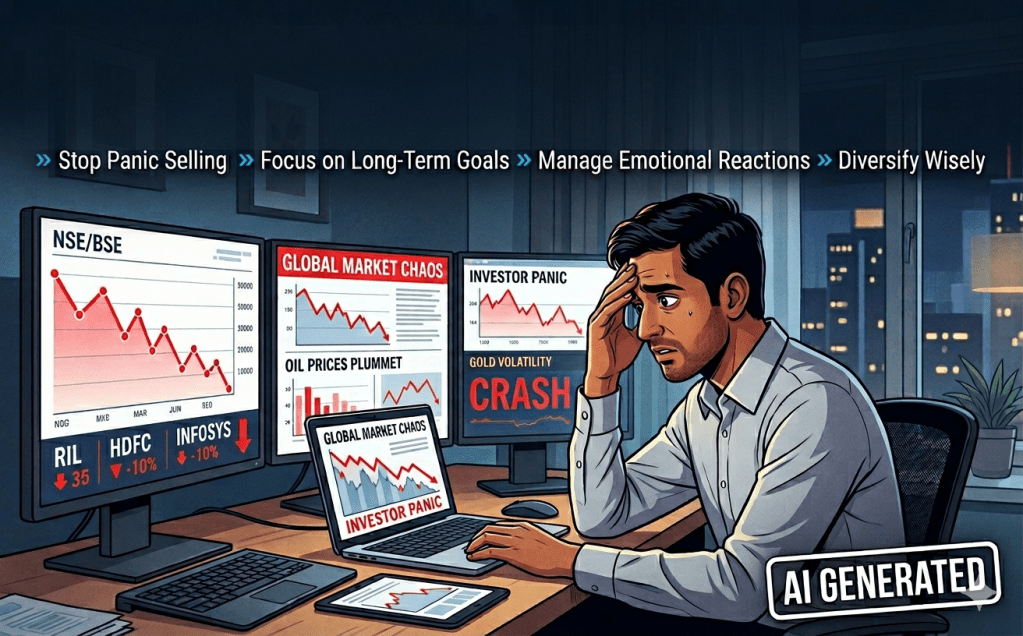
Ram: Shyam, you’re not alone. In the past few weeks alone, I’ve had dozens of investors sitting right where you are — panicking, questioning everything, and seriously considering moving all their money into fixed deposits or gold just to feel safe. The urge to run to safety is completely human. But before you make any move, let’s understand what’s actually happening — because reacting to noise without understanding it is often the most expensive mistake an investor can make.

Shyam: That’s exactly how I feel — like I just want to put everything somewhere safe and stop watching the numbers fall.

Ram: I hear you. But “safe” in the short term can quietly become “costly” in the long term. Let’s break it down step by step — once you understand what is happening and why, that fear starts to lose its grip.

Shyam: Please. Start from the beginning.

Ram: The root of most current worries is oil. Our country imports enormous amounts of crude oil. When tensions rise in oil-producing regions, global prices spike — and our import bill becomes very heavy very fast.

Shyam: But pump prices haven’t gone up yet. Isn’t that good?

Ram: Short term, yes. But someone is absorbing that extra cost — right now, it’s the government. They’re dipping into our national reserves — think of it as the country’s savings account — to cover the gap. That can’t go on indefinitely.

Shyam: So those reserves are shrinking?

Ram: Gradually, yes. These are called Forex Reserves — India’s emergency fund in foreign currency. They keep the Rupee stable and signal financial health to the world. With oil expensive and fuel prices unchanged, reserves are under pressure. The longer this continues, the more strain on the economy.

What are Forex Reserves? Our country’s foreign currency emergency fund — used to pay for imports like oil, gold, and electronics. When reserves fall, the Rupee weakens and imports get costlier, creating a ripple effect across the entire economy.

Part 2 — What Comes Next

Shyam: So what will the government do?

Ram: Eventually, they’ll likely raise petrol and diesel prices — passing the cost to consumers. Painful, but responsible. You simply cannot keep bleeding the national wallet. When that happens, inflation rises — fuel costs trickle into everything. Transporting vegetables, manufacturing goods, running businesses — all become costlier. Sectors like banking, housing, and automobiles slow down as people spend more carefully.

Shyam: What about gold? Why is the government asking people not to buy it?

Ram: Our country imports a massive amount of gold every year, all paid in foreign currency. Every gold purchase chips away at our reserves. Recently, import duties on gold were reduced significantly, which caused imports to surge. Now, to protect reserves, the government may raise those duties again — making gold costlier to import and slowing the drain.

Shyam: So gold stocks could fall further if duties go up?

Ram: Exactly. If duties rise, gold companies face pressure and stocks could drop more. If duties stay unchanged, the current dip is actually a buying opportunity in quality gold stocks. That duty announcement is the signal to watch.

Part 3 — The Stock Market

Shyam: My portfolio keeps falling. I keep hearing foreign investors are leaving the country. Is it that bad?

Ram: It’s real and significant. Foreign Institutional Investors — the big global funds — have been selling Indian stocks heavily. This is directly hurting your portfolio. But here’s the key — India hasn’t done anything wrong. It’s about global competition for money.

Shyam: What do you mean?

Ram: Think of it like two restaurants. Restaurant A offers solid, reliable food. Restaurant B just launched a dish everyone’s obsessed with and profits are extraordinary. Where does money flow first? Right now, the AI boom is Restaurant B — global investors are chasing extraordinary returns in markets with semiconductor and chip companies. Our country doesn’t have that story yet, so money flows there instead.

Shyam: Will foreign investors ever come back?

Ram: They will. Two triggers could bring them back fast — first, if the AI boom slows, funds seek the next opportunity and our country, with its strong growth projections, becomes very attractive. Second, any peace resolution in ongoing global conflicts. Markets reacted with sharp single-day gains just on ceasefire rumors — imagine a real, lasting peace deal.

The Silver Lining our country’s economic growth remains among the highest of any large economy globally. Foreign selling reflects competition for global capital — not a loss of faith in country’s fundamentals. The long-term story is very much alive.

Part 4 — What Should You Do?

Shyam: Enough about the problem. What do I actually do with my money?

Ram: Two answers — one for long-term investors, one for shorter-term moves.

For the long term: your most powerful weapon is patience. Our country has survived wars, recessions, crises, and pandemics. Every time, markets recovered and reached new highs. The investors who stayed calm and didn’t sell at the bottom built real wealth. Markets don’t rise every year — some years are flat or negative — but when recovery comes, it comes fast and powerfully, wiping out all the quiet years at once. You cannot afford to be sitting in cash when that surge happens.

Shyam: What about my SIPs? The market keeps falling — feels like throwing money into a hole.

Ram: Do not stop your SIPs. When markets fall, your fixed monthly amount buys more units. When markets rise, those extra units multiply your gains. Stopping SIPs in a falling market is like walking out of a sale because prices are too low. It makes no financial sense whatsoever.

Shyam: What if I have extra money to invest now?

Ram: Don’t just chase price drops — focus on valuations. A stock that’s fallen 30% isn’t automatically cheap, and one that’s risen isn’t automatically expensive. Look at Price-to-Earnings (P/E) or Price-to-Book (P/B) ratios and compare them to their 5-year averages. If today’s valuation is well below that average, you’re likely getting a good deal. Banking stocks, for instance, are currently trading meaningfully below historical averages — interesting for a patient investor with a 1-2 year horizon. Real estate stocks have also corrected — enter in small portions, don’t go all-in, and hold patiently.

Shyam: One last thing — what’s your single biggest piece of advice for someone feeling nervous right now?

Ram: Don’t let fear make your financial decisions. Fear is a terrible investor. People waited for the market to fall — now it has fallen and they’re too scared to act. The market rewards courage and patience, not perfect timing. Stay in the game. Keep your SIPs running. Avoid panic selling. Look for value when valuations make sense. The country’s growth story is intact — this is a turbulent chapter, not the end of the book.

Shyam: I came in panicking and I’m leaving with a plan. Thank you, Ram bhai.

Ram: That’s all any of us need — clarity over panic. Remember: in investing, the best action during chaos is often disciplined inaction. Stay the course. You’ll thank yourself later.

⚠️ DisclaimerThe content in this article — is created purely for general awareness and educational purposes. It is not intended to be, and should not be construed as, financial advice, investment guidance, or a recommendation to buy, sell, or hold any asset, security, or financial instrument.

Before making any financial decision — whether it relates to stocks, mutual funds, gold, real estate, or any other asset class — I strongly urge you to consult a qualified and registered financial planner or investment advisor who can assess your personal goals, risk appetite, income, and circumstances.

This article does not establish a client-advisor relationship of any kind. The characters of Ram and Shyam are fictional and used solely as a storytelling device to simplify complex financial concepts for a general audience.

Invest wisely. Invest informed. Always seek professional guidance.

The Salary Hike That Didn’t Feel Like One

Rohit had just received a 9% salary hike.

On paper, it looked impressive. His friends congratulated him. His family felt relieved. Even he thought, This year will finally feel different.”

But three months later, something didn’t add up.

His bank balance wasn’t growing the way he expected.
In fact, it felt like nothing had really changed.

The Invisible Leak in Your Income

One Sunday morning, Rohit sat down with a cup of tea and opened his expense sheet.

  • Rent had gone up again
  • His child’s school fees had increased
  • Health insurance premium had jumped
  • Doctor visits were more expensive than last year

That’s when it hit him.

While his salary had increased by 9%, his actual cost of living had increased even faster.

This is what we call personal inflation — the inflation that actually impacts your life.

And for most urban families, it quietly runs ahead of salary hikes.

The Trap We Don’t Notice

Even if expenses weren’t rising so fast, something else was waiting.

After the hike, Rohit felt he deserved a better lifestyle.

So naturally, he started thinking:

  • Maybe it’s time for a bigger house
  • Maybe a car upgrade makes sense
  • Maybe we can plan a more premium vacation

All reasonable thoughts.

But here’s the pattern: At first, every upgrade feels exciting. But within a few months… it feels normal.

The happiness fades.
The higher expense stays.

This is lifestyle creep — slow, silent, and powerful.

Why It’s Not About Discipline

Rohit blamed himself at first. “Maybe I just need to control my spending better.”

But the truth is — this isn’t just about discipline.

Three things are always working in the background:

  1. We adapt quickly – What feels like a luxury today becomes routine tomorrow
  2. Our surroundings influence us – As people around us upgrade, our expectations shift
  3. We reward ourselves – And honestly, after working hard, it feels deserved

So this isn’t a personal failure.

It’s a pattern almost everyone falls into.

The Turning Point

Then Rohit had a conversation with a friend who said something simple but powerful: “Don’t try to control your spending. Control what reaches your spending account.”

That one line changed everything.

What Rohit Did Differently

That year, Rohit’s salary increased by ₹10,000 per month.

Instead of letting the entire amount flow into his lifestyle, he made one rule:

  • ₹5,000 → goes straight into investments
  • ₹5,000 → he can spend freely

No guilt. No overthinking.

Why This Worked?

Two things happened:

  • He still enjoyed the benefits of his raise
  • But he also ensured that half of it started building his future

And because this was automated, there was no daily struggle of “Should I save or spend?”

The decision was already made.

The Real Power Shows Up Later

Over the years, Rohit kept repeating this habit.

Every time his salary increased, his investments increased too. And slowly, quietly, compounding started doing its job.

Years later, the gap between:

  • Investing a fixed amount
                         vs
  • Increasing investments every year

…became huge.

Not because he earned dramatically more.
But because he structured his behavior better.

What Rohit Finally Understood

He realized something simple, yet powerful:

You don’t build wealth by controlling expenses every day.
You build wealth by deciding once — and automating it.

The next time your salary increases, pause for a moment and ask: How much of this raise will actually stay with me?  And how much will quietly disappear into a better lifestyle?

Because if you don’t make that decision upfront…

Your lifestyle will make it for you.

Market Falls Don’t Destroy Wealth. Investor Reactions Do

It’s been a frenzy.

Investors have been reaching out—concerned, uneasy, trying to make sense of what’s happening.

“My portfolio is falling… my mutual fund values are dropping… What should I do?”

It starts quietly.

A headline flashes: Oil crosses $110.”
Markets fall. Then bounce. Then fall again.

Experts debate. Anchors shout. WhatsApp forwards explode.

And somewhere… an investor opens their portfolio.

Heart racing.

“Is this it? Am I about to lose everything?”

This isn’t just a market moment.

This is a human moment.

Because when events like the ongoing War conflict unfold, uncertainty doesn’t just hit economies…

It hits emotions.

And to be fair—this time feels different.

Oil supply disruptions.
Global inflation fears.
Markets swinging between panic and the relief.

Even experts admit—this could slow growth

So yes…

The fear feels justified.

But here’s the part most investors miss.

Markets are reacting.
But they are not collapsing.

Even after weeks of conflict:

Markets fell… but not drastically
Balanced portfolios saw only limited damage
Some sectors even gained (the energy sector)

This is not destruction.

This is volatility.

Now let me tell you a story.

Two investors entered the market.

Both saw the same headlines.
Both saw the same red screens.

But their experiences were completely different.

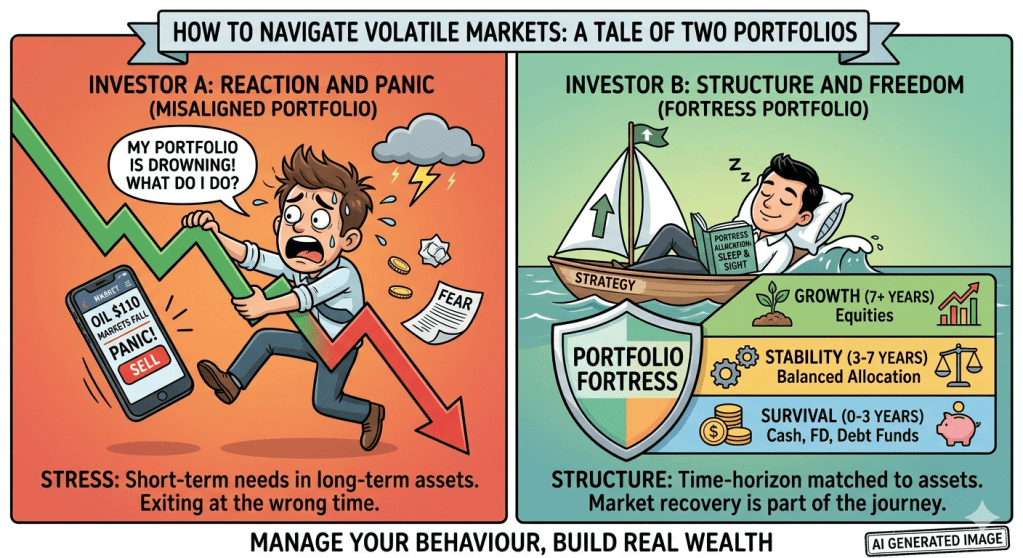
Investor A checked their portfolio every hour.

They had put most of their money into equities.
Short-term needs. Long-term goals. Everything mixed together.

Every dip felt like danger.

Every news update felt personal.

Investor B?

They slept.

Not because they didn’t care.

But because they had built their portfolio like a fortress.

Here’s what that fortress looked like:

Layer 1: Survival (0–3 years)
Cash, fixed deposits, debt funds : → Money untouched by market chaos

Layer 2: Stability (3–7 years)
Balanced allocation : → Some growth, some protection

Layer 3: Growth (7+ years)
Equity investments : → Allowed to ride volatility

So when markets shook…

Investor A felt like they were drowning.

Investor B felt like they were… sailing through rough waters.

That’s the difference.

Not intelligence.

Not timing.

But structure.

Because here’s the uncomfortable truth:

Markets don’t create panic.

Misaligned portfolios do.

And in times like these, investors often make the biggest mistake:

They react.

They sell in fear.
They pause investments.
They wait for “clarity.”

But clarity in markets usually comes…after the opportunity is gone.

So what should you actually do right now?

Not theory.

Not jargon.

Just simple strategy:

1. Check your time horizon – If you need the money in <3–5 years → it should NOT be in equities

2. Strengthen your safety net – Ensure at least 30–50% of your portfolio is in stable assets

3. Don’t interrupt long-term money – If your goals are 7+ years away → volatility is part of the journey

4. Avoid “reaction investing” – The biggest losses don’t come from markets falling. They come from investors exiting at the wrong time

5. Remember this simple truth – Every crisis feels permanent. None of them are.

Because we’ve been here before.

COVID.
Wars.
Crashes.
Corrections.

Different triggers. Same pattern.

So the real question is not: “Will markets recover?”

They always have.

The real question is: Will you still be invested when they do?

Because in moments like these…

You’re not just managing money.

You’re managing your behaviour.

And that…

Is where real wealth is built.

Ram vs Shyam – Two Central Government Employees, Two Different Retirements

Ram and Shyam both joined Central Government service in 2004.

Same department. Same salary. Same promotions.

For years, their financial lives looked exactly the same.

One Evening Over Tea…

Shyam said: “I met a financial planner recently. He explained something interesting about NPS.”

Ram replied casually: “What more is there? Tier I is already getting deducted. That’s enough.”

Shyam smiled: “That’s what I thought too… but there’s a smarter way to use it.”

The Small Decision That Changed Everything

Ram’s Approach

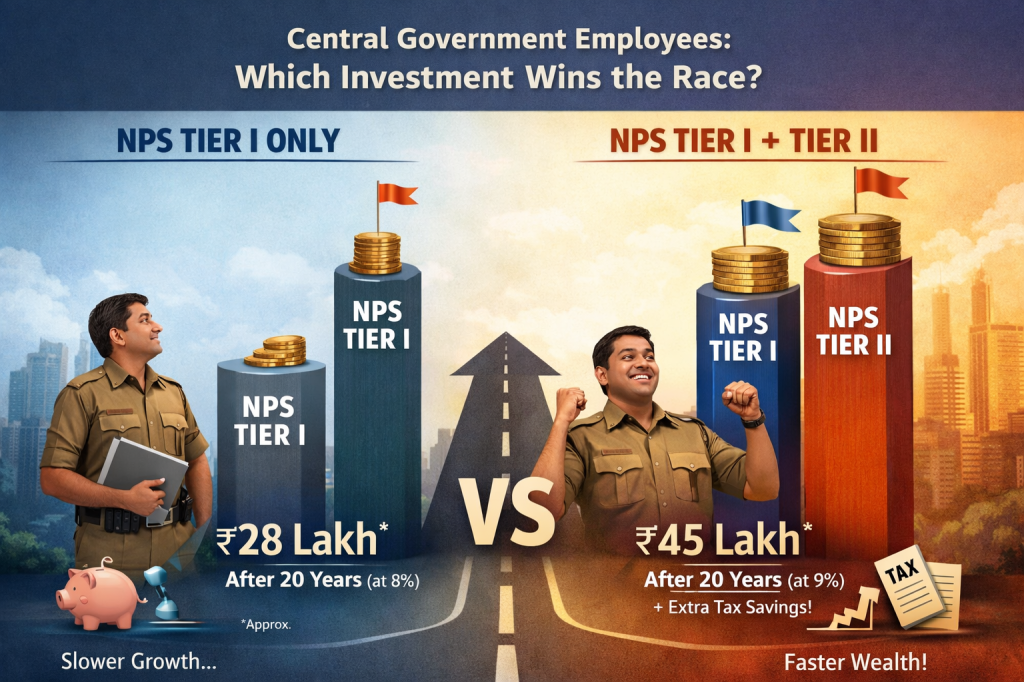
  • Continued with only NPS Tier I (mandatory)
  • Extra savings went into FDs and traditional options

Shyam’s Approach (After Advice)

The planner told him: “Use Tier II as your growth engine. Just invest ₹5,000 per month and forget about it.”

Shyam followed:

  • ₹5,000/month in Tier II
  • Continued Tier I as usual

Fast Forward to 2026

After 22 years…

They meet again.

Ram Shares His Numbers

“I stayed safe. I didn’t take risks.”

👉 His savings (mostly FD-based): ~₹26–28 lakh

Shyam Shares His Numbers

“I didn’t do anything complex. Just stayed consistent.”

👉 His Tier II corpus: ~₹36–38 lakh

Ram is Surprised

“We earned the same… how did you end up with more?”

Shyam replies: “I didn’t save more… I just used a better vehicle.”

The Real Game Begins Near Retirement

At age 58, Shyam meets his planner again.

Planner says: “Now use Tier II to save tax.”

Shyam’s 3-Year Strategy (Simple and Effective)

  • Age 58 → Moves ₹50,000 from Tier II to Tier I → saves tax
  • Age 59 → Moves ₹50,000 → saves tax
  • Age 60 → Moves ₹50,000 → saves tax

Then Shyam Asks a Smart Question

“Why not move my entire ₹30 lakh into Tier I and save more tax?”

The Planner Explains the Reality

Tax benefit is LIMITED

Even if Shyam moves ₹10 lakh (or even ₹30 lakh):

👉 He cannot claim full tax deduction

Because:

  • Only ₹50,000 per year is allowed under Section 80CCD(1B)
  • Tax benefit applies only to Tier I contributions

Planner Simplifies It

“Tax rules don’t reward how much you invest…
they reward how well you use the limit.”

Why Moving Entire Corpus is NOT a Good Idea

The planner continues:

You lose liquidity

  • Tier II → flexible
  • Tier I → locked till retirement

No extra tax benefit

  • Still capped at ₹50,000

More money gets locked into annuity

  • 40% must go into pension (less flexibility)

What Ram Realises Late

Ram asks quietly: “I never used Tier II… can I still do this?”

Shyam replies: “You can… but you missed the compounding journey.”

The Simple Strategy Every Govt Employee Can Follow

During your career:

  • Invest ₹3,000–₹10,000/month in Tier II
  • Stay consistent

Near retirement:

  • Move ₹50,000/year from Tier II → Tier I
  • Claim tax deduction

Final Conversation

As they walk out on their last working day…

Ram says: “We earned the same… but you planned better.”

Shyam smiles: “I didn’t plan better… I just started one small step early and used it wisely.”

Final Takeaway

👉 Tier I is your foundation
👉 Tier II is your advantage

And most importantly:

👉 Don’t move everything… move only what gives you tax benefit

When Markets Panic, Smart Investors Accumulate

It was a usual Sunday morning.

Rohit, a mid-level professional and a disciplined SIP investor, sat with his cup of tea scrolling through the news.

“Markets fall sharply amid global tensions…”
“War fears shake investor confidence…”
“Experts warn of further downside…”

His heart skipped a beat. He opened his portfolio.

Red everywhere!!

Just last month, he was feeling confident. Today, fear had taken over.

The Emotional Trap

Rohit called his friend Amit. “I think I should stop my SIPs… maybe even sell some funds. What if markets fall more?”

Amit paused and asked one question: “Do you remember what happened during COVID in 2020?”

Rohit nodded.

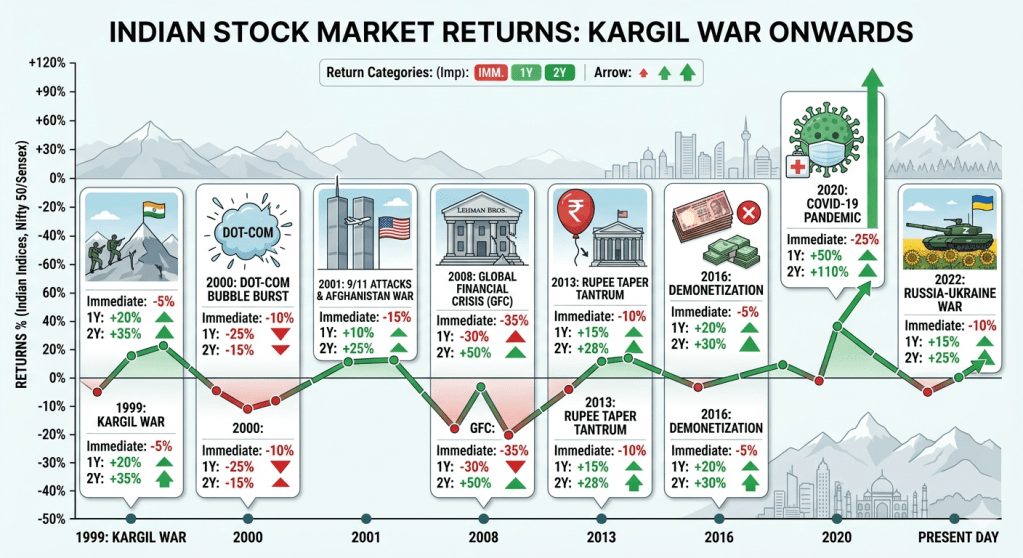
Markets had crashed 25% almost overnight.

But what happened next?

  • Within 1 year: +50%
  • Within 2 years: +110%

History Doesn’t Repeat, But It Rhymes

Amit continued: “Let’s go back further…”

  • Kargil War (1999): Short-term fall, strong recovery
  • Dot-com crash (2000): Painful, but temporary
  • Global Financial Crisis (2008): Markets crashed ~35%… then doubled
  • Demonetization (2016): Panic → Recovery
  • COVID (2020): Fear → Massive rally
  • Russia-Ukraine War (2022): Same story

Every single time:

👉 Markets fell sharply
👉 Investors panicked
👉 And then… markets recovered and moved higher

So What Separates Winners from Worriers?

Amit smiled and said: “It’s not about timing the market… it’s about time in the market.”

Let’s simplify this.

There are two types of investors:

1. Reaction-Based Investor (Rohit Today)

  • Stops SIPs when markets fall
  • Sells in fear
  • Waits for “clarity”
  • Misses recovery

2. Goal-Based Investor (Rohit Tomorrow)

  • Invests with a purpose (retirement, kids, wealth)
  • Ignores short-term noise
  • Uses volatility to accumulate more
  • Stays consistent

The Real Truth About Equity Markets

Equity is like the ocean

  • Calm sometimes
  • Stormy at times
  • But always moving forward over the long term

Volatility is not a bug.

👉 It is the price you pay for higher returns

Why This Is the Time to Act (Not Panic)

When markets fall:

💡 You are buying the same businesses at lower prices
💡 Your SIP buys more units
💡 Future returns potential improves significantly

This is where the famous principle comes alive:

“Buy when others are fearful.”

Goal-Based Planning: Your Anchor in Chaos

Instead of asking: “Should I stop investing?”
Ask: “Has my financial goal changed?”

If your goals are intact:

  • Your retirement is still 15 years away
  • Your child’s education is still 10 years away

Then why react to a 3-month market fall?

The Turning Point

Rohit closed his app.

He didn’t stop his SIP.

In fact, He increased it slightly.

Because he finally understood: “This is not a crisis… this is an opportunity in disguise.”

Final Thought for You :

Markets will always test your patience before rewarding your discipline.

  • Wars will happen
  • Crashes will come
  • Fear will spread

But…

  • Wealth is created by those who stay invested
    • And accelerated by those who invest more during fear

So what should be your Action Plan?

  • Stay invested
  • Continue SIPs
  • Align with goals, not headlines
  • Use dips to accumulate
  • Trust the long-term journey

The Silver ETF Trap: Why Following the Crowd in Gold & Silver Can Hurt Your Portfolio

A simple truth before we begin

Whenever markets become scary, people stop thinking and start copying.

That is when gold shines on headlines and silver burns portfolios.

Let us break this down calmly without fear, hype, or WhatsApp forwards.

Part 1: Why Silver ETFs Can Shock You When Markets Fall?

Silver looks harmless.

People even call it poor man’s gold.

But here is the reality – silver is far more dangerous than it looks.

Why silver behaves badly in crashes?

Think of silver as a man with two jobs:

1. Industrial metal (used in electronics, solar panels, factories)

2. Safe-haven metal (like gold, during fear)

When the economy slows or crashes:

• Factories stop ordering silver

• Industrial demand vanishes

• Prices fall fast and hard

Gold does not have this problem. Silver does.

What went wrong in silver ETFs recently (in simple terms)?
When silver prices crashed sharply:

• ETF prices fell even faster

• Many investors could not exit

• Some ETFs did not reflect real prices for hours

Why?

Because during panic:

• Exchanges apply circuit limits

• Trading freezes at exactly the time you want to sell

• Leveraged silver ETFs magnify losses (losses don t double they explode)

Lesson for you: Silver ETFs are not safe assets.

They are high-volatility instruments wearing a precious metal label.

Part 2: Why People Rush into Gold at the Worst Possible Time?

Gold crossing ₹15,000+ per gram (or $160 globally) did not happen quietly.

It happened with noise, fear, and headlines.

So why does everyone suddenly want gold when it is already expensive?

The psychology behind gold buying

It usually follows this pattern:

1. Something scary happens (war, inflation, currency fear)

2. Gold starts rising

3. Media headlines shout: Gold is the only safe asset

4. Friends, relatives, and social media jump in

5. Retail investors enter last

This is not investing.

This is emotional migration.

The uncomfortable truth

Gold protects wealth when bought patiently, not when chased.

Historically:

• Gold performs well over long periods

• But sharp rallies are often followed by long dull or painful phases

• Buying at peak fear = low future returns

Lesson: Gold is insurance not a lottery ticket. You buy insurance before the fire, not when the house is already burning.

Part 3: The Smarter, Boring, and More Effective Approach

Here is where most investors go wrong: “Gold is doing well, let me increase exposure.

Here is what actually works: Use commodities only for diversification, not excitement.

The magic number: 5 to 8%

For most retail investors:

• 5 to 8% in commodities is enough

• Anything more increases stress, not returns

Think of commodities like salt in food:

• Too little → tasteless

• Too much → ruined dish

How a retail investor should approach commodities?

✔ Use broad-based commodity funds, not single-metal bets

✔ Avoid leveraged or thematic commodity products

✔ Stay invested long-term (7 10 years’ mindset)

✔ Rebalance once a year don not react daily.

If silver crashes but oil or agriculture holds up, your portfolio survives. That’s diversification quiet, boring, effective.

Part 4: Herd Mentality V/s Pragmatic Investing

Herd mentality in investing usually starts with headlines. When gold is all over the news, investors rush in, assuming safety lies in what everyone else is buying.

A pragmatic investor behaves very differently. Instead of chasing headlines, they buy gradually over time, knowing that timing the market is far less important than consistency.

Herd-driven investors chase silver rallies hoping for quick gains. Pragmatic investors, on the other hand, limit their exposure and understand that high volatility can damage portfolios faster than it builds wealth.

The crowd looks for “safe bets.”
But experienced investors focus on building balanced portfolios that can handle both good and bad market phases.

Fear drives herd behavior.
Pragmatic investing is about planning for cycles—because markets will rise, fall, and rise again.

Remember: Markets reward discipline, not drama.

To Summarize: Build Stability, Not Stories Silver ETFs crashing and gold hitting record highs are not signals to act fast. They are signals to slow down and think clearly.

A strong portfolio does not depend on guessing:

• Which metal will shine?

• Which crisis will come next?

It depends on:

• Asset allocation

• Risk control

• Emotional discipline

Keep commodities small.

Keep expectations realistic.

And let your portfolio do the heavy lifting not headlines.

? Have you felt tempted to increase gold exposure recently?

Or has silver s volatility made you rethink commodity investing?

Drop your thoughts in the comments let s learn from each other.

Disclaimer: This is educational content, not investment advice. Please consult a financial advisor for personal decisions.

The 2-Minute UPI Audit: An NPCI Trick to Reclaim Your Capital from “Ghost” Apps

“My salary hasn’t changed much, my lifestyle hasn’t exploded… yet my savings feel tighter.”

Rita felt this discomfort many investors experience but can’t clearly explain.
No big shopping sprees. No luxury upgrades. Still, money felt like it was quietly slipping away.

Think of it like this
You haven’t bought a new car, but somehow your fuel bill keeps rising.

That’s when Ravi pointed out something most investors ignore.

We Chase Returns, But Ignore Leaks

Ravi told Rita something uncomfortable but true:

“Most investors spend hours chasing 1% extra return in mutual funds, but ignore the 2% silently leaking from their bank accounts.”

How?

Auto-payments. Subscriptions. Free trials that weren’t really free.

  • OTT platforms you barely watch
  • Research tools you tried once
  • Apps you forgot you even installed

Each one feels “small”. ₹199 here. ₹299 there.
Just like daily snacks—tea, samosa, coffee—none feel expensive… until month-end

The “Invisible SIP” Problem

Ravi calls this the Invisible SIP.

Just like you run a SIP into mutual funds every month, you’re unknowingly running a reverse SIP—money going out every month.

Example:

  • ₹99 app subscription
  • ₹199 OTT platform
  • ₹299 AI tool
  • ₹149 cloud storage

That’s ₹700+ every month.

Not painful.
Not noticeable.
But very real.

“But How Do I Find These?” – Rita’s Question

Rita asked the right question:

“Do I really need to check months of SMS alerts and bank statements?”

Thankfully, no.

The NPCI Autopay Dashboard (Your Subscription Mirror)

Think of NPCI’s portal like a credit report, but for your auto-payments.

It shows:

  • Every UPI Autopay mandate
  • Every active subscription
  • Every app quietly charging you

All in one place.

The 2-Minute Audit (Anyone Can Do This)

Here’s exactly what Rita did:

  1. Go to upihelp.npci.org.in
  2. Enter your UPI-linked mobile number
  3. Verify with OTP
  4. Click “Show my AUTOPAY mandates”
  5. Review Active mandates
  6. Cancel what you don’t clearly use or value

That’s it.

No app hopping.
No digging through statements.

The “Aha” Moment

Within seconds, Rita spotted:

  • A financial news subscription she stopped reading last year
  • An AI design tool charging ~$6 (₹500+) every month
    (She hadn’t logged in for months)

Total damage?
₹500 per month

“₹500 Isn’t a Big Deal… Right?”

This is where investors underestimate compounding.

Ravi asked Rita to think differently:

“What if this ₹500 wasn’t wasted—but invested?”

Small Leak vs Smart Investment

Let’s compare

Scenario 1: Do Nothing

  • ₹500 wasted every month
  • ₹6,000 gone every year
  • ₹1.2 lakh lost over 20 years

Scenario 2: Redirect ₹500 into an Index Fund (12% CAGR)

  • Same ₹500 every month
  • Over 20 years → ~₹5 lakh

Same money. Different direction.

That’s the real cost of “small amounts”.

The Bigger Lesson for Investors

Wealth creation isn’t only about:

  • Finding the best fund
  • Timing the market
  • Chasing returns

It’s also about plugging leaks.

Just like:

  • A bucket with a hole won’t fill
  • A salary with silent drains won’t compound

Convenience is useful. But unchecked convenience is expensive.

Make This a Habit

Rita decided to:

  • Audit autopay mandates once every quarter
  • Treat unwanted subscriptions like bad investments
  • Redirect “found money” into SIPs

A simple habit.
A powerful outcome.

Final Thought

Before asking: “Which mutual fund will give me higher returns?”

Ask: “Where is my money quietly escaping?”

Because stopping a leak often creates more wealth than chasing the next multi-bagger.

When the Paycheck Stops, How Should Your Money Work?

Shyam retired at 60.

His children were settled. The home loan was closed. Life was finally slow and peaceful.
But one question kept coming back again and again:

“Will my money last… and will it give me regular income?”

Shyam did not want excitement from his investments anymore.
He wanted stability, income, and peace of mind.

That’s when he met Ravi.

“I Don’t Want Big Returns, I Want Peace”

Shyam explained his concern honestly.

“I don’t want to take big risks now.
I need monthly income for expenses.
And my money should grow slowly so inflation doesn’t hurt me.”

Ravi smiled. This was a very common retirement question.

“That’s actually a good starting point,” Ravi said.
“In retirement, the goal is not to beat the market.
The goal is to protect money, create income, and avoid stress.”


Step 1: Understanding the 3–5 Year Reality

Ravi first spoke about time.

“Shyam, since your focus is the next 3–5 years, we must be careful.
Markets can go up and down sharply in short periods.
So we should not depend heavily on pure equity funds.”

Shyam nodded. He remembered how markets sometimes fell suddenly.


Step 2: Making Stability the Base

Ravi then explained the foundation.

“A large part of your money should be in debt mutual funds.”

He kept it simple.

These include:

  • Short-duration funds
  • Medium-duration funds
  • Bond and corporate bond funds

“These funds invest in government securities and strong companies.
They are not flashy, but they are stable and predictable.”

Ravi added,

“Think of them like the ground floor of a house.
Strong, quiet, and reliable.”

Shyam liked that comparison.


Step 3: Adding Gentle Growth with Hybrid Funds

“But what about growth?” Shyam asked.

Ravi replied calmly.

“To beat inflation, we add conservative hybrid funds.”

He explained in simple words:

  • Most of the money is in debt
  • A small part is in equity
  • Risk stays controlled
  • Growth is slow but steady

“This gives your money a chance to grow
without giving you sleepless nights.”

Shyam felt reassured.


Step 4: Optional Low-Risk Equity Exposure

Ravi also mentioned another option.

“If you are comfortable, a small portion can go into
equity savings funds or arbitrage funds.”

These funds:

  • Keep volatility low
  • Do not behave like full equity funds
  • Are used only as support, not the main plan

“This step is optional,” Ravi clarified.
“Comfort matters more than returns.”


Step 5: Turning Investments into Monthly Income

Now came the most important question.

“How do I get monthly income from all this?” Shyam asked.

Ravi explained a simple solution.

“We use something called a Systematic Withdrawal Plan (SWP).”

With SWP:

  • A fixed amount comes to Shyam every month
  • Withdrawals are planned, not random
  • Remaining money stays invested

“It works like a salary from your own savings,” Ravi said.

Shyam smiled. That’s exactly what he wanted.

What Ravi Clearly Avoided

Ravi also made one thing very clear.

“For a 3–5 year retirement goal,
we usually avoid pure equity funds.”

“They are great for long-term wealth creation,
but too risky for regular income needs.”


To Sum up

Ravi summed it up for Shyam:

  • Debt funds for safety and stability
  • Conservative hybrid funds for slow, steady growth
  • Optional equity savings/arbitrage funds for balance
  • SWP for regular income
  • Focus on peace, not performance charts

Shyam’s Realisation

After the conversation, Shyam felt lighter.

“This feels comfortable,” he said.
“My money doesn’t need to run fast.
It just needs to walk steadily with me.”

Ravi smiled.

“That’s exactly how retirement investing should feel.”

In retirement, the best investment plan is not exciting.
It is simple, steady, and quietly supportive.

When money works silently in the background,
retirement feels exactly the way it should—peaceful.

Disclaimer: This is only a general example to explain how retirement investments can be planned. Every person’s needs are different. Your lifestyle, monthly expenses, health needs, and comfort with risk can change what is suitable for you. Please consider your personal situation or speak to a financial advisor before investing.

An NPS Scheme Change Every Investor Should Understand: The Scheme A Merger Explained

Raj, a 38-year-old private sector employee, had a simple ritual.

Once a year, usually around tax-saving season, he would log in to his NPS account, download his statement, glance at the numbers, feel reassured—and log out.

But this year was different.

An email from NPS caught his eye: “Scheme A will be merged with Schemes C and E…”

Raj frowned.

“Merge? Scheme A? Did I invest in something risky without knowing?”
“Will my retirement money be affected?”
“And is this change only for private sector employees like me?”

By evening, Raj did what most sensible investors do when confused.

He called Sunil, his long-time financial planner.

“Sunil, my NPS statement is changing. Should I be worried?”

Sunil smiled.
“Relax, Raj. Nothing has gone wrong. In fact, this is a clean-up exercise, not a problem.”

Seeing Raj still anxious, Sunil pulled out a notebook.

“Let me explain this the easy way.”

What exactly was Scheme A?

“Raj,” Sunil began,
“Scheme A was an optional asset class under NPS Active Choice. It invested in things like infrastructure funds, REITs, and InvITs—what we call alternative investments.”

Raj nodded slowly.

“But,” Sunil continued, “very few people chose it.

The corpus stayed small, liquidity was limited, and some investments had long lock-ins. Not ideal for a pension product.”

So why is Scheme A being merged now?

Sunil explained:

“PFRDA looked at three things:
1. Scheme A was too small to manage efficiently
2. It had liquidity constraints
3. Regulators want simpler, cleaner investment structures

So they decided: Let’s merge Scheme A into Scheme C (Corporate Bonds) and Scheme E (Equities)—larger, well-diversified, liquid schemes.”

Raj leaned back.

“So this isn’t because markets crashed or returns were bad?”

“Exactly,” Sunil said.
“This is preventive maintenance, not damage control.”

“But is this only for private sector employees like me?”

Raj’s next question came quickly.

Sunil shook his head.

“No. This applies to everyone who had opted for Scheme A:

  • Private sector employees
  • Government employees
  • Corporate NPS subscribers
  • All Citizens NPS

You’re hearing about it because Active Choice subscribers were the ones using Scheme A.”

Do I need to do anything now?

Sunil laid out the options clearly.

“You have two choices, Raj:

Option 1: Do nothing

  • Scheme A money will be automatically merged
  • No tax impact
  • No charges
  • No paperwork

Option 2: Use the free switch window

  • Till 25 December 2025, you can reallocate that money
  • You can choose how much goes into:
    • Scheme E (Equity)
    • Scheme C (Corporate Bonds)
    • Scheme G (Government Securities)
  • No switching cost for this move”

Raj smiled.
“At least they’re giving time.

“Now the important part—how should I invest post merger?”

Sunil leaned forward.

“Raj, you’re 38. Private sector. Long runway till retirement.
This change is actually a good opportunity to reset your NPS correctly.”

He wrote three letters on paper: E – C – G

Sunil’s suggested post-merger allocation for Raj

For someone below 40:

SchemeAllocation
Scheme E (Equity)70–75%
Scheme C (Corporate Bonds)20–25%
Scheme G (G-Secs)5–10%

“This,” Sunil said, “does three things:

  • Equity captures India’s long-term growth
  • Bonds reduce volatility
  • G-Secs provide stability without dragging returns too much”

Then he added:

“If you want something simple and low-maintenance, just remember this.”

E 60% – C 30% – G 10%

“It works beautifully for most people between 35 and 45.”

Raj’s final takeaway

Raj closed his notebook, visibly relaxed.

“So my retirement is safe.
The scheme is simpler.
And I actually get a chance to improve my allocation.”

Sunil nodded.

“That’s the right way to see it.
NPS is a long-distance train, Raj. Track maintenance doesn’t stop the journey—it makes it smoother.”

Raj smiled.

For the first time, that NPS email didn’t feel like bad news.

It felt like a course correction done in time.

✍️ Note

If you’ve received a similar NPS message and are unsure what to do, remember:

  • This change applies to all Scheme A investors
  • You have time till Dec 2025 to act
  • A simple, age-appropriate E–C–G allocation is all you need

Is Your Retirement Plan Wrong? The Real Truth About Insurance Policies

Rita walked into Ram’s office right after work—ID card still around her neck.

“Ram, I think I’m sorted for retirement.”

That sentence always made Ram slow down.

She pulled out a brochure.
“HR’s insurance partner explained this plan. ₹1 lakh a year. After 60, guaranteed pension. No market tension.”

Rita smiled.
“With EMIs, kids’ fees, and job uncertainty, this feels safe.”

Ram nodded.
“Let’s talk through it—using your daily life, not brochure language.”

“What Happens to Your Salary-Cut Premium?”

“Rita,” Ram asked,
“when ₹1 lakh goes from your bank account every year, what do you think happens next?”

Rita answered like most salaried professionals would.
“It grows for retirement.”

Ram replied gently.
“First, it gets divided.”

He explained it like a monthly salary slip:

  • Some part goes to insurance cost
  • Some to admin charges
  • Some to agent commission
  • What remains goes into investment

“It’s like your CTC,” Ram said.
“The full number looks big, but your take-home is smaller.”

Rita nodded slowly.
“That makes sense.”

“The Return That Doesn’t Beat Rising Costs”

Ram continued.

“These plans typically give 4 to ~6% return over 20–25 years.”

Rita said,
“But that’s stable. No ups and downs.”

Ram smiled.
“So is your old PPF passbook.”

Then he asked:
“Do you remember what petrol cost 15 years ago?”

Rita laughed.
“₹50 per litre?”

“And now?” Ram asked.

“₹100+.”

Ram paused.

“If expenses double every 12–15 years, can a 5% return handle retirement for 25–30 years?”

Rita went quiet.

“The Harsh Retirement Math We Ignore”

Ram scribbled numbers.

“You invest:

  • ₹1 lakh per year
  • For 25 years
  • Total: ₹25 lakh”

“At retirement, you’ll have around ₹45–50 lakhs.”

Rita did a quick mental calculation.

“That’s barely:

  • Two medical emergencies
  • One major hospitalisation
  • And household expenses for a few years”

Ram nodded.

“And remember—there’s:

  • No salary hikes
  • No Diwali bonus
  • No company medical cover anymore”

That hit hard.

“Why We Love Guarantees (And Why It Hurts)”

Ram leaned forward.

“Indians love guarantees because:

  • Our parents trusted LIC
  • Fixed deposits felt safe
  • Markets scared us”

He paused.

“But safety without growth works only when:

  • Life expectancy was lower
  • Expenses were predictable
  • Families were joint”

“Today,” Ram said,
“you may live till 85–90, with rising healthcare costs and nuclear family support.”

Guarantees, suddenly, didn’t feel so comforting.

“Same Salary, Smarter Allocation”

“Now let’s rework this like a middle-class budget,” Ram said.

Term insurance

  • ₹1 crore cover
  • Costs roughly the same as one family dinner out per month

Mutual fund SIP for retirement

  • Monthly SIP adjusted to your salary cycle
  • Increase SIP when appraisal happens
  • Equity does the long-term heavy lifting

“Same discipline. Same monthly deduction,” Ram explained.
“Different destination.”

Result?

“About ₹1.5 crore in 25 years.”

Rita blinked.

“That’s a retirement I can actually imagine,” she said.
“Medical, travel, dignity.”

“The Moment of Clarity”

Rita closed the insurance brochure.

“So this plan wasn’t bad,” she said slowly.
“It just wasn’t meant for retirement.”

Ram nodded.

“Insurance plans are like umbrellas.
Great when it rains.”

“But retirement,” he added,
“is a long road trip. You need a strong engine, not just protection.”

Rita smiled.

“I wanted peace of mind,” she said.
“But I also want peace in my 60s and 70s.”

Ram smiled back.

“That’s when retirement planning truly begins.”

“A Thought for Every Salaried Person”

Retirement is not about avoiding market volatility.

It’s about avoiding dependency.

Plan accordingly.