Your Money Is Being Quietly Eaten — Here’s What’s Really Happening

Part 1 — The Big Picture

Shyam: Ram bhai, I’ve been hearing scary things — petrol prices rising, global tensions, gold going haywire. Should I be worried about my savings?

Ram: Shyam, you’re not alone. In the past few weeks alone, I’ve had dozens of investors sitting right where you are — panicking, questioning everything, and seriously considering moving all their money into fixed deposits or gold just to feel safe. The urge to run to safety is completely human. But before you make any move, let’s understand what’s actually happening — because reacting to noise without understanding it is often the most expensive mistake an investor can make.

Shyam: That’s exactly how I feel — like I just want to put everything somewhere safe and stop watching the numbers fall.

Ram: I hear you. But “safe” in the short term can quietly become “costly” in the long term. Let’s break it down step by step — once you understand what is happening and why, that fear starts to lose its grip.

Shyam: Please. Start from the beginning.

Ram: The root of most current worries is oil. Our country imports enormous amounts of crude oil. When tensions rise in oil-producing regions, global prices spike — and our import bill becomes very heavy very fast.

Shyam: But pump prices haven’t gone up yet. Isn’t that good?

Ram: Short term, yes. But someone is absorbing that extra cost — right now, it’s the government. They’re dipping into our national reserves — think of it as the country’s savings account — to cover the gap. That can’t go on indefinitely.

Shyam: So those reserves are shrinking?

Ram: Gradually, yes. These are called Forex Reserves — India’s emergency fund in foreign currency. They keep the Rupee stable and signal financial health to the world. With oil expensive and fuel prices unchanged, reserves are under pressure. The longer this continues, the more strain on the economy.

What are Forex Reserves? Our country’s foreign currency emergency fund — used to pay for imports like oil, gold, and electronics. When reserves fall, the Rupee weakens and imports get costlier, creating a ripple effect across the entire economy.

Part 2 — What Comes Next

Shyam: So what will the government do?

Ram: Eventually, they’ll likely raise petrol and diesel prices — passing the cost to consumers. Painful, but responsible. You simply cannot keep bleeding the national wallet. When that happens, inflation rises — fuel costs trickle into everything. Transporting vegetables, manufacturing goods, running businesses — all become costlier. Sectors like banking, housing, and automobiles slow down as people spend more carefully.

Shyam: What about gold? Why is the government asking people not to buy it?

Ram: Our country imports a massive amount of gold every year, all paid in foreign currency. Every gold purchase chips away at our reserves. Recently, import duties on gold were reduced significantly, which caused imports to surge. Now, to protect reserves, the government may raise those duties again — making gold costlier to import and slowing the drain.

Shyam: So gold stocks could fall further if duties go up?

Ram: Exactly. If duties rise, gold companies face pressure and stocks could drop more. If duties stay unchanged, the current dip is actually a buying opportunity in quality gold stocks. That duty announcement is the signal to watch.

Part 3 — The Stock Market

Shyam: My portfolio keeps falling. I keep hearing foreign investors are leaving the country. Is it that bad?

Ram: It’s real and significant. Foreign Institutional Investors — the big global funds — have been selling Indian stocks heavily. This is directly hurting your portfolio. But here’s the key — India hasn’t done anything wrong. It’s about global competition for money.

Shyam: What do you mean?

Ram: Think of it like two restaurants. Restaurant A offers solid, reliable food. Restaurant B just launched a dish everyone’s obsessed with and profits are extraordinary. Where does money flow first? Right now, the AI boom is Restaurant B — global investors are chasing extraordinary returns in markets with semiconductor and chip companies. Our country doesn’t have that story yet, so money flows there instead.

Shyam: Will foreign investors ever come back?

Ram: They will. Two triggers could bring them back fast — first, if the AI boom slows, funds seek the next opportunity and our country, with its strong growth projections, becomes very attractive. Second, any peace resolution in ongoing global conflicts. Markets reacted with sharp single-day gains just on ceasefire rumors — imagine a real, lasting peace deal.

The Silver Lining our country’s economic growth remains among the highest of any large economy globally. Foreign selling reflects competition for global capital — not a loss of faith in country’s fundamentals. The long-term story is very much alive.

Part 4 — What Should You Do?

Shyam: Enough about the problem. What do I actually do with my money?

Ram: Two answers — one for long-term investors, one for shorter-term moves.

For the long term: your most powerful weapon is patience. Our country has survived wars, recessions, crises, and pandemics. Every time, markets recovered and reached new highs. The investors who stayed calm and didn’t sell at the bottom built real wealth. Markets don’t rise every year — some years are flat or negative — but when recovery comes, it comes fast and powerfully, wiping out all the quiet years at once. You cannot afford to be sitting in cash when that surge happens.

Shyam: What about my SIPs? The market keeps falling — feels like throwing money into a hole.

Ram: Do not stop your SIPs. When markets fall, your fixed monthly amount buys more units. When markets rise, those extra units multiply your gains. Stopping SIPs in a falling market is like walking out of a sale because prices are too low. It makes no financial sense whatsoever.

Shyam: What if I have extra money to invest now?

Ram: Don’t just chase price drops — focus on valuations. A stock that’s fallen 30% isn’t automatically cheap, and one that’s risen isn’t automatically expensive. Look at Price-to-Earnings (P/E) or Price-to-Book (P/B) ratios and compare them to their 5-year averages. If today’s valuation is well below that average, you’re likely getting a good deal. Banking stocks, for instance, are currently trading meaningfully below historical averages — interesting for a patient investor with a 1-2 year horizon. Real estate stocks have also corrected — enter in small portions, don’t go all-in, and hold patiently.

Shyam: One last thing — what’s your single biggest piece of advice for someone feeling nervous right now?

Ram: Don’t let fear make your financial decisions. Fear is a terrible investor. People waited for the market to fall — now it has fallen and they’re too scared to act. The market rewards courage and patience, not perfect timing. Stay in the game. Keep your SIPs running. Avoid panic selling. Look for value when valuations make sense. The country’s growth story is intact — this is a turbulent chapter, not the end of the book.

Shyam: I came in panicking and I’m leaving with a plan. Thank you, Ram bhai.

Ram: That’s all any of us need — clarity over panic. Remember: in investing, the best action during chaos is often disciplined inaction. Stay the course. You’ll thank yourself later.

⚠️ DisclaimerThe content in this article — is created purely for general awareness and educational purposes. It is not intended to be, and should not be construed as, financial advice, investment guidance, or a recommendation to buy, sell, or hold any asset, security, or financial instrument.

Before making any financial decision — whether it relates to stocks, mutual funds, gold, real estate, or any other asset class — I strongly urge you to consult a qualified and registered financial planner or investment advisor who can assess your personal goals, risk appetite, income, and circumstances.

This article does not establish a client-advisor relationship of any kind. The characters of Ram and Shyam are fictional and used solely as a storytelling device to simplify complex financial concepts for a general audience.

Invest wisely. Invest informed. Always seek professional guidance.

40 Is the New Retirement Age. Are You Ready for It?

Ravi: Shyam, 200,000+ tech professionals lost their jobs last year. BPO layoffs jumped 70% in a single year. And companies are quietly drawing an invisible line at 50 — restructuring people out, not renewing contracts, replacing entire teams with automation. I’m telling you this not to scare you — but because you’ve been putting off this conversation with me for two years now, and I think it’s time you understood what’s actually at stake.

Shyam: (shifting uncomfortably) I know, I know. I keep meaning to “sort things out”. But every month something comes up — the home loan EMI, the car loan, Priya’s school fees. By the time the month ends there’s barely anything left. I keep telling myself I’ll start a SIP once things settle down a bit.

Ravi: And when do you think things will settle down?

Shyam: (laughs awkwardly) Maybe another year or two? Once the car loan closes.

Ravi: Shyam, that one or two years is costing you more than you realize. Let me show you something. If you had started a SIP of just ₹5,000 a month at age 25, you would have roughly ₹1.74 crore by the time you’re 55. If you start today at 38, you’re looking at something closer to ₹33 to 35 lakhs. Same monthly investment. Same rate of return. The only difference is time. And time, once gone, cannot be bought back.

Shyam: That’s a massive difference!

But Ravi, the market feels so uncertain right now. With everything happening — layoffs, AI taking over jobs — it feels risky to put money in when things are so unstable.

Ravi: I understand that feeling. But here’s what I need you to flip in your head — that instability is not a reason to delay investing. It is the most urgent reason to start immediately. Think about your own situation right now. You have a home loan, a car loan, school fees, household expenses. If your company handed you a pink slip tomorrow — or simply didn’t renew your project — how long could you sustain your family without a salary?

Shyam: (goes quiet) Honestly? Maybe two, three months at most. We don’t really have savings beyond that.

Ravi: That is the real emergency, Shyam.

Not the market.

Not the economy.

The emergency is that you are running your entire family’s financial life on a single income with no buffer, no investment corpus, and no backup plan. The EMIs will not pause because your career paused. The school fees will not wait. That is a genuinely precarious position to be in.

Shyam: When you put it that way it does sound scary. But what can I realistically do? I genuinely don’t have a lot left at the end of the month.

Ravi: Let’s start with two things. First, we build an emergency fund — I want you to have at least nine months of living expenses sitting in a liquid mutual fund. That is your income bridge. If anything happens to your job, that fund buys you time to think clearly instead of panic. Second, we start a SIP. I don’t care if it’s ₹2,000 a month right now. What matters is that it starts, it is automated, and it runs every single month without you having to make a decision.

Shyam: But ₹2,000 feels so small. Will it even make a difference?

Ravi: Every large corpus started as a small, consistent habit. The amount will grow as your income grows. What you’re building right now is not just money — you’re building discipline and time in the market. Both of those compound. A one-time large investment made later is always less powerful than a small consistent investment made now. Always.

Shyam: Okay, I hear you on the SIP. But this whole thing about 40 being the new retirement age — is that really happening? Companies quietly pushing out people in their late 40s, roles not being renewed, seniors being restructured out?

Ravi: It is happening, and more quietly than people realise. In IT and BPO especially, the roles most at risk are the ones involving routine, repeatable tasks — and those are exactly the roles that have employed millions of people for the last two decades. AI is not replacing everyone overnight. But it is shrinking the headcount needed for those functions significantly. And the people who find it hardest to recover after a layoff at 45 or 48 are the ones who spent those years spending their salary rather than converting any of it into assets.

Shyam: So what you’re really saying is — by the time I’m 45, I need to already be financially independent enough that a job loss doesn’t destroy me?

Ravi: Exactly. I’m not saying you need to retire at 40. I’m saying you need to be in a position where if the job ends at 45, you are not in financial freefall. There is a big difference between choosing to stop working and being forced to stop with nothing to fall back on. The goal of everything we are building together is to give you options — not obligations.

Shyam: That actually makes a lot of sense. I think I’ve been thinking about this completely wrong. I thought investing was about getting rich someday. I never thought of it as just — protecting myself and my family right now.

Ravi: Most people don’t, until it’s too late. You’re 38, Shyam. You still have time. Not as much as you had at 28, but enough to build something meaningful if you start now and stay consistent. But I need you to stop waiting for life to feel settled before you begin. Life will never feel settled. That is not a future condition — that is just life.

Shyam: (nodding slowly) So where do we actually start? Today, concretely?

Ravi: Today, three things. One — we calculate your actual monthly surplus properly, not just roughly in your head. Two — we open a liquid fund and start redirecting ₹5,000 a month towards your emergency corpus. Three — we set up a SIP of whatever is left, even if it is ₹1,500. And we take a hard look at that car loan — I suspect it’s your highest-interest liability and we should think about prepaying it aggressively.

Shyam: The car loan is at 9.5% interest. Two more years to run.

Ravi: Right. So every extra rupee you put into that loan is a guaranteed 9.5% return. That is better than most fixed deposits right now. We kill that loan early, free up ₹8,500 a month, and redirect it straight into your investments. Within 30 months you’ll have meaningfully more breathing room than you do today.

Shyam: I never thought about prepaying a loan as actually earning a return. That’s a completely different way of looking at it.

Ravi: Personal finance is full of reframes like that. But your biggest obstacle has never been your income, Shyam. It has been the belief that you will start “properly” once everything is in order. Nothing is ever fully in order. The people who build financial security are simply the ones who started before they felt ready.

Shyam: (after a long pause) Okay. I’m ready. Let’s do it.

Ravi: (smiles) Good. No signatures needed yet.

Just that decision — made today, not next week, not after the next salary credit. Today.

The SIP will do the rest. You just have to begin.

RBI Floating Rate Bond Simplified

Ram was staring at his bank app again.

“Sam, I don’t get it FD rates keep changing. Mutual funds go up and down. I just want something safe but not rigid.”

Sam smiled, stirring his tea said “Then you are ready for something smarter but not risky, not fixed forever.”

Sounds interesting, Ram said. What is it?

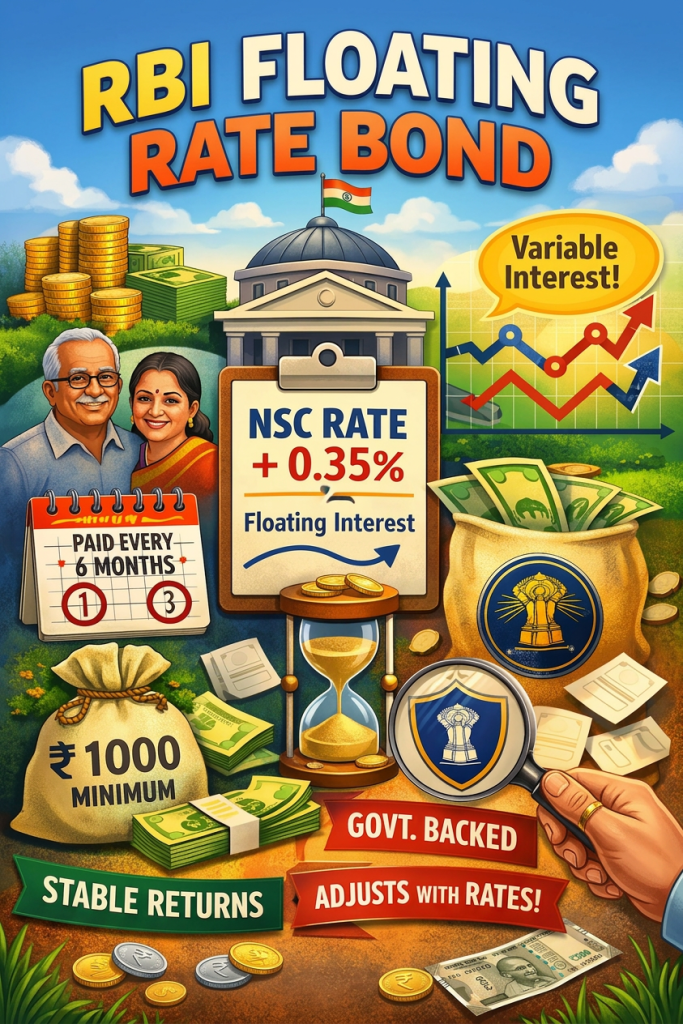
It’s the Reserve Bank of India Floating Rate Savings Bond.

Ram raised an eyebrow. Floating? Like it keeps changing?

Exactly, Sam said.

Think of it like your salary.

Salary?

Yes. Imagine your company says – “We will revise your salary every 6 months depending on market conditions.”

That sounds fair, Ram nodded.

That’s how this bond works. The interest is not fixed forever. It adjusts every 6 months. So how is the interest decided? Ram asked.

Its linked to the National Savings Certificate (NSC) rate, Sam explained.

And you get a little extra on top currently NSC rate + 0.35%.

So if rates go up, I earn more?

Yes.

And if they fall? You earn a bit less but still safely.

Ram leaned forward. Give me a real-life example. Sam smiled.

Think about house rent.

If you lock rent for 5 years, you may lose out if rents increase

If rent is revised every year, it adjusts with the market

This bond is like that adjustable rent agreement. And how do I get returns? Ram asked.

You get paid twice a year, Sam replied.

Like?

Like rent from a house or like interest income credited to your account.

So no compounding?

No. It’s regular income, not reinvested automatically. Ram thought for a moment. And how long do I stay invested?

7 years, Sam said calmly.

That’s long!

It is. Think of it like planting a tree. You commit time, and in return, you get steady output.

But what if I need money suddenly? Ram asked.

That’s why this is not for emergency funds, Sam explained.

This is for money you want to keep safe and earn from them without worrying daily.

Ram nodded. So when should I use this?

Sam replied with everyday situations:

  • Money you want to keep safe like your parent’s retirement corpus
  • Surplus funds from bonus or FD maturity
  • Money you don’t need for the next 7 years

And when not to use it?

  • If you may need money anytime soon
  • If you want high growth like equity investments
  • If you are in a high tax bracket and want tax-efficient options

Ram smiled. So this is not exciting but reliable.

Exactly, Sam said. And reliability is underrated.

After a pause, Ram asked, Can I invest only once?

Sam shook his head.No, that’s the best part  you can invest multiple times.

Really?

Yes. There is no maximum limit.

Think of it like this, Sam continued:

  • You don’t open just one FD in life
  • You create FDs whenever you have surplus money

Same here.

  • Got a bonus invest
  • FD matured invest again
  • Want to invest gradually do it in parts

So each investment is separate? Ram asked.

Yes, Sam said.

Each one will have its own 7-year tenure, but all will follow the same interest reset cycle.

Rams eyes lit up. So I can build this slowly?

Exactly. In fact, smart investors use this like a ladder strategy.

Ladder? Ram asked.

Sam explained: “Instead of putting 10 Lacs at once, you can do this”:

  • Year 1 – 1 Lac
  • Year 2 –  1 Lac
  • Year 3 – 1 Lac

Over time, you create a system where money keeps getting invested and maturing at different points.

Like multiple water taps giving income at different times, Ram said.

Perfect analogy, Sam smiled.

Okay, last question, Ram said. How do I actually buy this?

Sam replied: You can do it online or offline.

For online, he said: You can use internet banking from banks like:

  • State Bank of India
  • HDFC Bank
  • ICICI Bank
  • Axis Bank

Steps are simple:

  • Login to net banking
  • Go to Investments/Bonds section
  • Select RBI Floating Rate Bonds
  • Enter amount (minimum 1,000)
  • Confirm and invest

And offline? Ram asked.

Just visit a bank branch, Sam said.

  • Fill application form
  • Submit PAN and KYC
  • Pay via cheque/cash
  • Bond gets issued

Ram leaned back, finally at ease. You know what this feels like?

What? Sam asked.

It’s like keeping money in a locker but the locker pays me income.

Sam nodded. That’s exactly what it is.

Ram summarized what he learned:

  • Safe investment backed by Government
  • Interest changes every 6 months (NSC + 0.35%)
  • Regular income twice a year
  • 7-year commitment
  • Can invest multiple times and build gradually

As Ram closed his banking app, he smiled: Not every investment needs to be exciting some just need to be dependable.

Sam replied: And those are the ones that quietly build financial stability.

The Salary Hike That Didn’t Feel Like One

Rohit had just received a 9% salary hike.

On paper, it looked impressive. His friends congratulated him. His family felt relieved. Even he thought, This year will finally feel different.”

But three months later, something didn’t add up.

His bank balance wasn’t growing the way he expected.
In fact, it felt like nothing had really changed.

The Invisible Leak in Your Income

One Sunday morning, Rohit sat down with a cup of tea and opened his expense sheet.

  • Rent had gone up again
  • His child’s school fees had increased
  • Health insurance premium had jumped
  • Doctor visits were more expensive than last year

That’s when it hit him.

While his salary had increased by 9%, his actual cost of living had increased even faster.

This is what we call personal inflation — the inflation that actually impacts your life.

And for most urban families, it quietly runs ahead of salary hikes.

The Trap We Don’t Notice

Even if expenses weren’t rising so fast, something else was waiting.

After the hike, Rohit felt he deserved a better lifestyle.

So naturally, he started thinking:

  • Maybe it’s time for a bigger house
  • Maybe a car upgrade makes sense
  • Maybe we can plan a more premium vacation

All reasonable thoughts.

But here’s the pattern: At first, every upgrade feels exciting. But within a few months… it feels normal.

The happiness fades.
The higher expense stays.

This is lifestyle creep — slow, silent, and powerful.

Why It’s Not About Discipline

Rohit blamed himself at first. “Maybe I just need to control my spending better.”

But the truth is — this isn’t just about discipline.

Three things are always working in the background:

  1. We adapt quickly – What feels like a luxury today becomes routine tomorrow
  2. Our surroundings influence us – As people around us upgrade, our expectations shift
  3. We reward ourselves – And honestly, after working hard, it feels deserved

So this isn’t a personal failure.

It’s a pattern almost everyone falls into.

The Turning Point

Then Rohit had a conversation with a friend who said something simple but powerful: “Don’t try to control your spending. Control what reaches your spending account.”

That one line changed everything.

What Rohit Did Differently

That year, Rohit’s salary increased by ₹10,000 per month.

Instead of letting the entire amount flow into his lifestyle, he made one rule:

  • ₹5,000 → goes straight into investments
  • ₹5,000 → he can spend freely

No guilt. No overthinking.

Why This Worked?

Two things happened:

  • He still enjoyed the benefits of his raise
  • But he also ensured that half of it started building his future

And because this was automated, there was no daily struggle of “Should I save or spend?”

The decision was already made.

The Real Power Shows Up Later

Over the years, Rohit kept repeating this habit.

Every time his salary increased, his investments increased too. And slowly, quietly, compounding started doing its job.

Years later, the gap between:

  • Investing a fixed amount
                         vs
  • Increasing investments every year

…became huge.

Not because he earned dramatically more.
But because he structured his behavior better.

What Rohit Finally Understood

He realized something simple, yet powerful:

You don’t build wealth by controlling expenses every day.
You build wealth by deciding once — and automating it.

The next time your salary increases, pause for a moment and ask: How much of this raise will actually stay with me?  And how much will quietly disappear into a better lifestyle?

Because if you don’t make that decision upfront…

Your lifestyle will make it for you.

Market Falls Don’t Destroy Wealth. Investor Reactions Do

It’s been a frenzy.

Investors have been reaching out—concerned, uneasy, trying to make sense of what’s happening.

“My portfolio is falling… my mutual fund values are dropping… What should I do?”

It starts quietly.

A headline flashes: Oil crosses $110.”
Markets fall. Then bounce. Then fall again.

Experts debate. Anchors shout. WhatsApp forwards explode.

And somewhere… an investor opens their portfolio.

Heart racing.

“Is this it? Am I about to lose everything?”

This isn’t just a market moment.

This is a human moment.

Because when events like the ongoing War conflict unfold, uncertainty doesn’t just hit economies…

It hits emotions.

And to be fair—this time feels different.

Oil supply disruptions.
Global inflation fears.
Markets swinging between panic and the relief.

Even experts admit—this could slow growth

So yes…

The fear feels justified.

But here’s the part most investors miss.

Markets are reacting.
But they are not collapsing.

Even after weeks of conflict:

Markets fell… but not drastically
Balanced portfolios saw only limited damage
Some sectors even gained (the energy sector)

This is not destruction.

This is volatility.

Now let me tell you a story.

Two investors entered the market.

Both saw the same headlines.
Both saw the same red screens.

But their experiences were completely different.

Investor A checked their portfolio every hour.

They had put most of their money into equities.
Short-term needs. Long-term goals. Everything mixed together.

Every dip felt like danger.

Every news update felt personal.

Investor B?

They slept.

Not because they didn’t care.

But because they had built their portfolio like a fortress.

Here’s what that fortress looked like:

Layer 1: Survival (0–3 years)
Cash, fixed deposits, debt funds : → Money untouched by market chaos

Layer 2: Stability (3–7 years)
Balanced allocation : → Some growth, some protection

Layer 3: Growth (7+ years)
Equity investments : → Allowed to ride volatility

So when markets shook…

Investor A felt like they were drowning.

Investor B felt like they were… sailing through rough waters.

That’s the difference.

Not intelligence.

Not timing.

But structure.

Because here’s the uncomfortable truth:

Markets don’t create panic.

Misaligned portfolios do.

And in times like these, investors often make the biggest mistake:

They react.

They sell in fear.
They pause investments.
They wait for “clarity.”

But clarity in markets usually comes…after the opportunity is gone.

So what should you actually do right now?

Not theory.

Not jargon.

Just simple strategy:

1. Check your time horizon – If you need the money in <3–5 years → it should NOT be in equities

2. Strengthen your safety net – Ensure at least 30–50% of your portfolio is in stable assets

3. Don’t interrupt long-term money – If your goals are 7+ years away → volatility is part of the journey

4. Avoid “reaction investing” – The biggest losses don’t come from markets falling. They come from investors exiting at the wrong time

5. Remember this simple truth – Every crisis feels permanent. None of them are.

Because we’ve been here before.

COVID.
Wars.
Crashes.
Corrections.

Different triggers. Same pattern.

So the real question is not: “Will markets recover?”

They always have.

The real question is: Will you still be invested when they do?

Because in moments like these…

You’re not just managing money.

You’re managing your behaviour.

And that…

Is where real wealth is built.

The Silver Trap: A Story Every Investor Must Read Before Buying

Rohit had always been a sensible investor.

  • Gold for safety.
  • Mutual funds for growth.
  • FDs for peace of mind.

Silver? That was something you bought for festivals… not portfolios.

Until one day, it wasn’t.

Headlines screamed: “Silver is rallying!” “Next big opportunity!”

Prices were rising fast. Friends were talking about it. Even his least-invested colleague had already bought.

Rohit felt it.

The fear of missing out. (FOMO).  And just like that — he bought silver.

Chapter 1: The Familiar Mistake

Rohit didn’t ask:

  • Why is silver rising?
  • What drives its price?

He only saw:

  • Recent returns
  • Social proof
  • The idea that silver was “cheap gold”

But here’s the truth:

Silver is not cheaper gold. It’s a completely different asset.

Chapter 2: Two Metals, Two Behaviours

In India, gold has a clear role:

  • Store of value
  • Stability during uncertainty
  • Cultural importance

Silver, however, behaves differently. Gold is driven by fear. Silver is driven by economic activity.

Silver demand comes from:

  • Solar panels
  • Electronics
  • EV ecosystem

So:

  • When growth looks strong → silver rises fast
  • When sentiment changes → silver falls fast

Chapter 3: The Data Rohit Missed

If Rohit had paused, he would have seen this:

  • Gold delivers ~8–9% steady long-term returns
  • Silver delivers higher returns in bursts — but inconsistently

And the real difference?

Volatility.

  • Gold: ~13–15%
  • Silver: ~22–30%

Which means that – If gold falls 10%, silver can fall 20–30%.

Silver doesn’t just move more — it moves faster.

Chapter 4: When the Fall Comes

The fall confused Rohit.

“Nothing has changed… so why is silver falling?”

But markets adjust quickly:

  • Investors start booking profits
  • Demand expectations shift
  • Short-term traders exit

And because many traders use borrowed money:

  • Small falls trigger forced selling
  • Selling creates more selling

That’s why silver falls feel sudden and sharp.

Chapter 5: The Realisation

Months later, Rohit reflected. His mistake wasn’t buying silver.

It was:

  • Treating it like a stable asset
  • Expecting predictable returns
  • Investing without understanding its nature

That’s when he reframed the question: “Where does silver fit in my portfolio?”

So… What Should an Indian Investor Actually Do?

Let’s simplify this into action.

Step 1: Build Your Core with Gold (Practical Options Today)

Since fresh SGB issuances is not available anymore, Indian investors can consider:

  • Gold ETFs
  • Gold mutual funds
  • Existing SGBs from the secondary market (if suitable)

Gold provides:

  • Relative stability
  • Portfolio balance during uncertainty

This becomes your portfolio anchor.

Step 2: Add Silver — But Carefully

For silver exposure in India:

  • Prefer Silver ETFs / Silver Funds
  • Avoid physical silver for investment purposes
  • Avoid leveraged trading

But most importantly:

Limit allocation to 2–4% at the max

Because:

  • No income generation
  • Fully dependent on price movement
  • High volatility

Step 3: Set the Right Expectation

Before investing in silver, ask:

  • Can I handle sharp ups and downs?
  • Am I investing based on hype or strategy?

If unsure → reduce allocation.

Step 4: Understand Their Roles Clearly

  • Gold is meant or stability & wealth creation
  • Silver is meant for Opportunity and wealth creation

Gold compounds quietly. Silver moves in cycles.

Chapter 6: Rohit’s New Portfolio

Rohit didn’t exit silver.

He simply rebalanced his thinking:

  • Gold is for Core holding
  • Silver is for Small, controlled allocation

No more chasing rallies.
No more emotional decisions.

Just clarity.

To Sum it – Silver can make you money fast… but it can test your patience even faster.

Invest in it — but don’t treat it like gold.

Remember – Gold helps you stay calm. Silver tests your conviction. The smart investor knows how much of each they can handle.

Ram vs Shyam – Two Central Government Employees, Two Different Retirements

Ram and Shyam both joined Central Government service in 2004.

Same department. Same salary. Same promotions.

For years, their financial lives looked exactly the same.

One Evening Over Tea…

Shyam said: “I met a financial planner recently. He explained something interesting about NPS.”

Ram replied casually: “What more is there? Tier I is already getting deducted. That’s enough.”

Shyam smiled: “That’s what I thought too… but there’s a smarter way to use it.”

The Small Decision That Changed Everything

Ram’s Approach

  • Continued with only NPS Tier I (mandatory)
  • Extra savings went into FDs and traditional options

Shyam’s Approach (After Advice)

The planner told him: “Use Tier II as your growth engine. Just invest ₹5,000 per month and forget about it.”

Shyam followed:

  • ₹5,000/month in Tier II
  • Continued Tier I as usual

Fast Forward to 2026

After 22 years…

They meet again.

Ram Shares His Numbers

“I stayed safe. I didn’t take risks.”

👉 His savings (mostly FD-based): ~₹26–28 lakh

Shyam Shares His Numbers

“I didn’t do anything complex. Just stayed consistent.”

👉 His Tier II corpus: ~₹36–38 lakh

Ram is Surprised

“We earned the same… how did you end up with more?”

Shyam replies: “I didn’t save more… I just used a better vehicle.”

The Real Game Begins Near Retirement

At age 58, Shyam meets his planner again.

Planner says: “Now use Tier II to save tax.”

Shyam’s 3-Year Strategy (Simple and Effective)

  • Age 58 → Moves ₹50,000 from Tier II to Tier I → saves tax
  • Age 59 → Moves ₹50,000 → saves tax
  • Age 60 → Moves ₹50,000 → saves tax

Then Shyam Asks a Smart Question

“Why not move my entire ₹30 lakh into Tier I and save more tax?”

The Planner Explains the Reality

Tax benefit is LIMITED

Even if Shyam moves ₹10 lakh (or even ₹30 lakh):

👉 He cannot claim full tax deduction

Because:

  • Only ₹50,000 per year is allowed under Section 80CCD(1B)
  • Tax benefit applies only to Tier I contributions

Planner Simplifies It

“Tax rules don’t reward how much you invest…
they reward how well you use the limit.”

Why Moving Entire Corpus is NOT a Good Idea

The planner continues:

You lose liquidity

  • Tier II → flexible
  • Tier I → locked till retirement

No extra tax benefit

  • Still capped at ₹50,000

More money gets locked into annuity

  • 40% must go into pension (less flexibility)

What Ram Realises Late

Ram asks quietly: “I never used Tier II… can I still do this?”

Shyam replies: “You can… but you missed the compounding journey.”

The Simple Strategy Every Govt Employee Can Follow

During your career:

  • Invest ₹3,000–₹10,000/month in Tier II
  • Stay consistent

Near retirement:

  • Move ₹50,000/year from Tier II → Tier I
  • Claim tax deduction

Final Conversation

As they walk out on their last working day…

Ram says: “We earned the same… but you planned better.”

Shyam smiles: “I didn’t plan better… I just started one small step early and used it wisely.”

Final Takeaway

👉 Tier I is your foundation
👉 Tier II is your advantage

And most importantly:

👉 Don’t move everything… move only what gives you tax benefit

When Markets Panic, Smart Investors Accumulate

It was a usual Sunday morning.

Rohit, a mid-level professional and a disciplined SIP investor, sat with his cup of tea scrolling through the news.

“Markets fall sharply amid global tensions…”
“War fears shake investor confidence…”
“Experts warn of further downside…”

His heart skipped a beat. He opened his portfolio.

Red everywhere!!

Just last month, he was feeling confident. Today, fear had taken over.

The Emotional Trap

Rohit called his friend Amit. “I think I should stop my SIPs… maybe even sell some funds. What if markets fall more?”

Amit paused and asked one question: “Do you remember what happened during COVID in 2020?”

Rohit nodded.

Markets had crashed 25% almost overnight.

But what happened next?

  • Within 1 year: +50%
  • Within 2 years: +110%

History Doesn’t Repeat, But It Rhymes

Amit continued: “Let’s go back further…”

  • Kargil War (1999): Short-term fall, strong recovery
  • Dot-com crash (2000): Painful, but temporary
  • Global Financial Crisis (2008): Markets crashed ~35%… then doubled
  • Demonetization (2016): Panic → Recovery
  • COVID (2020): Fear → Massive rally
  • Russia-Ukraine War (2022): Same story

Every single time:

👉 Markets fell sharply
👉 Investors panicked
👉 And then… markets recovered and moved higher

So What Separates Winners from Worriers?

Amit smiled and said: “It’s not about timing the market… it’s about time in the market.”

Let’s simplify this.

There are two types of investors:

1. Reaction-Based Investor (Rohit Today)

  • Stops SIPs when markets fall
  • Sells in fear
  • Waits for “clarity”
  • Misses recovery

2. Goal-Based Investor (Rohit Tomorrow)

  • Invests with a purpose (retirement, kids, wealth)
  • Ignores short-term noise
  • Uses volatility to accumulate more
  • Stays consistent

The Real Truth About Equity Markets

Equity is like the ocean

  • Calm sometimes
  • Stormy at times
  • But always moving forward over the long term

Volatility is not a bug.

👉 It is the price you pay for higher returns

Why This Is the Time to Act (Not Panic)

When markets fall:

💡 You are buying the same businesses at lower prices
💡 Your SIP buys more units
💡 Future returns potential improves significantly

This is where the famous principle comes alive:

“Buy when others are fearful.”

Goal-Based Planning: Your Anchor in Chaos

Instead of asking: “Should I stop investing?”
Ask: “Has my financial goal changed?”

If your goals are intact:

  • Your retirement is still 15 years away
  • Your child’s education is still 10 years away

Then why react to a 3-month market fall?

The Turning Point

Rohit closed his app.

He didn’t stop his SIP.

In fact, He increased it slightly.

Because he finally understood: “This is not a crisis… this is an opportunity in disguise.”

Final Thought for You :

Markets will always test your patience before rewarding your discipline.

  • Wars will happen
  • Crashes will come
  • Fear will spread

But…

  • Wealth is created by those who stay invested
    • And accelerated by those who invest more during fear

So what should be your Action Plan?

  • Stay invested
  • Continue SIPs
  • Align with goals, not headlines
  • Use dips to accumulate
  • Trust the long-term journey

Ever Wondered How Oil & Gas Companies Really Make Money?

Imagine a small town called Energy Nagar. Three friends run different businesses in this town:

  • Arjun – The Explorer
  • Bharat – The Transporter
  • Chirag – The Shopkeeper

Each of them represents a different type of oil & gas company in the stock market.

1. Arjun the Explorer (Upstream Companies)

Arjun’s job is to find oil deep underground or under the sea.

He spends years and huge money drilling wells.
If he strikes oil, it’s like finding a hidden treasure.

He sells crude oil to refineries.

Companies like:

  • Oil and Natural Gas Corporation
  • Oil India Limited

make money like Arjun.

How they earn?

  • Extract crude oil
  • Sell it at market prices

If global crude prices rise, Arjun earns more.

2. Bharat the Transporter (Gas Pipelines & LNG)

Once oil or gas is produced, it must travel long distances.

Bharat builds pipelines and LNG terminals to move gas across the country.

Every time gas flows through his pipelines, he charges a transportation fee.

Companies like:

  • GAIL India Limited
  • Petronet LNG Limited

work like Bharat.

How they earn?

  • Pipeline transportation charges
  • Gas processing fees
  • LNG import margins

This business is like a toll road for gas.

3. Chirag the Shopkeeper (Refining & Fuel Retail)

Chirag buys crude oil from Arjun.

But crude oil cannot directly run your bike or car.

So he refines it into petrol, diesel, LPG, and ATF.

Then he sells these products through petrol pumps.

Companies like:

  • Indian Oil Corporation
  • Bharat Petroleum Corporation Limited
  • Hindustan Petroleum Corporation Limited

operate like Chirag.

How they earn?

  • Refining crude oil
  • Selling fuel at petrol pumps
  • Refining margins

The Complete Money Flow

The oil business works like a value chain:

  • Explorer finds oil
  • Transporter moves oil/gas
  • Refiner converts it to fuel
  • Consumers buy petrol/diesel

Every step creates profit for different companies.

Now what’s the Investor Lesson?

When investing in oil & gas stocks, remember:

  • Upstream companies benefit when oil prices rise.
  • Pipeline companies earn steady income like utilities.
  • Refining companies depend on refining margins and government policies.

So the sector is like three different businesses inside one industry.

One-line takeaway for investors : – Oil & Gas companies make money by finding oil, moving it, and converting it into the fuel we use every day.

Disclaimer: The information provided in this post is for educational and informational purposes only. It should not be considered as investment advice or a recommendation to buy or sell any securities. Stock market investments are subject to market risks. Investors should conduct their own research or consult a qualified financial advisor before making any investment decisions.

Your Credit Card Isn’t a Convenience Tool. It’s a Profit Engine.

The uncomfortable truths most users never stop to ask.

We love our credit cards. Don’t WE?

They make us feel powerful.
Effortless.
Rewarded.
Upgraded

A single tap delivers cashbacks, points, lounge access, and the illusion of financial control. But here’s the uncomfortable question:

If credit cards are so rewarding for you…
why are banks making billions from them every year?

Something doesn’t add up.
And most users never pause long enough to ask why.

Question 1: If You Always Pay on Time, How Does the Bank Still Profit From You?

Many disciplined users proudly say: “I never pay interest. The bank earns nothing from me.”

Are you sure?

Every swipe you make silently earns the bank a merchant commission.
Not from you. From the seller.

So even when you are “smart,”
your spending is still the product being sold.

Add joining fees, annual charges, processing fees, and hidden EMI economics—
and suddenly a disturbing truth appears:

You don’t need to be in debt for the system to profit from you.

You only need to keep spending.

Question 2: Are Rewards Really Rewards… or Behavioral Traps?

Pause for a moment and ask yourself honestly:

  • Have you ever spent more just to “earn points”?
  • Chosen credit instead of cash because of cashback?
  • Bought something unnecessary because an offer was expiring?

If yes, the system is working exactly as designed.

Rewards are not generosity.
They are behavioral engineering.

They train you to:

  • Spend more frequently
  • Spend slightly more than planned
  • Feel smart while increasing bank revenue

And the most seductive illusion of all?

“No-Cost EMI.”

If it’s truly free…
why would anyone fund it?

Because somewhere in the chain,
the cost is simply hidden, not removed.

Question 3: Who Really Pays for Your Rewards?

Here is the harshest truth.

Credit-card companies don’t make their biggest money from disciplined users.

They make it from people who:

  • Pay only the minimum due
  • Carry balances month after month
  • Fall into compounding interest cycles

In industry language, they are called “revolvers.”

In human language,
they are people slowly sinking into expensive debt.

So ask yourself:

Are your rewards indirectly funded by someone else’s financial stress?

Uncomfortable.
But necessary to confront.

Question 4: When Does Convenience Quietly Become Dependence?

Credit cards begin as tools of ease.

But over time, subtle shifts happen:

  • Spending detaches from real money
  • Minimum due feels acceptable
  • EMIs normalize future income being spent today
  • Lifestyle silently inflates

Nothing dramatic.
Nothing alarming.

Just a slow drift.

And one day the real question appears:

Am I controlling my card…
or is my card shaping my life decisions?

The Truth Most Promotions Will Never Tell You

Credit cards are not evil.
They are brilliantly designed financial products.

Which means:

They reward discipline.
They exploit indiscipline.
And they quietly observe which side you fall on.

The same plastic card can be:

  • A powerful cash-flow tool

or

  • The most expensive debt you will ever take

The difference is never the bank.

It is always behavior.

Three Brutally Honest Rules for Survival

If you want the system to work for you instead of on you,
nothing complicated is required.

Just brutal honesty:

  1. If you don’t already have the money, don’t swipe.
  2. If you can’t pay in full, you can’t afford the purchase.
  3. If rewards influence your decision, the system already won.

Simple.
But not easy.

Because the real battle is not financial.

It is psychological.

A Final Question Only You Can Answer

Next time you tap your credit card,
pause for two seconds and ask:

Is this purchase improving my life…
or improving the bank’s quarterly results?

Your answer to that question will quietly decide your financial future.

If this made you slightly uncomfortable, good.

Because awareness is where financial freedom actually begins.