
It’s been a frenzy.
Investors have been reaching out—concerned, uneasy, trying to make sense of what’s happening.
“My portfolio is falling… my mutual fund values are dropping… What should I do?”
It starts quietly.
A headline flashes: “Oil crosses $110.”
Markets fall. Then bounce. Then fall again.
Experts debate. Anchors shout. WhatsApp forwards explode.
And somewhere… an investor opens their portfolio.
Heart racing.
“Is this it? Am I about to lose everything?”
This isn’t just a market moment.
This is a human moment.
Because when events like the ongoing War conflict unfold, uncertainty doesn’t just hit economies…
It hits emotions.
And to be fair—this time feels different.
Oil supply disruptions.
Global inflation fears.
Markets swinging between panic and the relief.
Even experts admit—this could slow growth
So yes…
The fear feels justified.
But here’s the part most investors miss.
Markets are reacting.
But they are not collapsing.
Even after weeks of conflict:
Markets fell… but not drastically
Balanced portfolios saw only limited damage
Some sectors even gained (the energy sector)
This is not destruction.
This is volatility.
Now let me tell you a story.
Two investors entered the market.
Both saw the same headlines.
Both saw the same red screens.
But their experiences were completely different.
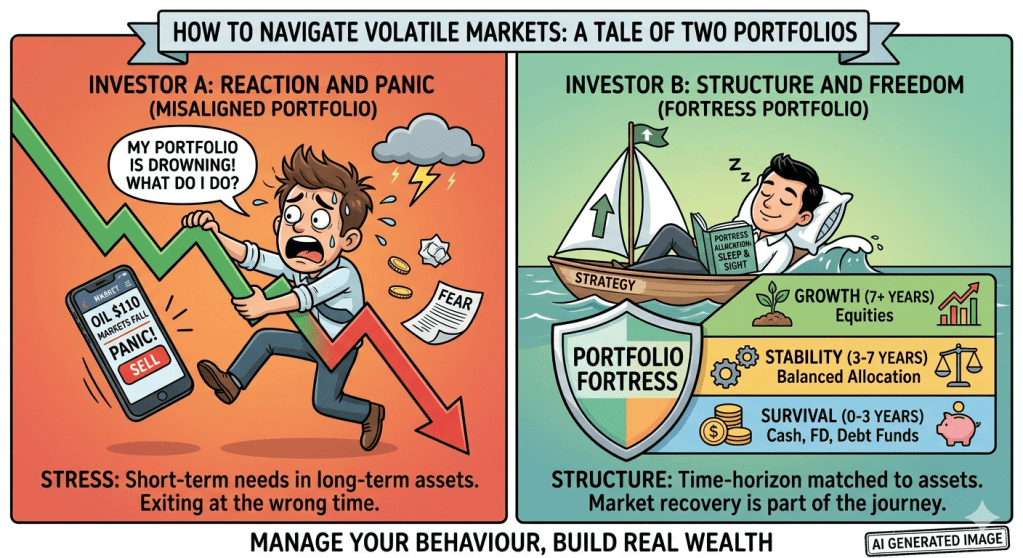
Investor A checked their portfolio every hour.
They had put most of their money into equities.
Short-term needs. Long-term goals. Everything mixed together.
Every dip felt like danger.
Every news update felt personal.
Investor B?
They slept.
Not because they didn’t care.
But because they had built their portfolio like a fortress.
Here’s what that fortress looked like:
Layer 1: Survival (0–3 years)
Cash, fixed deposits, debt funds : → Money untouched by market chaos
Layer 2: Stability (3–7 years)
Balanced allocation : → Some growth, some protection
Layer 3: Growth (7+ years)
Equity investments : → Allowed to ride volatility
So when markets shook…
Investor A felt like they were drowning.
Investor B felt like they were… sailing through rough waters.
That’s the difference.
Not intelligence.
Not timing.
But structure.
Because here’s the uncomfortable truth:
Markets don’t create panic.
Misaligned portfolios do.
And in times like these, investors often make the biggest mistake:
They react.
They sell in fear.
They pause investments.
They wait for “clarity.”
But clarity in markets usually comes…after the opportunity is gone.
So what should you actually do right now?
Not theory.
Not jargon.
Just simple strategy:
1. Check your time horizon – If you need the money in <3–5 years → it should NOT be in equities
2. Strengthen your safety net – Ensure at least 30–50% of your portfolio is in stable assets
3. Don’t interrupt long-term money – If your goals are 7+ years away → volatility is part of the journey
4. Avoid “reaction investing” – The biggest losses don’t come from markets falling. They come from investors exiting at the wrong time
5. Remember this simple truth – Every crisis feels permanent. None of them are.
Because we’ve been here before.
COVID.
Wars.
Crashes.
Corrections.
Different triggers. Same pattern.
So the real question is not: “Will markets recover?”
They always have.
The real question is: Will you still be invested when they do?
Because in moments like these…
You’re not just managing money.
You’re managing your behaviour.
And that…
Is where real wealth is built.
 Simplified Money Talks