
Rita walked into Ram’s office right after work—ID card still around her neck.
“Ram, I think I’m sorted for retirement.”
That sentence always made Ram slow down.
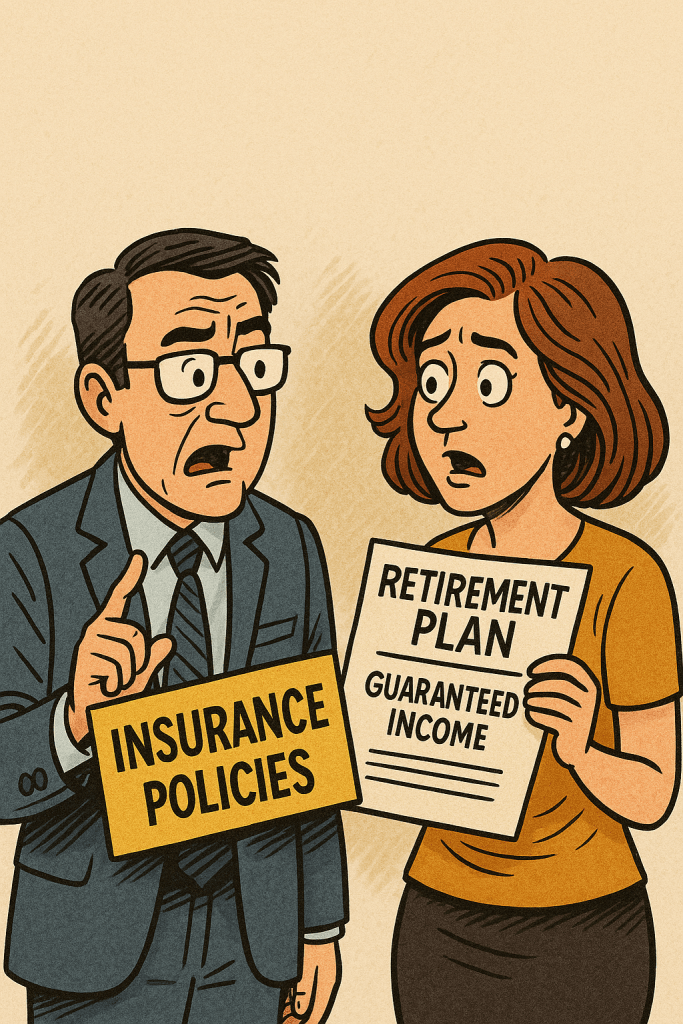
She pulled out a brochure.
“HR’s insurance partner explained this plan. ₹1 lakh a year. After 60, guaranteed pension. No market tension.”
Rita smiled.
“With EMIs, kids’ fees, and job uncertainty, this feels safe.”
Ram nodded.
“Let’s talk through it—using your daily life, not brochure language.”
“What Happens to Your Salary-Cut Premium?”
“Rita,” Ram asked,
“when ₹1 lakh goes from your bank account every year, what do you think happens next?”
Rita answered like most salaried professionals would.
“It grows for retirement.”
Ram replied gently.
“First, it gets divided.”
He explained it like a monthly salary slip:
- Some part goes to insurance cost
- Some to admin charges
- Some to agent commission
- What remains goes into investment
“It’s like your CTC,” Ram said.
“The full number looks big, but your take-home is smaller.”
Rita nodded slowly.
“That makes sense.”
“The Return That Doesn’t Beat Rising Costs”
Ram continued.
“These plans typically give 4 to ~6% return over 20–25 years.”
Rita said,
“But that’s stable. No ups and downs.”
Ram smiled.
“So is your old PPF passbook.”
Then he asked:
“Do you remember what petrol cost 15 years ago?”
Rita laughed.
“₹50 per litre?”
“And now?” Ram asked.
“₹100+.”
Ram paused.
“If expenses double every 12–15 years, can a 5% return handle retirement for 25–30 years?”
Rita went quiet.
“The Harsh Retirement Math We Ignore”
Ram scribbled numbers.
“You invest:
- ₹1 lakh per year
- For 25 years
- Total: ₹25 lakh”
“At retirement, you’ll have around ₹45–50 lakhs.”
Rita did a quick mental calculation.
“That’s barely:
- Two medical emergencies
- One major hospitalisation
- And household expenses for a few years”
Ram nodded.
“And remember—there’s:
- No salary hikes
- No Diwali bonus
- No company medical cover anymore”
That hit hard.
“Why We Love Guarantees (And Why It Hurts)”
Ram leaned forward.
“Indians love guarantees because:
- Our parents trusted LIC
- Fixed deposits felt safe
- Markets scared us”
He paused.
“But safety without growth works only when:
- Life expectancy was lower
- Expenses were predictable
- Families were joint”
“Today,” Ram said,
“you may live till 85–90, with rising healthcare costs and nuclear family support.”
Guarantees, suddenly, didn’t feel so comforting.
“Same Salary, Smarter Allocation”
“Now let’s rework this like a middle-class budget,” Ram said.
Term insurance
- ₹1 crore cover
- Costs roughly the same as one family dinner out per month
Mutual fund SIP for retirement
- Monthly SIP adjusted to your salary cycle
- Increase SIP when appraisal happens
- Equity does the long-term heavy lifting
“Same discipline. Same monthly deduction,” Ram explained.
“Different destination.”
Result?
“About ₹1.5 crore in 25 years.”
Rita blinked.
“That’s a retirement I can actually imagine,” she said.
“Medical, travel, dignity.”
“The Moment of Clarity”
Rita closed the insurance brochure.
“So this plan wasn’t bad,” she said slowly.
“It just wasn’t meant for retirement.”
Ram nodded.
“Insurance plans are like umbrellas.
Great when it rains.”
“But retirement,” he added,
“is a long road trip. You need a strong engine, not just protection.”
Rita smiled.
“I wanted peace of mind,” she said.
“But I also want peace in my 60s and 70s.”
Ram smiled back.
“That’s when retirement planning truly begins.”
“A Thought for Every Salaried Person”
Retirement is not about avoiding market volatility.
It’s about avoiding dependency.
Plan accordingly.
 Simplified Money Talks