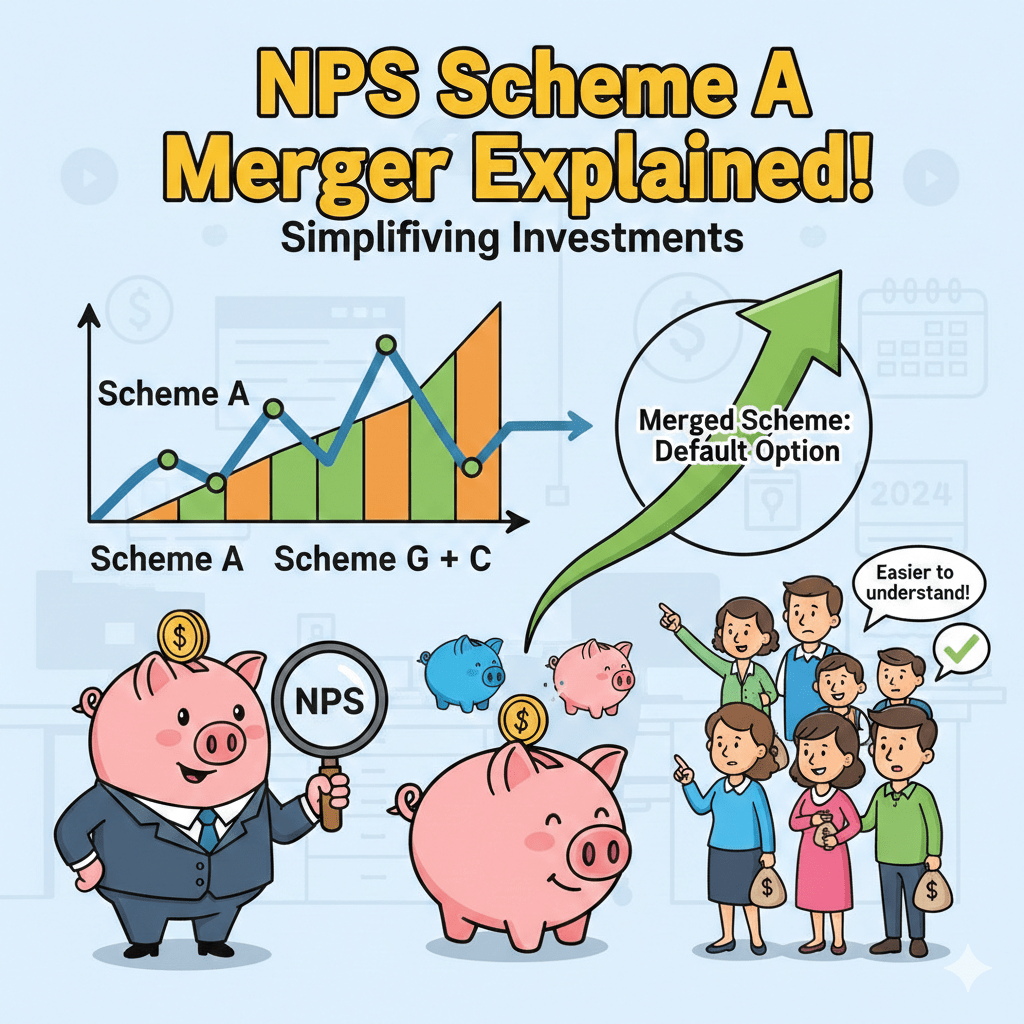
An NPS Scheme Change Every Investor Should Understand: The Scheme A Merger Explained

Raj, a 38-year-old private sector employee, had a simple ritual.

Once a year, usually around tax-saving season, he would log in to his NPS account, download his statement, glance at the numbers, feel reassured—and log out.

But this year was different.

An email from NPS caught his eye: “Scheme A will be merged with Schemes C and E…”

Raj frowned.

“Merge? Scheme A? Did I invest in something risky without knowing?”
“Will my retirement money be affected?”
“And is this change only for private sector employees like me?”

By evening, Raj did what most sensible investors do when confused.

He called Sunil, his long-time financial planner.

“Sunil, my NPS statement is changing. Should I be worried?”

Sunil smiled.
“Relax, Raj. Nothing has gone wrong. In fact, this is a clean-up exercise, not a problem.”

Seeing Raj still anxious, Sunil pulled out a notebook.

“Let me explain this the easy way.”

What exactly was Scheme A?

“Raj,” Sunil began,
“Scheme A was an optional asset class under NPS Active Choice. It invested in things like infrastructure funds, REITs, and InvITs—what we call alternative investments.”

Raj nodded slowly.

“But,” Sunil continued, “very few people chose it.

The corpus stayed small, liquidity was limited, and some investments had long lock-ins. Not ideal for a pension product.”

So why is Scheme A being merged now?

Sunil explained:

“PFRDA looked at three things:
1. Scheme A was too small to manage efficiently
2. It had liquidity constraints
3. Regulators want simpler, cleaner investment structures

So they decided: Let’s merge Scheme A into Scheme C (Corporate Bonds) and Scheme E (Equities)—larger, well-diversified, liquid schemes.”

Raj leaned back.

“So this isn’t because markets crashed or returns were bad?”

“Exactly,” Sunil said.
“This is preventive maintenance, not damage control.”

“But is this only for private sector employees like me?”

Raj’s next question came quickly.

Sunil shook his head.

“No. This applies to everyone who had opted for Scheme A:

  • Private sector employees
  • Government employees
  • Corporate NPS subscribers
  • All Citizens NPS

You’re hearing about it because Active Choice subscribers were the ones using Scheme A.”

Do I need to do anything now?

Sunil laid out the options clearly.

“You have two choices, Raj:

Option 1: Do nothing

  • Scheme A money will be automatically merged
  • No tax impact
  • No charges
  • No paperwork

Option 2: Use the free switch window

  • Till 25 December 2025, you can reallocate that money
  • You can choose how much goes into:
    • Scheme E (Equity)
    • Scheme C (Corporate Bonds)
    • Scheme G (Government Securities)
  • No switching cost for this move”

Raj smiled.
“At least they’re giving time.

“Now the important part—how should I invest post merger?”

Sunil leaned forward.

“Raj, you’re 38. Private sector. Long runway till retirement.
This change is actually a good opportunity to reset your NPS correctly.”

He wrote three letters on paper: E – C – G

Sunil’s suggested post-merger allocation for Raj

For someone below 40:

SchemeAllocation
Scheme E (Equity)70–75%
Scheme C (Corporate Bonds)20–25%
Scheme G (G-Secs)5–10%

“This,” Sunil said, “does three things:

  • Equity captures India’s long-term growth
  • Bonds reduce volatility
  • G-Secs provide stability without dragging returns too much”

Then he added:

“If you want something simple and low-maintenance, just remember this.”

E 60% – C 30% – G 10%

“It works beautifully for most people between 35 and 45.”

Raj’s final takeaway

Raj closed his notebook, visibly relaxed.

“So my retirement is safe.
The scheme is simpler.
And I actually get a chance to improve my allocation.”

Sunil nodded.

“That’s the right way to see it.
NPS is a long-distance train, Raj. Track maintenance doesn’t stop the journey—it makes it smoother.”

Raj smiled.

For the first time, that NPS email didn’t feel like bad news.

It felt like a course correction done in time.

✍️ Note

If you’ve received a similar NPS message and are unsure what to do, remember:

  • This change applies to all Scheme A investors
  • You have time till Dec 2025 to act
  • A simple, age-appropriate E–C–G allocation is all you need

A Simple Story That Explains How to Invest a Large Amount Safely

One Monday morning, Mr. Mehta walked in looking like someone who had just received a big wedding gift but didn’t know where to keep it safely.

“I have ₹20 lakh after selling an old property,” he said. “I want to invest it… but I’m scared of doing it too fast. Markets go up, down, spin around — I can’t figure out what to do.”

I smiled. “Relax, Mr. Mehta. You know what your situation reminds me of? Having a huge bucket of water and trying to empty it into a small bottle. If you pour it all at once, everything spills. But a slow, steady pour keeps things clean.”

He laughed. “That explains my financial mess perfectly.”

And so we began…

Step 1: Choosing the Right ‘Parking Spot’ — Like Finding a Place for Extra Bags

“Think of your ₹20 lakh like luggage you’ve brought back from a long trip,” I said. “Before arranging it in the cupboards, where do you keep it?”

He thought for a second.
“Usually in the guest room or store room.”

“Exactly! You don’t dump the suitcases directly into your wardrobe. Similarly, before sending the money to equities, you park it safely.”

So we explored three “rooms”:

1. Liquid Funds → The ‘Guest Room’

Like a spare room where you keep things temporarily — clean, safe, and easy to access.

Perfect if:

  • You plan to start investing soon.
  • You want zero tension.

2. Arbitrage Funds → The ‘Locker’

Like putting jewellery in a locker instead of a regular cupboard. Same safety, but smarter tax-wise, especially for high taxpayers.

Good for parking the luggage for a few months.

3. Ultra-Short Funds → The ‘Store Room’

Not visited often but secure.
Ideal when the wait is slightly longer.

Mr. Mehta laughed, “So basically, you’re telling me not to scatter the ₹20 lakh all over my financial house!”

“Exactly,” I said.
“Let’s keep it neatly in one room until we’re ready.”

Step 2: Entering the Market Slowly Like Merging Into Traffic

“Now imagine driving onto a busy main road,” I continued.

He nodded.

“You don’t blast your car into traffic. You merge slowly, right?”

“That’s true.”

“That slow merging is what we call an STP — Systematic Transfer Plan.”

I explained:

  • If the market is like a calm road → merge over 6 months
  • If it’s like peak-hour traffic → merge over 12–18 months
  • If there’s a sudden traffic lull (market correction) → merge faster

“It’s just common sense,” I added.
“Even Google Maps won’t tell you to accelerate blindly.”

He chuckled, “I didn’t know investing had so much in common with driving.”

Step 3: Avoiding Everyday Mistakes Like Grocery Shopping When Hungry

“Mr. Mehta,” I said, “Have you ever gone grocery shopping when hungry?”

His eyes widened. “Worst idea ever! I buy half the store.”

“Exactly! Investing everything at once when markets look exciting is the same mistake.”

Some examples:

Mistake 1: Waiting for the perfect price

Like waiting for the perfect mango in summer.
You keep waiting… and the season ends.

Mistake 2: Stopping midway because the market dips

Like stopping your morning walk just because it rained one day.
It breaks the routine.

Mistake 3: Investing all 20 lakh in a single shot

Like adding all spices at once while cooking —
chances of messing up are high.

He laughed so loudly the receptionist looked inside.

Step 4: The Plan That Gave Him Relief

“So let me summarise,” I said.

“Your ₹20 lakh will first rest safely — just like luggage waiting to be unpacked.
Then, month by month, it will slowly move into equity funds, like merging into traffic without honking or panic.”

He leaned back.

“You know… this finally makes sense in everyday terms. Investments always felt like rocket science, but you made it sound like managing my own home.”

“That’s the truth,” I replied.
“Good investing is usually just good housekeeping.”

And That’s How Mr. Mehta’s Journey Began

He left with:

  • A calm mind
  • A clear plan
  • And confidence that came from simple rules, not market predictions.

The ₹20 lakh wasn’t a burden anymore.
It had become a well-behaved guest, ready to settle into a long-term home — one month at a time.

Understanding Mutual Funds – A Shopping Mall Analogy

Amit: Hey Riya, I keep hearing about mutual funds, but there are so many types! Can you simplify them for me?

Riya: Sure! Think of mutual funds like different types of shopping malls—each designed for different needs. Let me break it down with examples you’ll relate to.

Amit: That sounds helpful!

Riya: Let’s start with the three main categories:

1. Equity Funds – Like a Shopping Mall

Just like how different stores in a mall cater to different shoppers, equity funds invests similarly  in different types of companies:

  • Large-Cap Funds: Like big anchor stores—stable and reliable. You shop at these big brands because you trust their quality.
  • Mid-Cap Funds: Like growing retail chains that are becoming popular (think about any successful regional brands that come to your mind). Just as these stores might become the next big thing, mid-cap companies have the same sort of growth potential.
  • Small-Cap Funds: Like promising local boutiques or startups. These carry a higher risk since they might either succeed big or fail, but they could offer great returns—like discovering the next Big Coffee brand when it was just a single coffee shop!

Amit: Oh, so it’s like choosing between shopping at a big mall versus exploring local markets?

Riya: Exactly! Now, let’s move on to the next category.

2. Debt Funds – Like Different Bank Accounts

These are similar to different ways to save your money:

  • Liquid Funds: Like keeping money in a digital wallet for quick shopping—it’s easily accessible and safer than cash.
  • Short-Term Funds: It is similar to a recurring deposit account where you park money for your upcoming vacation in six months.
  • Corporate Bond Funds: Like lending money to your reliable cousin’s successful business—they’ll pay you back with interest.
  • Gilt Funds: Like keeping money in a government bank—super safe, but returns might be lower.
  • Overnight Fund: One of the best options if you are thinking about keeping money for a week to a fortnight

Amit: That makes sense! And what about the third category?

3. Hybrid Funds – Like a Balanced Diet

Just as we balance healthy and tasty food:

  • Aggressive Hybrid Funds: Like a diet with 70% protein (eggs, meat) and 30% carbs (rice, bread)—more growth-focused but they are still balanced.
  • Conservative Hybrid Funds: Like a diet with 25% protein and 75% carbs—safer but with some growth potential.
  • Balanced Advantage Funds: Like adjusting your diet based on your activity level—more carbs on workout days, more protein on rest days.

Special Categories:

  • Index Funds: Like buying everything on a shopping list without making changes—you get exactly what’s on the list (market index).
  • Fund of Funds: Like a food subscription box that contains different meal kits—you get variety managed by experts.

Amit: These examples really help! So, if I’m saving for my daughter’s education in 15 years, I should probably look at equity funds?

Riya: Exactly! Just like you’d plan a big purchase well in advance. For long-term goals like education:

  • Consider Large-Cap Funds as your main course (70%).
  • Add some Mid-Cap Funds for extra growth (20%).
  • Maybe a small portion in Small-Cap Funds for potentially higher returns (10%).

But if you’re saving for next year’s car down payment, you’d want Debt Funds—just like you wouldn’t risk your car money in a new startup!

Amit: This makes so much more sense now. One last question—what about tax-saving funds?

Riya: Ah, ELSS (Equity Linked Savings Scheme) funds! Think of them like a combo deal—you get tax benefits under Section 80C, plus the potential for good returns. It’s like getting a discount while shopping, but you need to hold onto your shopping bags for three years from the date of investment before using them!

Amit: Perfect! Now, I can actually relate mutual funds to things I understand. Thanks, Riya!

Riya: Happy to help! Just remember, just like you don’t buy all your clothes from one store, it’s good to diversify your investments based on your needs and goals.

Market-Timing v/s Value Investing: A Smarter Approach to Market Investing

Rohan:“Hey, Sudhir! I’ve been reading your blog for a while now, and there’s something that’s been on my mind. You always say not to time the market, right? But then I see you talking about avoiding the overvalued market conditions and even the stocks that I want to buy! Isn’t that also a form of timing the market?”

Sudhir:“Good question, Rohan! It sounds like there’s a contradiction, doesn’t it? But there’s a big difference between the two approaches. Let’s break it down a bit.”

Rohan:“Sure, go ahead.”

Sudhir:“When I talk about not timing the market, I mean we shouldn’t try to predict short-term market movements/corrections – you know, the ups and downs from one day to the next day (Some time back only the Gulf War broke out!). Somehow we get into this false belief that we know whether prices will go up or down tomorrow, the next week, or even the next month. But in reality, all that one is doing is mere speculation. You know.”

Rohan:“So, you’re saying it’s impossible to guess where the market is headed in the short term?”

Sudhir:“Exactly! I have seen people trying to play ‘catch game’ the market’s highs and lows, only to miss out on long-term gains or take unnecessary losses. It’s tempting, but more often than not, people lose money or lose valuable time waiting for the perfect price entry or exit point.”

Rohan:“But isn’t it the same when you say we should wait for stocks to be ‘fairly valued’? Doesn’t that involve timing too?”

Sudhir:“Good Point though. I know where you’re coming from, but let’s look at it from a perspective. When I say you should be mindful of valuations it doesn’t mean I’m trying to guess when a stock will hit a peak or bottom. Instead, I’m assessing whether the current price makes sense based on the company’s fundamentals –its balance sheet, its growth story, and its industry position. I’m not saying ‘this stock will drop next month,’ but rather ‘this price doesn’t reflect what this company is worth today.’ It’s less about timing and more about fair pricing.”

Rohan:“Hmmm, so it’s more like being a smart shopper, not a fortune-teller.”

Sudhir:“Exactly! Think of it like this: when you’re timing the market, emotions – fear of missing out or panic when prices drop – often drive your decisions. That’s more like you are reacting to a specific event. But when you’re focusing on valuations, you’re taking a calm, business-owner mindset. You’re asking, ‘What is this? Is this stock genuinely worth it?’ It’s like shopping for value rather than gambling on sheer luck.”

Rohan:“I get it now. Instead of stressing over when to jump in, you’re simply checking if a company’s price aligns with its value.”

Sudhir:“Yes! This approach will keep you grounded at all times. To put it further, consider the current market from the Highs of BSE Sensex trading at 85,978 in Sept’24 to 80,000 in Oct’24 as an example. Some investors are frantically watching every 5% decline, wondering if this is ‘the big one’ they’ve been waiting for. They’re glued to charts and social media, following every prediction. That’s classic market timing. But on the other hand, a valuation-conscious investor is looking at individual companies, assessing if some great businesses are now selling at fair or even discounted prices.”

Rohan:“So, while the usual investor is more fixated on the market’s next move, the valuation-conscious investor is trying to find out the specific opportunities?”

Sudhir:“Exactly, Rohan! While the market timer might be paralyzed, waiting for the perfect moment, the valuation-focused investor is spotting strong companies at good prices – regardless of what the Sensex might do next week. It’s about taking a measured, analytical approach, and ultimately, that helps you make sound, long-term investment decisions. This is the long term principle that I have been following through”

Rohan:“Thanks, Sudhir! This makes so much more sense now. I’m beginning to see how I can keep my emotions in check and focus more on value than on timing. Really appreciate the perspective!”

Sudhir:“Anytime, Rohan! Keep those questions coming – it’s these kinds of conversations that make us all better investors.”

The Tale of Two Investors: Simplicity V/s. Complexity in Wealth Building

Today, let me take you through the story of two friends, Aryan and Sameer.

Both friends had inherited inherited ₹ 15 million from a long-lost relative. Both had the same goal: invest wisely and grow their wealth over the next 15 years. However, their investment journeys were poles apart, shaped by the choices they made and the advice they followed.

Chapter 1: The Advice Dilemma

Aryan, eager to make the most of this once-in-a-lifetime opportunity, turned to an online Question and Answer forum on a social media for advice. He had heard about index funds—specifically, those from a US based Investment company —and was inclined to invest in a few, sit tight, and watch his wealth grow. His goal was simple: he didn’t need the money for the next 15 years and wanted to grow it safely without much hassle.

But as Aryan scrolled through the responses, the sheer number of suggestions overwhelmed him. One set of Gurus argued passionately for buying properties, citing rental income and capital appreciation. Equity traders recommended actively managing a stock portfolio for higher returns, while hedge fund advocates touted complex strategies that promised outsized gains. And, of course, the gold enthusiasts warned of economic collapses, urging Aryan to convert his fortune into precious metals.

Sameer, on the other hand, consulted a private banker. The banker presented a glossy portfolio filled with sophisticated products: alternative investments, structured notes, and even a fund promising returns based on rare whiskey investments. It all sounded impressive, and Sameer, intrigued by the exclusivity, signed up for the services.

Chapter 2: A Matter of Simplicity

Aryan, however, found himself at a crossroads. After reading a diverse range of opinions, he attended a webinar on goal-based investing. The presenter’s message was simple but timeless: “Investments should be aligned with your financial goals, match your investment horizon, beat inflation by a reasonable margin, have the liquidity you need, and come with low costs.”

The simplicity of this approach resonated with Aryan. His goal was to grow his wealth for the long term, so a 15-year investment period made sense. He didn’t need the money now, so he could afford to invest in assets that would appreciate steadily. The advice about keeping costs low and beating inflation also clicked. Aryan chose to stick to his original plan of investing in low-cost index funds, which offered broad market exposure and minimal management fees. He saw this as the most prudent way to beat inflation over time and achieve long-term growth.

Sameer, meanwhile, was excited by the exclusivity of his investments. His private banker assured him that these unique strategies would outperform the market, offering much higher returns than the “boring” index funds Aryan had chosen.

Chapter 3: The Path of Patience vs. The Trap of Complexity

As the years rolled by, Aryan’s simple, goal-based investment strategy began to bear fruit. The low-cost funds provided steady returns, benefiting from the overall growth of the global economy. The power of compounding worked its magic. Aryan didn’t have to monitor the market obsessively or make sudden moves when the economy dipped; he trusted his 15-year horizon and his original plan.

On the other hand, Sameer’s complex investments started to unravel. The private banker had charged significant fees for managing the exclusive portfolio, eating into Sameer’s returns. Some of the exotic products didn’t perform as promised, and the volatility of hedge funds and alternative investments caused anxiety during market downturns. Sameer found himself checking his portfolio more frequently and making impulsive decisions to switch investments based on the banker’s suggestions. The costs of active management and the underperformance of several products left Sameer disillusioned.

Chapter 4: The Lesson of Simplicity

By the end of 15 years, Aryan had more than doubled his wealth, thanks to his disciplined, goal-oriented approach. His funds had not only outpaced inflation but also delivered healthy returns, all with minimal stress and effort.

Sameer, despite starting with the same amount, found that his complex portfolio had barely kept pace with inflation. The high fees, the underperformance of exotic investments, and the constant switching had eroded his gains.

Reflecting on their respective journeys, Aryan realized that the simplest approach had been the best. His initial instincts, backed by solid principles of goal-based investing, low costs, and long-term focus, had led him to success. Sameer, meanwhile, regretted falling into the trap of complexity, exclusivity, and high fees.

—————————————————————–

Conclusion: The Fundamentals Remain the Same

Aryan’s story is a powerful reminder that the fundamentals of investing never change. Your investments should always align with your financial goals, (REFER to my earlier Blogs posted in Aug 2024) and the period should match your needs. It should beat inflation, have the liquidity you might require, and, most importantly, come at a low cost. Amid all the noise of various financial products and strategies, sometimes the simplest route—funds, patience, and discipline—is the wisest.

And so, Aryan and Sameer’s tale ends with a lesson for all investors: don’t be swayed by the allure of complexity or exclusivity. Instead, focus on the timeless principles of investing, and you’ll set yourself up for success.