Ravi: Shyam, it’s been a while. You look lighter today — last time we spoke, you were carrying the weight of the world on your shoulders. What changed?
Shyam: Ravi, I have a story to tell you. Do you remember why I first came to you, worried?
Ravi: Of course. You’d been in your job for close to eight years, steady and stable, but your salary had barely moved — under four percent a year. And you still had seventeen years left on your home loan.
Shyam: Exactly. I’m in my mid-forties now, and that math kept me up at night. A loan running into lakhs, a raise that couldn’t even keep pace with inflation, and time slipping by. I felt stuck.
Ravi: So you went looking for a shortcut.
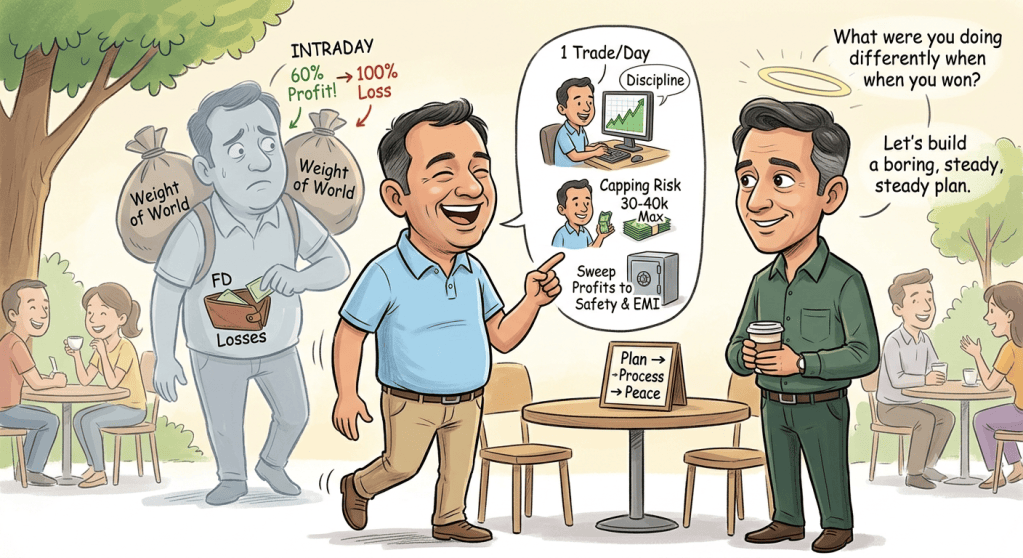
Shyam: (laughs, a little embarrassed) I did. Someone told me intraday trading could fetch quick returns. I put in one lakh rupees — just to “try.” And in the first few weeks, I made sixty percent returns. Sixty percent, Ravi! I thought I’d finally found the answer.
Ravi: I remember that phase. You were buoyant, calling me to ask why you should bother with mutual funds and SIPs when you could make that kind of money in weeks.
Shyam: And then it all came apart. I got greedy, started trading more, chasing bigger positions. In a single week, I lost every rupee of profit I had made. It didn’t stop there — I broke my fixed deposits to cover the losses, and even that money kept getting eaten up. The losses were compounding faster than I could plug them.
Ravi: That was a hard time. You told me you wanted to quit — not just trading, but almost quit believing in yourself.
Shyam: I did feel very low. That’s actually when I came to you, remember? I was ready to walk away from the markets altogether.
Ravi: I remember. But instead of telling you to quit, I asked you a simple question — “Before you had losses, you had a few weeks of real profit. What were you doing differently then?” I wanted you to go back and study your own winning trades, not just the losing ones.
Shyam: That question stayed with me. I went back through my trade log from those first few weeks and looked closely.
Ravi: And what did you find?
Shyam: Discipline, mainly. In those early weeks, I wasn’t trading all day. I’d research one stock in the morning, take a single trade, and stop — win or lose. Once I started overtrading later, chasing every small movement and taking five or six trades a day, that’s exactly when it fell apart.
Ravi: That’s the clue I was hoping you’d find. One good, researched trade a day was your actual edge. The moment you turned it into all-day speculation, the edge disappeared and emotion took over.
Shyam: So we rebuilt my approach around that one insight.
Ravi: Yes, but I also insisted on one more rule, because insight alone doesn’t protect you from yourself in a bad week. I told you: ring-fence your trading capital. Keep a fixed amount — say thirty or forty thousand rupees — set aside purely for intraday trading. Every other rupee of your income, your savings, your EMI money, stays completely separate and untouched. That way, the worst that can ever happen is you lose that fixed thirty or forty thousand. Never more.
Shyam: That changed everything for me psychologically. I wasn’t trading with the fear of touching my FDs or EMI money anymore, because I’d already decided the maximum damage was capped. Within that fixed pool, I traded just once a day, only after some research, happy with two to four thousand rupees. No greed, no revenge trading.
Ravi: And the second habit I asked you to build?
Shyam: Every single day, whatever profit I made, I moved it out of the trading account immediately into a liquid fund or an overnight fund. The profit never sat there tempting me to “let it ride” the next day.
Ravi: That’s the part that impressed me most. You didn’t just find a strategy — you built two guardrails around it: a hard cap on capital at risk, and a same-day sweep of profits to safety.
Shyam: Between the fixed thirty-to-forty-thousand cap, the one-trade-a-day rule, and sweeping profits out daily, I built up thirty-eight thousand rupees in the very first month, which I pulled out and used toward my EMIs. And I kept at it — patiently, consistently, within that same fixed capital — for two years.
Ravi: Two years of showing up, staying inside a fixed capital, taking one measured trade a day, and sweeping the gains to safety. That’s not luck, Shyam. That’s a system — one we built together after your worst week.
Shyam: I couldn’t have found it alone, Ravi. If you hadn’t asked me to go back and study my own winning trades instead of only mourning the losses, and if you hadn’t insisted on that fixed thirty-to-forty-thousand cap, I think I’d have either quit the markets out of fear, or kept doubling down until there was truly nothing left. It taught me something I’ll carry for the rest of my life — there’s no easy money in the world of finance. None. But if you’re honest about your shortcomings, understand them fully, and then take a leap of faith with a measured, calculated approach — you really can do wonders.
Ravi: (smiling) That’s exactly the wisdom I wish every investor arrived at without having to lose their FDs first. You paid a costly tuition fee, Shyam, but you learned the real lesson: markets don’t reward impatience or greed. They reward process, a hard cap on what you’re willing to risk, and protecting what you’ve already earned.
Shyam: So where do I go from here? I still have seventeen years on this loan.
Ravi: Now that you’ve proven to yourself you can be disciplined, let’s bring that same discipline to your whole financial picture — your EMIs, your emergency fund, your long-term investments, even that one trade a day if you still enjoy it, but as a small satellite, never the core of your plan. The core has to be boring, steady, and built for seventeen years, not seventeen days.
Shyam: Boring sounds good to me now, Ravi. I’ve had enough excitement for one lifetime. And do you realize — thirty-eight thousand a month, sustained for two years, meant I pushed close to nine lakh rupees extra towards my home loan in that time. Money that would never have come my way through a four percent annual raise.
Ravi: That’s the real proof, Shyam. Almost nine lakh rupees shaved off a seventeen-year loan, built purely through discipline, a fixed cap on risk, and patience — not through any miracle strategy.
Shyam: I want to thank you for that, Ravi. Not just for the numbers, but for not letting me walk away when I was at my lowest. You could have simply told me to quit trading altogether. Instead, you asked me the right question, gave me the guardrails I needed, and stood by me while I rebuilt everything, one disciplined trade at a time. I don’t think I’d be standing here today, this much closer to being debt-free, without you.
Ravi: (smiling) That’s what I’m here for, Shyam. My job was never to give you a shortcut — it was to help you turn your own hard-earned lesson into a system you could trust. You did the discipline. I just helped you see it clearly.
Shyam: (laughs) Then let’s build the rest of this boring, unshakeable plan together.
Disclaimer: This is a fictional, illustrative story created for educational purposes only. It does not constitute financial, investment, or trading advice. Intraday trading carries a high risk of loss and is not suitable for everyone. Past performance, including any figures mentioned here, is not indicative of future results. Please consult a SEBI-registered financial advisor before making any investment or trading decisions.