When the Paycheck Stops, How Should Your Money Work?

Shyam retired at 60.

His children were settled. The home loan was closed. Life was finally slow and peaceful.
But one question kept coming back again and again:

“Will my money last… and will it give me regular income?”

Shyam did not want excitement from his investments anymore.
He wanted stability, income, and peace of mind.

That’s when he met Ravi.

“I Don’t Want Big Returns, I Want Peace”

Shyam explained his concern honestly.

“I don’t want to take big risks now.
I need monthly income for expenses.
And my money should grow slowly so inflation doesn’t hurt me.”

Ravi smiled. This was a very common retirement question.

“That’s actually a good starting point,” Ravi said.
“In retirement, the goal is not to beat the market.
The goal is to protect money, create income, and avoid stress.”


Step 1: Understanding the 3–5 Year Reality

Ravi first spoke about time.

“Shyam, since your focus is the next 3–5 years, we must be careful.
Markets can go up and down sharply in short periods.
So we should not depend heavily on pure equity funds.”

Shyam nodded. He remembered how markets sometimes fell suddenly.


Step 2: Making Stability the Base

Ravi then explained the foundation.

“A large part of your money should be in debt mutual funds.”

He kept it simple.

These include:

  • Short-duration funds
  • Medium-duration funds
  • Bond and corporate bond funds

“These funds invest in government securities and strong companies.
They are not flashy, but they are stable and predictable.”

Ravi added,

“Think of them like the ground floor of a house.
Strong, quiet, and reliable.”

Shyam liked that comparison.


Step 3: Adding Gentle Growth with Hybrid Funds

“But what about growth?” Shyam asked.

Ravi replied calmly.

“To beat inflation, we add conservative hybrid funds.”

He explained in simple words:

  • Most of the money is in debt
  • A small part is in equity
  • Risk stays controlled
  • Growth is slow but steady

“This gives your money a chance to grow
without giving you sleepless nights.”

Shyam felt reassured.


Step 4: Optional Low-Risk Equity Exposure

Ravi also mentioned another option.

“If you are comfortable, a small portion can go into
equity savings funds or arbitrage funds.”

These funds:

  • Keep volatility low
  • Do not behave like full equity funds
  • Are used only as support, not the main plan

“This step is optional,” Ravi clarified.
“Comfort matters more than returns.”


Step 5: Turning Investments into Monthly Income

Now came the most important question.

“How do I get monthly income from all this?” Shyam asked.

Ravi explained a simple solution.

“We use something called a Systematic Withdrawal Plan (SWP).”

With SWP:

  • A fixed amount comes to Shyam every month
  • Withdrawals are planned, not random
  • Remaining money stays invested

“It works like a salary from your own savings,” Ravi said.

Shyam smiled. That’s exactly what he wanted.

What Ravi Clearly Avoided

Ravi also made one thing very clear.

“For a 3–5 year retirement goal,
we usually avoid pure equity funds.”

“They are great for long-term wealth creation,
but too risky for regular income needs.”


To Sum up

Ravi summed it up for Shyam:

  • Debt funds for safety and stability
  • Conservative hybrid funds for slow, steady growth
  • Optional equity savings/arbitrage funds for balance
  • SWP for regular income
  • Focus on peace, not performance charts

Shyam’s Realisation

After the conversation, Shyam felt lighter.

“This feels comfortable,” he said.
“My money doesn’t need to run fast.
It just needs to walk steadily with me.”

Ravi smiled.

“That’s exactly how retirement investing should feel.”

In retirement, the best investment plan is not exciting.
It is simple, steady, and quietly supportive.

When money works silently in the background,
retirement feels exactly the way it should—peaceful.

Disclaimer: This is only a general example to explain how retirement investments can be planned. Every person’s needs are different. Your lifestyle, monthly expenses, health needs, and comfort with risk can change what is suitable for you. Please consider your personal situation or speak to a financial advisor before investing.

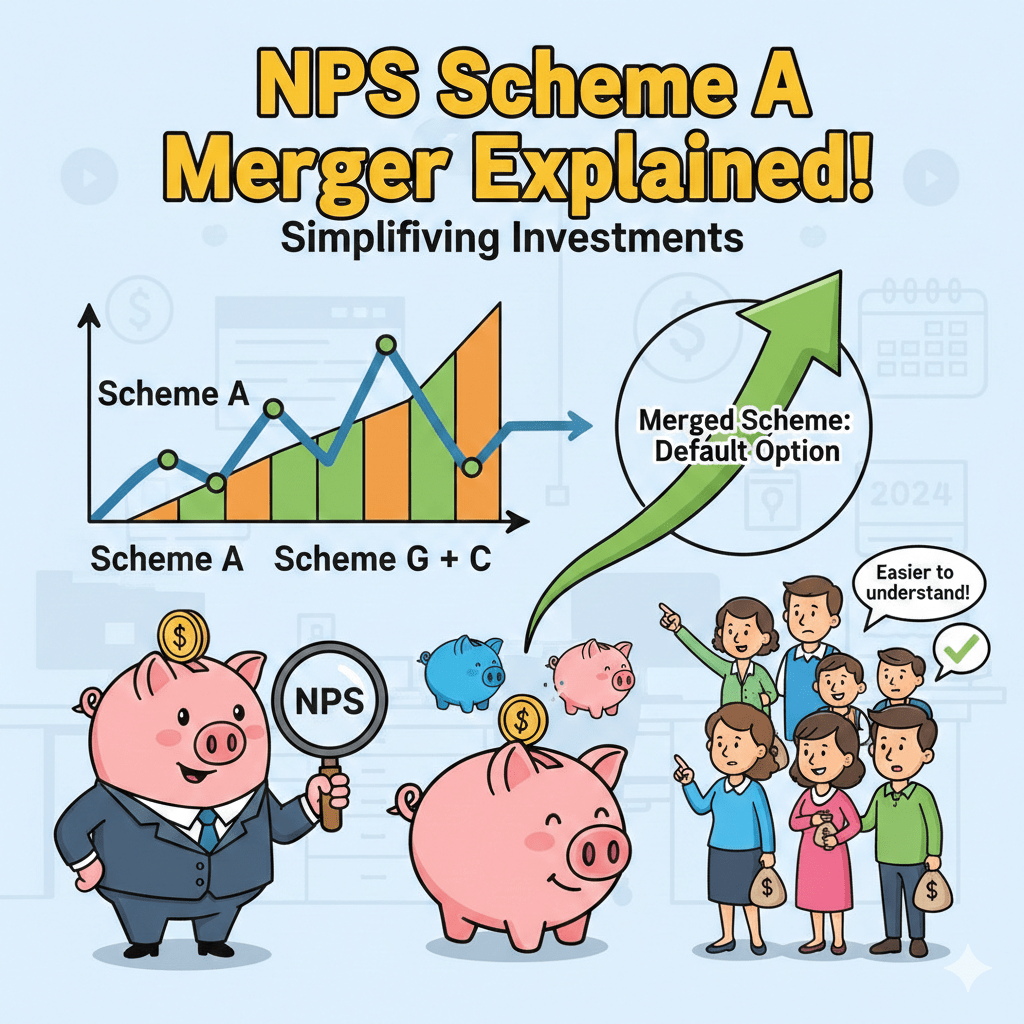
An NPS Scheme Change Every Investor Should Understand: The Scheme A Merger Explained

Raj, a 38-year-old private sector employee, had a simple ritual.

Once a year, usually around tax-saving season, he would log in to his NPS account, download his statement, glance at the numbers, feel reassured—and log out.

But this year was different.

An email from NPS caught his eye: “Scheme A will be merged with Schemes C and E…”

Raj frowned.

“Merge? Scheme A? Did I invest in something risky without knowing?”
“Will my retirement money be affected?”
“And is this change only for private sector employees like me?”

By evening, Raj did what most sensible investors do when confused.

He called Sunil, his long-time financial planner.

“Sunil, my NPS statement is changing. Should I be worried?”

Sunil smiled.
“Relax, Raj. Nothing has gone wrong. In fact, this is a clean-up exercise, not a problem.”

Seeing Raj still anxious, Sunil pulled out a notebook.

“Let me explain this the easy way.”

What exactly was Scheme A?

“Raj,” Sunil began,
“Scheme A was an optional asset class under NPS Active Choice. It invested in things like infrastructure funds, REITs, and InvITs—what we call alternative investments.”

Raj nodded slowly.

“But,” Sunil continued, “very few people chose it.

The corpus stayed small, liquidity was limited, and some investments had long lock-ins. Not ideal for a pension product.”

So why is Scheme A being merged now?

Sunil explained:

“PFRDA looked at three things:
1. Scheme A was too small to manage efficiently
2. It had liquidity constraints
3. Regulators want simpler, cleaner investment structures

So they decided: Let’s merge Scheme A into Scheme C (Corporate Bonds) and Scheme E (Equities)—larger, well-diversified, liquid schemes.”

Raj leaned back.

“So this isn’t because markets crashed or returns were bad?”

“Exactly,” Sunil said.
“This is preventive maintenance, not damage control.”

“But is this only for private sector employees like me?”

Raj’s next question came quickly.

Sunil shook his head.

“No. This applies to everyone who had opted for Scheme A:

  • Private sector employees
  • Government employees
  • Corporate NPS subscribers
  • All Citizens NPS

You’re hearing about it because Active Choice subscribers were the ones using Scheme A.”

Do I need to do anything now?

Sunil laid out the options clearly.

“You have two choices, Raj:

Option 1: Do nothing

  • Scheme A money will be automatically merged
  • No tax impact
  • No charges
  • No paperwork

Option 2: Use the free switch window

  • Till 25 December 2025, you can reallocate that money
  • You can choose how much goes into:
    • Scheme E (Equity)
    • Scheme C (Corporate Bonds)
    • Scheme G (Government Securities)
  • No switching cost for this move”

Raj smiled.
“At least they’re giving time.

“Now the important part—how should I invest post merger?”

Sunil leaned forward.

“Raj, you’re 38. Private sector. Long runway till retirement.
This change is actually a good opportunity to reset your NPS correctly.”

He wrote three letters on paper: E – C – G

Sunil’s suggested post-merger allocation for Raj

For someone below 40:

SchemeAllocation
Scheme E (Equity)70–75%
Scheme C (Corporate Bonds)20–25%
Scheme G (G-Secs)5–10%

“This,” Sunil said, “does three things:

  • Equity captures India’s long-term growth
  • Bonds reduce volatility
  • G-Secs provide stability without dragging returns too much”

Then he added:

“If you want something simple and low-maintenance, just remember this.”

E 60% – C 30% – G 10%

“It works beautifully for most people between 35 and 45.”

Raj’s final takeaway

Raj closed his notebook, visibly relaxed.

“So my retirement is safe.
The scheme is simpler.
And I actually get a chance to improve my allocation.”

Sunil nodded.

“That’s the right way to see it.
NPS is a long-distance train, Raj. Track maintenance doesn’t stop the journey—it makes it smoother.”

Raj smiled.

For the first time, that NPS email didn’t feel like bad news.

It felt like a course correction done in time.

✍️ Note

If you’ve received a similar NPS message and are unsure what to do, remember:

  • This change applies to all Scheme A investors
  • You have time till Dec 2025 to act
  • A simple, age-appropriate E–C–G allocation is all you need

Is Your Retirement Plan Wrong? The Real Truth About Insurance Policies

Rita walked into Ram’s office right after work—ID card still around her neck.

“Ram, I think I’m sorted for retirement.”

That sentence always made Ram slow down.

She pulled out a brochure.
“HR’s insurance partner explained this plan. ₹1 lakh a year. After 60, guaranteed pension. No market tension.”

Rita smiled.
“With EMIs, kids’ fees, and job uncertainty, this feels safe.”

Ram nodded.
“Let’s talk through it—using your daily life, not brochure language.”

“What Happens to Your Salary-Cut Premium?”

“Rita,” Ram asked,
“when ₹1 lakh goes from your bank account every year, what do you think happens next?”

Rita answered like most salaried professionals would.
“It grows for retirement.”

Ram replied gently.
“First, it gets divided.”

He explained it like a monthly salary slip:

  • Some part goes to insurance cost
  • Some to admin charges
  • Some to agent commission
  • What remains goes into investment

“It’s like your CTC,” Ram said.
“The full number looks big, but your take-home is smaller.”

Rita nodded slowly.
“That makes sense.”

“The Return That Doesn’t Beat Rising Costs”

Ram continued.

“These plans typically give 4 to ~6% return over 20–25 years.”

Rita said,
“But that’s stable. No ups and downs.”

Ram smiled.
“So is your old PPF passbook.”

Then he asked:
“Do you remember what petrol cost 15 years ago?”

Rita laughed.
“₹50 per litre?”

“And now?” Ram asked.

“₹100+.”

Ram paused.

“If expenses double every 12–15 years, can a 5% return handle retirement for 25–30 years?”

Rita went quiet.

“The Harsh Retirement Math We Ignore”

Ram scribbled numbers.

“You invest:

  • ₹1 lakh per year
  • For 25 years
  • Total: ₹25 lakh”

“At retirement, you’ll have around ₹45–50 lakhs.”

Rita did a quick mental calculation.

“That’s barely:

  • Two medical emergencies
  • One major hospitalisation
  • And household expenses for a few years”

Ram nodded.

“And remember—there’s:

  • No salary hikes
  • No Diwali bonus
  • No company medical cover anymore”

That hit hard.

“Why We Love Guarantees (And Why It Hurts)”

Ram leaned forward.

“Indians love guarantees because:

  • Our parents trusted LIC
  • Fixed deposits felt safe
  • Markets scared us”

He paused.

“But safety without growth works only when:

  • Life expectancy was lower
  • Expenses were predictable
  • Families were joint”

“Today,” Ram said,
“you may live till 85–90, with rising healthcare costs and nuclear family support.”

Guarantees, suddenly, didn’t feel so comforting.

“Same Salary, Smarter Allocation”

“Now let’s rework this like a middle-class budget,” Ram said.

Term insurance

  • ₹1 crore cover
  • Costs roughly the same as one family dinner out per month

Mutual fund SIP for retirement

  • Monthly SIP adjusted to your salary cycle
  • Increase SIP when appraisal happens
  • Equity does the long-term heavy lifting

“Same discipline. Same monthly deduction,” Ram explained.
“Different destination.”

Result?

“About ₹1.5 crore in 25 years.”

Rita blinked.

“That’s a retirement I can actually imagine,” she said.
“Medical, travel, dignity.”

“The Moment of Clarity”

Rita closed the insurance brochure.

“So this plan wasn’t bad,” she said slowly.
“It just wasn’t meant for retirement.”

Ram nodded.

“Insurance plans are like umbrellas.
Great when it rains.”

“But retirement,” he added,
“is a long road trip. You need a strong engine, not just protection.”

Rita smiled.

“I wanted peace of mind,” she said.
“But I also want peace in my 60s and 70s.”

Ram smiled back.

“That’s when retirement planning truly begins.”

“A Thought for Every Salaried Person”

Retirement is not about avoiding market volatility.

It’s about avoiding dependency.

Plan accordingly.

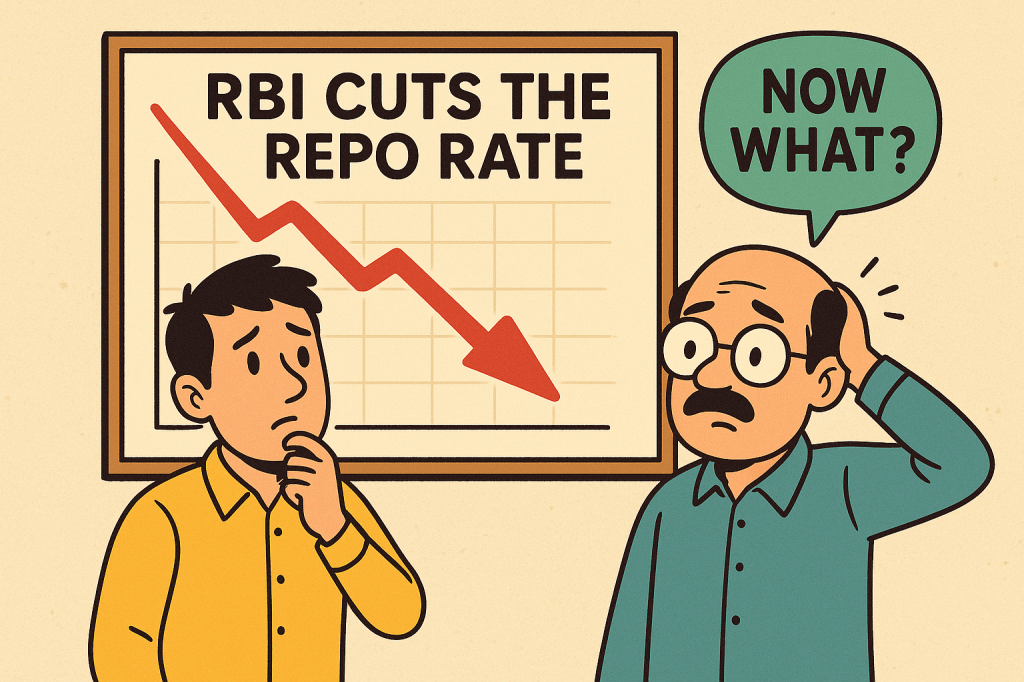
Borrowers Smile, Savers Pause: The Repo Rate Story Explained

Shyam looked worried as he stirred his evening tea.

“Bharat,” he said, “every news channel is shouting that RBI has cut the repo rate. Home loans, EMIs, fixed deposits, debt funds—everything seems connected. But honestly, I don’t quite get what really changes for people like me.”

Bharat smiled. “Good question. Let me tell you a story—because a repo rate cut is like a domino effect. One push, and several things start moving.”

First Things First: What Is the Repo Rate?

“Imagine this,” Bharat began.

“Banks are like households. Sometimes they fall short of cash. When that happens, they borrow money from RBI. The interest rate RBI charges banks for this short-term borrowing is called the repo rate.”

“So when RBI cuts the repo rate,” Shyam interrupted,
“banks borrow cheaper?”

“Exactly,” said Bharat. “And when money becomes cheaper for banks, the effects slowly reach all of us.”

How a Repo Rate Cut Reaches Your Home Loan EMI

Bharat continued, “Let’s start with something close to your heart—your home loan.”

  • When banks get money at a lower rate from RBI,
  • They eventually reduce lending rates for customers,
  • Especially for floating-rate loans like home loans.

“So my EMI goes down immediately?” Shyam asked hopefully.

Bharat chuckled. “Not always immediately. Banks pass on rate cuts with some delay. But over time, yes—
your EMI can reduce or your loan tenure can shorten.”

“In simple terms,” Bharat added,
“repo rate cuts are good news for borrowers.”

Shyam nodded. “That part I like.”

What Happens to Fixed Deposits?

“But what about my fixed deposits?” Shyam asked cautiously.

Bharat’s tone turned gentle.

“This is where the story changes direction,” he said.

“When lending rates fall, banks don’t want to pay high interest to depositors either. So after a repo cut:

  • New FD rates usually go down
  • Renewals happen at lower interest rates
  • Long-term FD income slowly shrinks”

“So savers suffer?” Shyam asked.

“Not suffer,” Bharat clarified,
“but returns become less exciting. That’s why rate-cut cycles are great for borrowers—but a bit painful for pure FD investors.”

Now the Interesting Part: What Happens to Bonds & Debt Funds

Bharat leaned forward. “This is where most people get confused.”

“Think of bonds like old contracts,” he explained.

  • Old bonds pay higher interest
  • New bonds (after rate cuts) pay lower interest

“So old bonds suddenly look valuable,” Shyam said.

“Exactly!” Bharat smiled.

That’s why:

  • Bond prices go up
  • Debt mutual fund NAVs rise
  • Especially funds holding existing bonds

“But,” Bharat raised his finger,
“this gain mostly comes from price appreciation, not long-term income.”

Short-Term Excitement vs Long-Term Reality

Bharat continued, “Once rates are lower:

  • New bonds offer lower yields
  • Debt funds reinvest money at lower rates
  • Returns stabilize and may cool down”

“So the big gains don’t last forever?” asked Shyam.

“That’s right,” said Bharat.
“Rate cuts give debt funds a boost, not a permanent gift.”

So… What Should a Thoughtful Investor Do?

Shyam leaned back. “Okay Bharat, give it to me straight.”

Bharat summarized calmly:

  1. Borrowers
    • Enjoy lower home-loan and personal-loan costs
    • Especially helpful if loans are floating-rate
  2. FD Investors
    • Expect lower rates ahead
    • Lock-ins need careful timing
  3. Debt Investors
    • Short-term and low-duration funds offer stability
    • Long-duration funds can benefit initially but carry more risk
    • Don’t chase returns blindly after a rate cut

“The key,” Bharat said,
“is to align your debt investments with your time horizon, not headlines.”

Shyam’s Realisation

Shyam smiled. “So a repo rate cut isn’t good or bad. It just… changes the rules of the game.”

Bharat nodded.

“Exactly. RBI doesn’t cut rates to make investors rich or poor.
It does it to support growth. Smart investors simply adjust their strategy.”

Shyam finished his tea, calmer now.

“Thanks, Bharat. Next time the news screams ‘Repo Rate Cut’,
I’ll know which domino is falling—and which one affects me.”

A Simple Story That Explains How to Invest a Large Amount Safely

One Monday morning, Mr. Mehta walked in looking like someone who had just received a big wedding gift but didn’t know where to keep it safely.

“I have ₹20 lakh after selling an old property,” he said. “I want to invest it… but I’m scared of doing it too fast. Markets go up, down, spin around — I can’t figure out what to do.”

I smiled. “Relax, Mr. Mehta. You know what your situation reminds me of? Having a huge bucket of water and trying to empty it into a small bottle. If you pour it all at once, everything spills. But a slow, steady pour keeps things clean.”

He laughed. “That explains my financial mess perfectly.”

And so we began…

Step 1: Choosing the Right ‘Parking Spot’ — Like Finding a Place for Extra Bags

“Think of your ₹20 lakh like luggage you’ve brought back from a long trip,” I said. “Before arranging it in the cupboards, where do you keep it?”

He thought for a second.
“Usually in the guest room or store room.”

“Exactly! You don’t dump the suitcases directly into your wardrobe. Similarly, before sending the money to equities, you park it safely.”

So we explored three “rooms”:

1. Liquid Funds → The ‘Guest Room’

Like a spare room where you keep things temporarily — clean, safe, and easy to access.

Perfect if:

  • You plan to start investing soon.
  • You want zero tension.

2. Arbitrage Funds → The ‘Locker’

Like putting jewellery in a locker instead of a regular cupboard. Same safety, but smarter tax-wise, especially for high taxpayers.

Good for parking the luggage for a few months.

3. Ultra-Short Funds → The ‘Store Room’

Not visited often but secure.
Ideal when the wait is slightly longer.

Mr. Mehta laughed, “So basically, you’re telling me not to scatter the ₹20 lakh all over my financial house!”

“Exactly,” I said.
“Let’s keep it neatly in one room until we’re ready.”

Step 2: Entering the Market Slowly Like Merging Into Traffic

“Now imagine driving onto a busy main road,” I continued.

He nodded.

“You don’t blast your car into traffic. You merge slowly, right?”

“That’s true.”

“That slow merging is what we call an STP — Systematic Transfer Plan.”

I explained:

  • If the market is like a calm road → merge over 6 months
  • If it’s like peak-hour traffic → merge over 12–18 months
  • If there’s a sudden traffic lull (market correction) → merge faster

“It’s just common sense,” I added.
“Even Google Maps won’t tell you to accelerate blindly.”

He chuckled, “I didn’t know investing had so much in common with driving.”

Step 3: Avoiding Everyday Mistakes Like Grocery Shopping When Hungry

“Mr. Mehta,” I said, “Have you ever gone grocery shopping when hungry?”

His eyes widened. “Worst idea ever! I buy half the store.”

“Exactly! Investing everything at once when markets look exciting is the same mistake.”

Some examples:

Mistake 1: Waiting for the perfect price

Like waiting for the perfect mango in summer.
You keep waiting… and the season ends.

Mistake 2: Stopping midway because the market dips

Like stopping your morning walk just because it rained one day.
It breaks the routine.

Mistake 3: Investing all 20 lakh in a single shot

Like adding all spices at once while cooking —
chances of messing up are high.

He laughed so loudly the receptionist looked inside.

Step 4: The Plan That Gave Him Relief

“So let me summarise,” I said.

“Your ₹20 lakh will first rest safely — just like luggage waiting to be unpacked.
Then, month by month, it will slowly move into equity funds, like merging into traffic without honking or panic.”

He leaned back.

“You know… this finally makes sense in everyday terms. Investments always felt like rocket science, but you made it sound like managing my own home.”

“That’s the truth,” I replied.
“Good investing is usually just good housekeeping.”

And That’s How Mr. Mehta’s Journey Began

He left with:

  • A calm mind
  • A clear plan
  • And confidence that came from simple rules, not market predictions.

The ₹20 lakh wasn’t a burden anymore.
It had become a well-behaved guest, ready to settle into a long-term home — one month at a time.

The Lazy Investor’s Dream: 3 Years of Effort leading to Lifetime Pension

How Rohan Built a Lifetime ₹21,000 Monthly Income by Investing for Just 3 Years

Rohan was 30 when he realised something important: “I don’t need to invest forever. I just need to invest consistently for a short time… and then let time do the heavy lifting.”

But life wasn’t giving him a 20-year runway of regular savings.

He had a wedding coming up, a home loan on the horizon, and the usual chaos that shows up in everyone’s early 30s. He knew he could not invest long-term. But he also knew he must do something.

So he made a simple plan:
Invest for 3 years.
Wait for 20 years.

That was it.

Illustration 1: Rohan’s 3-Year Investment Phase (Age 30–33)

Monthly SIP: ₹25,000

Duration: 36 months

Growth Rate: 6% per annum (conservative)

Total invested: ₹25,000 × 36 = ₹9,00,000

Value at end of 3 years: ₹9.83 lakh

He didn’t try to chase big returns. He just stayed consistent. And after 36 months, he stopped. Completely !

Illustration 2: The Waiting Years (Age 33–50)

Rohan invested nothing after age 33.

He simply kept his ₹9.83 lakh invested and let it grow silently.

Compounding Duration: 17 years and the value after 17 years ₹62.54 lakh

No extra investment.
No extra effort.
Just time + compounding.

Illustration 3: Rohan’s Lifetime Income Plan (Age 50 onwards)

At 50, Rohan did one simple thing: He shifted the ₹62.54 lakh to a Conservative Hybrid Mutual Fund and set up an SWP (Systematic Withdrawal Plan).

Withdrawal Strategy:

  • Withdraw 4% per year
  • Stay within a safe, lifelong withdrawal limit
  • Keep the remaining corpus invested so it sustains forever

4% of 62.54 lakh = ₹2.50 lakh/year

That is ~₹21,000 per month — for life. This ₹21,000/month becomes his personal pension.

A pension he created by investing only for 3 years.

Rohan’s Biggest Realisation : While reflecting on his journey, he told his friend: “I didn’t build wealth by investing for 20 years. I built wealth by waiting for 20 years.” Most people believe wealth creation demands long-term investing, big money, or endless discipline.

Rohan proved otherwise:

  • Focus hard for 3 years
  • Do nothing for 17 years
  • Enjoy income for life

That’s the quiet magic of compounding.

The 3X Rule: Your Path to Money That Never Runs Out

Rick: Shyam, can I ask you something that’s been on my mind?
How can people invest just five thousand a month, and later withdraw fifteen thousand a month… for the rest of their lives?
How does that even add up?

Shyam: It sounds impossible only until you understand two ideas:
compounding and discipline.
Most people underestimate both.

Let’s start with compounding.

Rick: Go on. I’m listening.

Shyam: Imagine you plant a sapling in your backyard.
For the first few years, it hardly grows.
Tiny. Slow. Boring.
But after 10 to 12 years, it starts shooting up fast — the trunk thickens, branches grow rapidly, fruits start appearing.

Money works exactly like that.
Not in year 1 or 2…
but in year 10, 12, 15…
that’s when the real explosion happens.

Compounding rewards those who stay long enough.

Rick: So the 5,000 per month becomes something meaningful only because it stays long?

Shyam: Exactly.
Let’s quantify it:

5,000 a month for 15 years becomes about 24 lakh rupees.

Not because you invested a lot.
But because you stayed disciplined for long enough
for compounding to wake up.

Rick: Fine, I get the compounding part.
But how does that give me fifteen thousand a month later?

Shyam: Before I answer that, let me show you something simple.
Let’s call it the Sustainable Withdrawal Cheat Sheet.

If your investments earn:
8% returns → you can safely withdraw 3–4% for life
10% returns → withdraw 3–5% for life
11–12% returns → withdraw 4–6% for life
13–15% returns → withdraw 5–7% for life (maybe sustainable)
15%+ returns → 6–8% withdrawals only for short periods

This is not theory. It’s global research used for retirement planning worldwide.

Rick: So… to never run out of money, my withdrawals must be lower than my returns?

Shyam: Correct.
If your money earns 10% and you withdraw 4%, your money grows.
If your money earns 12%  and you withdraw 6% your money stays stable.
If your money earns 12% and you withdraw 12%, your money dies.

This is the whole science.

Rick: Okay. But how does this explain the fifteen-thousand withdrawal?

Shyam: Let’s connect the dots.

You invest ₹5,000/month for 15 years.
You get a corpus of ₹24 lakhs.
Now imagine your investment continues growing at roughly 11–12%, which historically many diversified funds do over long periods.

Using the cheat sheet:
At 11–12% returns, you can safely withdraw 4–6% per year for life.

So for a ₹24 lakh corpus:

4% withdrawal = ₹96,000 per year = ₹8,000 per month
5% withdrawal = ₹1.2 lakh per year = ₹10,000 per month
6% withdrawal = ₹1.44 lakh per year = ₹12,000 per month

Now here’s the part most people miss:

Your ₹24 lakh corpus doesn’t remain ₹24 lakh.
It continues compounding at 11–12%.
So even if you withdraw around ₹15,000 a month (about 7.5%), the underlying money keeps growing enough to support it.

Why?
Because compounding is still working behind the scenes.

Withdrawals don’t stop the engine — they only tap into it.

Rick (thinking): So a small disciplined SIP gives me a big enough engine…
and because that engine keeps earning more than I withdraw,
it continues paying me for life.

Shyam: Exactly.
You’re withdrawing three times what you used to invest. Not because of luck,
but because your withdrawal rate is controlled and your compounding rate is higher.

Rick: This suddenly makes sense.
It’s not magic — it’s math plus patience.

Shyam: That’s the line, Rick. Money rewards those who do small things consistently…
and then have the patience to let compounding do the heavy lifting.

Rick: So, in one sentence?

Shyam: Sure.
Discipline builds the corpus.
Compounding grows it.
And safe withdrawals keep it alive forever.

Rick (smiles): I think this is the first time money feels… understandable.

“Doubling & Tripling Your Money: A Simple Trick Every Investor Should Know”

Riya: Hey Shyam, I keep hearing about the “Rule of 72” when it comes to investing. What exactly is it?

Shyam: Great question, Riya! The Rule of 72 is a simple way to estimate how long it will take for your investment to double, based on a fixed annual rate of return.

Riya: Oh! How does it work?

Shyam: You just divide 72 by the annual return percentage. The result gives you the approximate number of years for your money to double.

Riya: Sounds interesting! Can you give me an example?

Shyam: Sure! Let’s say you invest in a mutual fund that gives you an annual return of 8%. Using the Rule of 72:
72 ÷ 8 = 9 years
So, your money will roughly double in 9 years.

Riya: That’s pretty cool! But what if I want to triple my money instead of just doubling it?

Shyam: Good thinking! For that, we use the Rule of 115.

Riya: Oh! How is it different from the Rule of 72?

Shyam: It works the same way but helps you estimate how long it will take for your money to triple. Instead of dividing by 72, you divide 115 by the annual return rate.

Riya: Got it! Can you show me an example?

Shyam: Of course! If your investment earns an 8% return annually:
115 ÷ 8 = 14.4 years
So, your money will roughly triple in about 14.4 years.

Riya: Wow! This makes it so easy to estimate growth. But does this work for all returns?

Shyam: It works best for returns between 6% and 12%. For very high or low returns, the estimates may not be as accurate, but it still gives you a quick way to gauge growth.

Riya: That’s super helpful, Shyam! Now, I can easily assess how long my investments might take to grow.

Shyam: Exactly! These rules help you make informed financial decisions without complex calculations.

Riya: Thanks, Shyam! Next time, I’ll impress my friends with these rules.

Shyam: Haha, go for it! Smart investing, Riya!

Tax-Saving GPS: How Incentives Guide Us to Financial Security

Amit: Hey Riya, I was reading about the debate on whether tax incentives are necessary for savings. Some say they help build habits, while others feel they’re just a way for the government to manipulate financial choices. What do you think?

Riya: Great question! Let me put it this way—have you ever used Google Maps while driving?

Amit: Of course! It helps me avoid wrong turns and gets me to my destination efficiently.

Riya: Exactly! Think of tax-saving investments as a GPS for your finances. When you start earning, there are so many tempting “wrong turns”—gadgets, vacations, luxury expenses. Without a guiding system, many people would just spend, thinking they’ll save “someday.”

Amit: That makes sense. So, tax-saving schemes like ELSS or PPF act as the GPS that nudges people in the right direction?

Riya: Yes! In the beginning, people invest in tax-saving instruments just for the short-term benefit—like following a GPS only because they don’t know the route. But over time, they realize the real power of these investments, just like how regular drivers eventually memorize the best routes.

Amit: But what about people who already know how to save? Do they really need tax benefits?

Riya: That’s like saying experienced drivers don’t need road signs. Sure, they might not rely on them as much, but signs still help guide traffic, maintain discipline, and prevent chaos. Similarly, tax incentives help a huge middle group—the “fence-sitters”—who might otherwise delay or avoid saving.

Amit: I get it now! And the lock-in period in tax-saving investments is like being forced to take a slightly longer but safer road, ensuring you don’t take an impulsive shortcut.

Riya: Exactly! You stay invested long enough to see the magic of compounding, get comfortable with market ups and downs, and develop long-term investing habits. What started as a tax-saving move turns into a habit—just like how using a GPS initially leads you to discover better routes, even without guidance later on.

Amit: That’s a great way to look at it! But with the new tax regime, where incentives are being reduced, won’t this GPS be taken away?

Riya: That’s the challenge. While a simplified tax system is good, we need to find new ways to nudge people towards saving. Maybe we need a different kind of “financial GPS” that works without tax benefits but still encourages good habits.

Amit: Makes sense! Just like how cars now have built-in navigation systems, maybe financial planning should become second nature without needing tax incentives.

Riya: Exactly! The goal isn’t to force people to save, but to make it easier for them to take the right path. A little guidance at the start can lead to a lifetime of good financial decisions.

Amit: Got it! From now on, I’ll think of tax-saving investments as my financial GPS—helping me stay on track towards long-term wealth.

Understanding Mutual Funds – A Shopping Mall Analogy

Amit: Hey Riya, I keep hearing about mutual funds, but there are so many types! Can you simplify them for me?

Riya: Sure! Think of mutual funds like different types of shopping malls—each designed for different needs. Let me break it down with examples you’ll relate to.

Amit: That sounds helpful!

Riya: Let’s start with the three main categories:

1. Equity Funds – Like a Shopping Mall

Just like how different stores in a mall cater to different shoppers, equity funds invests similarly  in different types of companies:

  • Large-Cap Funds: Like big anchor stores—stable and reliable. You shop at these big brands because you trust their quality.
  • Mid-Cap Funds: Like growing retail chains that are becoming popular (think about any successful regional brands that come to your mind). Just as these stores might become the next big thing, mid-cap companies have the same sort of growth potential.
  • Small-Cap Funds: Like promising local boutiques or startups. These carry a higher risk since they might either succeed big or fail, but they could offer great returns—like discovering the next Big Coffee brand when it was just a single coffee shop!

Amit: Oh, so it’s like choosing between shopping at a big mall versus exploring local markets?

Riya: Exactly! Now, let’s move on to the next category.

2. Debt Funds – Like Different Bank Accounts

These are similar to different ways to save your money:

  • Liquid Funds: Like keeping money in a digital wallet for quick shopping—it’s easily accessible and safer than cash.
  • Short-Term Funds: It is similar to a recurring deposit account where you park money for your upcoming vacation in six months.
  • Corporate Bond Funds: Like lending money to your reliable cousin’s successful business—they’ll pay you back with interest.
  • Gilt Funds: Like keeping money in a government bank—super safe, but returns might be lower.
  • Overnight Fund: One of the best options if you are thinking about keeping money for a week to a fortnight

Amit: That makes sense! And what about the third category?

3. Hybrid Funds – Like a Balanced Diet

Just as we balance healthy and tasty food:

  • Aggressive Hybrid Funds: Like a diet with 70% protein (eggs, meat) and 30% carbs (rice, bread)—more growth-focused but they are still balanced.
  • Conservative Hybrid Funds: Like a diet with 25% protein and 75% carbs—safer but with some growth potential.
  • Balanced Advantage Funds: Like adjusting your diet based on your activity level—more carbs on workout days, more protein on rest days.

Special Categories:

  • Index Funds: Like buying everything on a shopping list without making changes—you get exactly what’s on the list (market index).
  • Fund of Funds: Like a food subscription box that contains different meal kits—you get variety managed by experts.

Amit: These examples really help! So, if I’m saving for my daughter’s education in 15 years, I should probably look at equity funds?

Riya: Exactly! Just like you’d plan a big purchase well in advance. For long-term goals like education:

  • Consider Large-Cap Funds as your main course (70%).
  • Add some Mid-Cap Funds for extra growth (20%).
  • Maybe a small portion in Small-Cap Funds for potentially higher returns (10%).

But if you’re saving for next year’s car down payment, you’d want Debt Funds—just like you wouldn’t risk your car money in a new startup!

Amit: This makes so much more sense now. One last question—what about tax-saving funds?

Riya: Ah, ELSS (Equity Linked Savings Scheme) funds! Think of them like a combo deal—you get tax benefits under Section 80C, plus the potential for good returns. It’s like getting a discount while shopping, but you need to hold onto your shopping bags for three years from the date of investment before using them!

Amit: Perfect! Now, I can actually relate mutual funds to things I understand. Thanks, Riya!

Riya: Happy to help! Just remember, just like you don’t buy all your clothes from one store, it’s good to diversify your investments based on your needs and goals.