
A simple truth before we begin
Whenever markets become scary, people stop thinking and start copying.
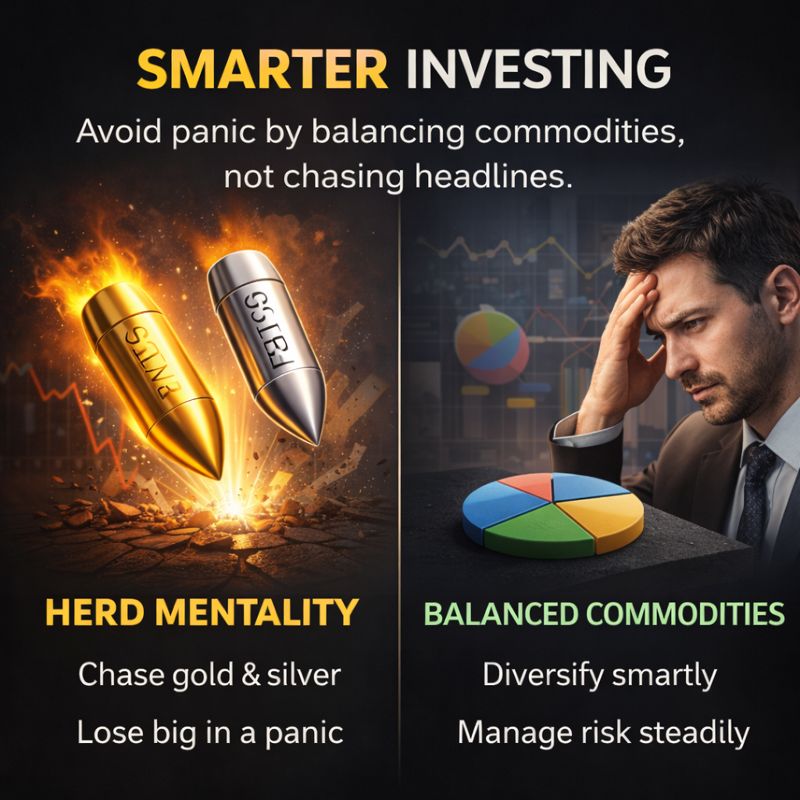
That is when gold shines on headlines and silver burns portfolios.
Let us break this down calmly without fear, hype, or WhatsApp forwards.
Part 1: Why Silver ETFs Can Shock You When Markets Fall?
Silver looks harmless.
People even call it poor man’s gold.
But here is the reality – silver is far more dangerous than it looks.
Why silver behaves badly in crashes?
Think of silver as a man with two jobs:
1. Industrial metal (used in electronics, solar panels, factories)
2. Safe-haven metal (like gold, during fear)
When the economy slows or crashes:
• Factories stop ordering silver
• Industrial demand vanishes
• Prices fall fast and hard
Gold does not have this problem. Silver does.
What went wrong in silver ETFs recently (in simple terms)?
When silver prices crashed sharply:
• ETF prices fell even faster
• Many investors could not exit
• Some ETFs did not reflect real prices for hours
Why?
Because during panic:
• Exchanges apply circuit limits
• Trading freezes at exactly the time you want to sell
• Leveraged silver ETFs magnify losses (losses don t double they explode)
Lesson for you: Silver ETFs are not safe assets.
They are high-volatility instruments wearing a precious metal label.
Part 2: Why People Rush into Gold at the Worst Possible Time?
Gold crossing ₹15,000+ per gram (or $160 globally) did not happen quietly.
It happened with noise, fear, and headlines.
So why does everyone suddenly want gold when it is already expensive?
The psychology behind gold buying
It usually follows this pattern:
1. Something scary happens (war, inflation, currency fear)
2. Gold starts rising
3. Media headlines shout: Gold is the only safe asset
4. Friends, relatives, and social media jump in
5. Retail investors enter last
This is not investing.
This is emotional migration.
The uncomfortable truth
Gold protects wealth when bought patiently, not when chased.
Historically:
• Gold performs well over long periods
• But sharp rallies are often followed by long dull or painful phases
• Buying at peak fear = low future returns
Lesson: Gold is insurance not a lottery ticket. You buy insurance before the fire, not when the house is already burning.
Part 3: The Smarter, Boring, and More Effective Approach
Here is where most investors go wrong: “Gold is doing well, let me increase exposure.”
Here is what actually works: Use commodities only for diversification, not excitement.
The magic number: 5 to 8%
For most retail investors:
• 5 to 8% in commodities is enough
• Anything more increases stress, not returns
Think of commodities like salt in food:
• Too little → tasteless
• Too much → ruined dish
How a retail investor should approach commodities?
✔ Use broad-based commodity funds, not single-metal bets
✔ Avoid leveraged or thematic commodity products
✔ Stay invested long-term (7 10 years’ mindset)
✔ Rebalance once a year don not react daily.
If silver crashes but oil or agriculture holds up, your portfolio survives. That’s diversification quiet, boring, effective.
Part 4: Herd Mentality V/s Pragmatic Investing
Herd mentality in investing usually starts with headlines. When gold is all over the news, investors rush in, assuming safety lies in what everyone else is buying.
A pragmatic investor behaves very differently. Instead of chasing headlines, they buy gradually over time, knowing that timing the market is far less important than consistency.
Herd-driven investors chase silver rallies hoping for quick gains. Pragmatic investors, on the other hand, limit their exposure and understand that high volatility can damage portfolios faster than it builds wealth.
The crowd looks for “safe bets.”
But experienced investors focus on building balanced portfolios that can handle both good and bad market phases.
Fear drives herd behavior.
Pragmatic investing is about planning for cycles—because markets will rise, fall, and rise again.
Remember: Markets reward discipline, not drama.
To Summarize: Build Stability, Not Stories Silver ETFs crashing and gold hitting record highs are not signals to act fast. They are signals to slow down and think clearly.
A strong portfolio does not depend on guessing:
• Which metal will shine?
• Which crisis will come next?
It depends on:
• Asset allocation
• Risk control
• Emotional discipline
Keep commodities small.
Keep expectations realistic.
And let your portfolio do the heavy lifting not headlines.
? Have you felt tempted to increase gold exposure recently?
Or has silver s volatility made you rethink commodity investing?
Drop your thoughts in the comments let s learn from each other.
Disclaimer: This is educational content, not investment advice. Please consult a financial advisor for personal decisions.

 Simplified Money Talks