
Rick: Shyam, can I ask you something that’s been on my mind?
How can people invest just five thousand a month, and later withdraw fifteen thousand a month… for the rest of their lives?
How does that even add up?
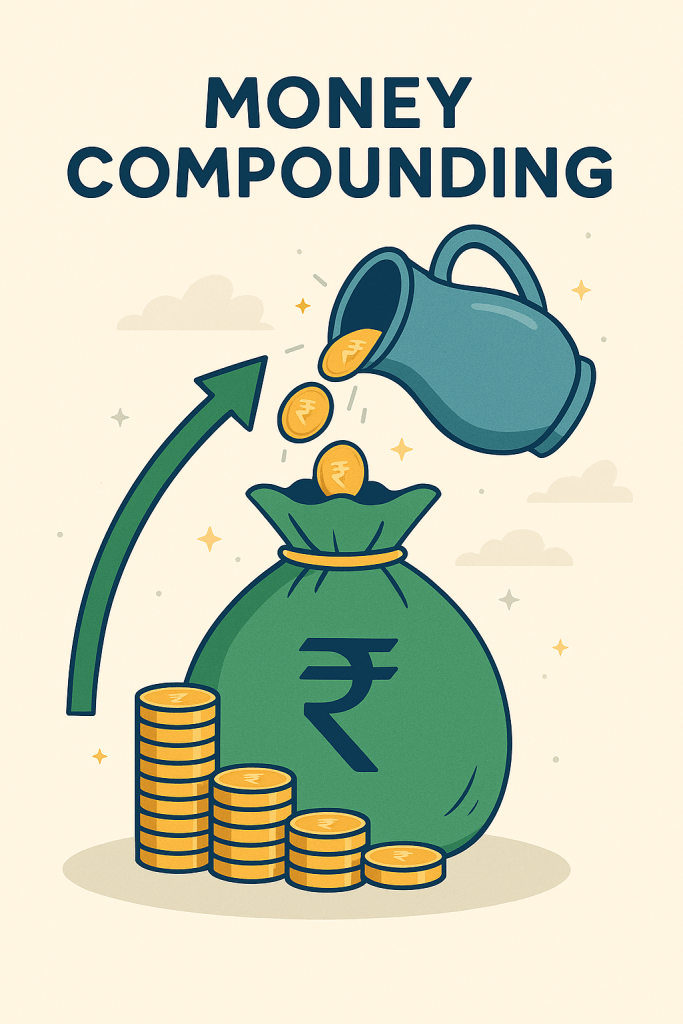
Shyam: It sounds impossible only until you understand two ideas:
compounding and discipline.
Most people underestimate both.
Let’s start with compounding.
Rick: Go on. I’m listening.
Shyam: Imagine you plant a sapling in your backyard.
For the first few years, it hardly grows.
Tiny. Slow. Boring.
But after 10 to 12 years, it starts shooting up fast — the trunk thickens, branches grow rapidly, fruits start appearing.
Money works exactly like that.
Not in year 1 or 2…
but in year 10, 12, 15…
that’s when the real explosion happens.
Compounding rewards those who stay long enough.
Rick: So the 5,000 per month becomes something meaningful only because it stays long?
Shyam: Exactly.
Let’s quantify it:
5,000 a month for 15 years becomes about 24 lakh rupees.
Not because you invested a lot.
But because you stayed disciplined for long enough
for compounding to wake up.
Rick: Fine, I get the compounding part.
But how does that give me fifteen thousand a month later?
Shyam: Before I answer that, let me show you something simple.
Let’s call it the Sustainable Withdrawal Cheat Sheet.
If your investments earn:
– 8% returns → you can safely withdraw 3–4% for life
– 10% returns → withdraw 3–5% for life
– 11–12% returns → withdraw 4–6% for life
– 13–15% returns → withdraw 5–7% for life (maybe sustainable)
– 15%+ returns → 6–8% withdrawals only for short periods
This is not theory. It’s global research used for retirement planning worldwide.
Rick: So… to never run out of money, my withdrawals must be lower than my returns?
Shyam: Correct.
If your money earns 10% and you withdraw 4%, your money grows.
If your money earns 12% and you withdraw 6% your money stays stable.
If your money earns 12% and you withdraw 12%, your money dies.
This is the whole science.
Rick: Okay. But how does this explain the fifteen-thousand withdrawal?
Shyam: Let’s connect the dots.
You invest ₹5,000/month for 15 years.
You get a corpus of ₹24 lakhs.
Now imagine your investment continues growing at roughly 11–12%, which historically many diversified funds do over long periods.
Using the cheat sheet:
At 11–12% returns, you can safely withdraw 4–6% per year for life.
So for a ₹24 lakh corpus:
4% withdrawal = ₹96,000 per year = ₹8,000 per month
5% withdrawal = ₹1.2 lakh per year = ₹10,000 per month
6% withdrawal = ₹1.44 lakh per year = ₹12,000 per month
Now here’s the part most people miss:
Your ₹24 lakh corpus doesn’t remain ₹24 lakh.
It continues compounding at 11–12%.
So even if you withdraw around ₹15,000 a month (about 7.5%), the underlying money keeps growing enough to support it.
Why?
Because compounding is still working behind the scenes.
Withdrawals don’t stop the engine — they only tap into it.
Rick (thinking): So a small disciplined SIP gives me a big enough engine…
and because that engine keeps earning more than I withdraw,
it continues paying me for life.
Shyam: Exactly.
You’re withdrawing three times what you used to invest. Not because of luck,
but because your withdrawal rate is controlled and your compounding rate is higher.
Rick: This suddenly makes sense.
It’s not magic — it’s math plus patience.
Shyam: That’s the line, Rick. Money rewards those who do small things consistently…
and then have the patience to let compounding do the heavy lifting.
Rick: So, in one sentence?
Shyam: Sure.
Discipline builds the corpus.
Compounding grows it.
And safe withdrawals keep it alive forever.
Rick (smiles): I think this is the first time money feels… understandable.
 Simplified Money Talks