An NPS Scheme Change Every Investor Should Understand: The Scheme A Merger Explained

Raj, a 38-year-old private sector employee, had a simple ritual.

Once a year, usually around tax-saving season, he would log in to his NPS account, download his statement, glance at the numbers, feel reassured—and log out.
But this year was different.

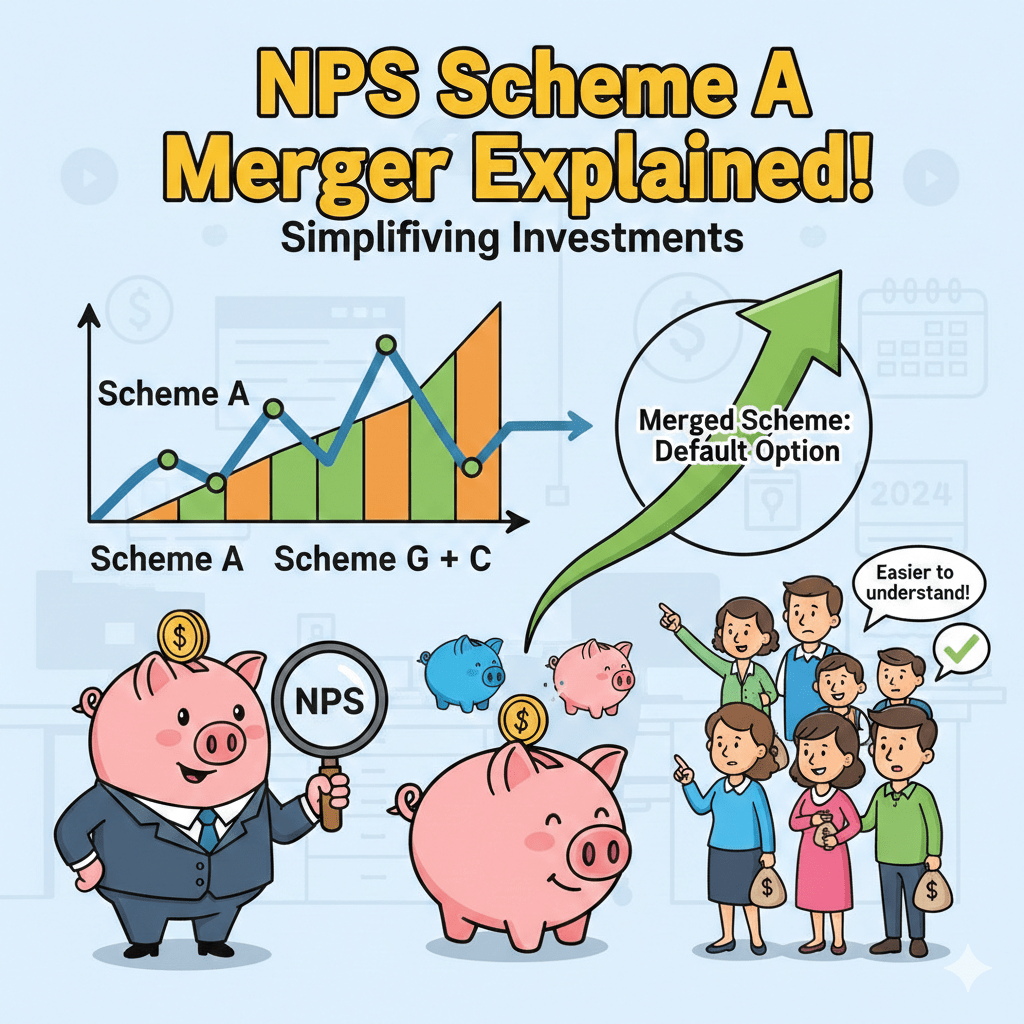
An email from NPS caught his eye: “Scheme A will be merged with Schemes C and E…”

Raj frowned.

“Merge? Scheme A? Did I invest in something risky without knowing?”
“Will my retirement money be affected?”
“And is this change only for private sector employees like me?”

By evening, Raj did what most sensible investors do when confused.

He called Sunil, his long-time financial planner.

“Sunil, my NPS statement is changing. Should I be worried?”

Sunil smiled.
“Relax, Raj. Nothing has gone wrong. In fact, this is a clean-up exercise, not a problem.”

Seeing Raj still anxious, Sunil pulled out a notebook.

“Let me explain this the easy way.”

What exactly was Scheme A?

“Raj,” Sunil began,
“Scheme A was an optional asset class under NPS Active Choice. It invested in things like infrastructure funds, REITs, and InvITs—what we call alternative investments.”

Raj nodded slowly.

“But,” Sunil continued, “very few people chose it.

The corpus stayed small, liquidity was limited, and some investments had long lock-ins. Not ideal for a pension product.”

So why is Scheme A being merged now?

Sunil explained:

“PFRDA looked at three things:
1. Scheme A was too small to manage efficiently
2. It had liquidity constraints
3. Regulators want simpler, cleaner investment structures

So they decided: Let’s merge Scheme A into Scheme C (Corporate Bonds) and Scheme E (Equities)—larger, well-diversified, liquid schemes.”

Raj leaned back.

“So this isn’t because markets crashed or returns were bad?”

“Exactly,” Sunil said.
“This is preventive maintenance, not damage control.”

“But is this only for private sector employees like me?”

Raj’s next question came quickly.

Sunil shook his head.

“No. This applies to everyone who had opted for Scheme A:

  • Private sector employees
  • Government employees
  • Corporate NPS subscribers
  • All Citizens NPS

You’re hearing about it because Active Choice subscribers were the ones using Scheme A.”

Do I need to do anything now?

Sunil laid out the options clearly.

“You have two choices, Raj:

Option 1: Do nothing

  • Scheme A money will be automatically merged
  • No tax impact
  • No charges
  • No paperwork

Option 2: Use the free switch window

  • Till 25 December 2025, you can reallocate that money
  • You can choose how much goes into:
    • Scheme E (Equity)
    • Scheme C (Corporate Bonds)
    • Scheme G (Government Securities)
  • No switching cost for this move”

Raj smiled.
“At least they’re giving time.

“Now the important part—how should I invest post merger?”

Sunil leaned forward.

“Raj, you’re 38. Private sector. Long runway till retirement.
This change is actually a good opportunity to reset your NPS correctly.”

He wrote three letters on paper: E – C – G

Sunil’s suggested post-merger allocation for Raj

For someone below 40:

SchemeAllocation
Scheme E (Equity)70–75%
Scheme C (Corporate Bonds)20–25%
Scheme G (G-Secs)5–10%

“This,” Sunil said, “does three things:

  • Equity captures India’s long-term growth
  • Bonds reduce volatility
  • G-Secs provide stability without dragging returns too much”

Then he added:

“If you want something simple and low-maintenance, just remember this.”

E 60% – C 30% – G 10%

“It works beautifully for most people between 35 and 45.”

Raj’s final takeaway

Raj closed his notebook, visibly relaxed.

“So my retirement is safe.
The scheme is simpler.
And I actually get a chance to improve my allocation.”

Sunil nodded.

“That’s the right way to see it.
NPS is a long-distance train, Raj. Track maintenance doesn’t stop the journey—it makes it smoother.”

Raj smiled.

For the first time, that NPS email didn’t feel like bad news.

It felt like a course correction done in time.

✍️ Note

If you’ve received a similar NPS message and are unsure what to do, remember:

  • This change applies to all Scheme A investors
  • You have time till Dec 2025 to act
  • A simple, age-appropriate E–C–G allocation is all you need

Market-Timing v/s Value Investing: A Smarter Approach to Market Investing

Rohan:“Hey, Sudhir! I’ve been reading your blog for a while now, and there’s something that’s been on my mind. You always say not to time the market, right? But then I see you talking about avoiding the overvalued market conditions and even the stocks that I want to buy! Isn’t that also a form of timing the market?”

Sudhir:“Good question, Rohan! It sounds like there’s a contradiction, doesn’t it? But there’s a big difference between the two approaches. Let’s break it down a bit.”

Rohan:“Sure, go ahead.”

Sudhir:“When I talk about not timing the market, I mean we shouldn’t try to predict short-term market movements/corrections – you know, the ups and downs from one day to the next day (Some time back only the Gulf War broke out!). Somehow we get into this false belief that we know whether prices will go up or down tomorrow, the next week, or even the next month. But in reality, all that one is doing is mere speculation. You know.”

Rohan:“So, you’re saying it’s impossible to guess where the market is headed in the short term?”

Sudhir:“Exactly! I have seen people trying to play ‘catch game’ the market’s highs and lows, only to miss out on long-term gains or take unnecessary losses. It’s tempting, but more often than not, people lose money or lose valuable time waiting for the perfect price entry or exit point.”

Rohan:“But isn’t it the same when you say we should wait for stocks to be ‘fairly valued’? Doesn’t that involve timing too?”

Sudhir:“Good Point though. I know where you’re coming from, but let’s look at it from a perspective. When I say you should be mindful of valuations it doesn’t mean I’m trying to guess when a stock will hit a peak or bottom. Instead, I’m assessing whether the current price makes sense based on the company’s fundamentals –its balance sheet, its growth story, and its industry position. I’m not saying ‘this stock will drop next month,’ but rather ‘this price doesn’t reflect what this company is worth today.’ It’s less about timing and more about fair pricing.”

Rohan:“Hmmm, so it’s more like being a smart shopper, not a fortune-teller.”

Sudhir:“Exactly! Think of it like this: when you’re timing the market, emotions – fear of missing out or panic when prices drop – often drive your decisions. That’s more like you are reacting to a specific event. But when you’re focusing on valuations, you’re taking a calm, business-owner mindset. You’re asking, ‘What is this? Is this stock genuinely worth it?’ It’s like shopping for value rather than gambling on sheer luck.”

Rohan:“I get it now. Instead of stressing over when to jump in, you’re simply checking if a company’s price aligns with its value.”

Sudhir:“Yes! This approach will keep you grounded at all times. To put it further, consider the current market from the Highs of BSE Sensex trading at 85,978 in Sept’24 to 80,000 in Oct’24 as an example. Some investors are frantically watching every 5% decline, wondering if this is ‘the big one’ they’ve been waiting for. They’re glued to charts and social media, following every prediction. That’s classic market timing. But on the other hand, a valuation-conscious investor is looking at individual companies, assessing if some great businesses are now selling at fair or even discounted prices.”

Rohan:“So, while the usual investor is more fixated on the market’s next move, the valuation-conscious investor is trying to find out the specific opportunities?”

Sudhir:“Exactly, Rohan! While the market timer might be paralyzed, waiting for the perfect moment, the valuation-focused investor is spotting strong companies at good prices – regardless of what the Sensex might do next week. It’s about taking a measured, analytical approach, and ultimately, that helps you make sound, long-term investment decisions. This is the long term principle that I have been following through”

Rohan:“Thanks, Sudhir! This makes so much more sense now. I’m beginning to see how I can keep my emotions in check and focus more on value than on timing. Really appreciate the perspective!”

Sudhir:“Anytime, Rohan! Keep those questions coming – it’s these kinds of conversations that make us all better investors.”