The 12% Debt Puzzle – Decoded

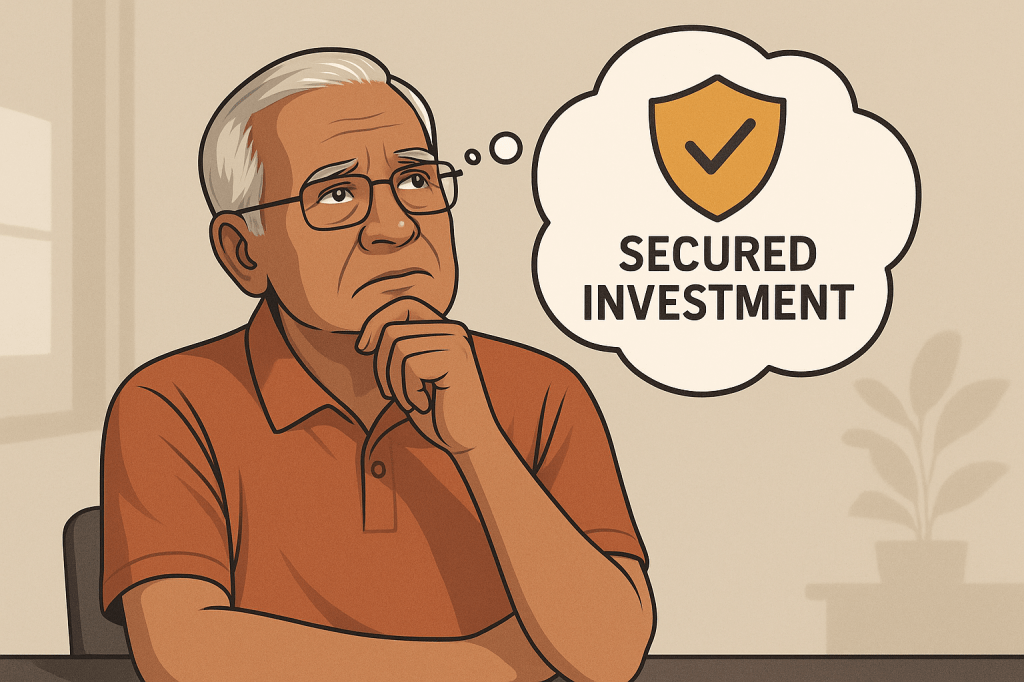
Riya: Shyam, have you heard about this platform called ABC Wealth? My social feed, the YouTube ads are all full of people claiming you can earn 11–12% returns through “safe” debt investments! That sounds way better than my FD. Is it for real?

Shyam: (smiling) Yes, Riya. It’s real — but not risk-free. ABC Wealth doesn’t lend your money directly. It helps investors like you invest in secured debt instruments issued by NBFCs — think of it as you indirectly lending to those NBFCs, who in turn lend to others.

Riya: So I’m not lending to ABC Wealth, but through them?

Shyam: Exactly. ABC Wealth is a debt marketplace, not a borrower. It connects investors to NBFCs offering secured, asset-backed bonds — like those backed by gold loans, vehicle loans, or SME loans.

How Do They Offer 9–12%?

Shyam: Let’s take a real example from their website.

One bond listed is by XYZ Fincorp Ltd, rated AAA by CRISIL, with a coupon rate of ~10.25% and maturity in March 2027.

Another listing is Proxyz Jun’25, offering a Yield to Maturity (YTM) of around 11.75%, maturing in January 2027.

These are secured bonds — meaning they’re backed by underlying collateral like gold or vehicles. But remember, secured doesn’t mean risk-free.

Let’s Do the Math

Riya: Okay, let’s say I invest ₹10,000 in one of these. How much will I actually earn?

Shyam: Sure — here’s a quick breakdown:

Example Coupon/Yield Tenure Annual Interest Total Interest Maturity Amount

XYZ Fincorp Ltd 10.25% 2 years in year one you will get ₹1,025 and in year 2 – ₹2,050 which totals to  ₹12,050
Proxyz Jun’25 11.75% 2 years, you will get ₹1,175 in year 1 and then in year 2 – ₹1,175 which totals to ₹12,350

So, on a ₹10,000 investment, you could expect between ₹2,000–₹2,350 in interest over two years, depending on the bond.

The Big BUT — These Are Not Guaranteed Returns

Riya: So, that’s guaranteed, right? I just need to hold till maturity?

Shyam: (shaking his head) Not quite. These are target returns, not guaranteed ones.
Remember, you’re lending to an NBFC — not depositing in a bank.

Here’s what could go wrong:

1. Credit Risk: If the issuer delays or defaults, interest or principal may be affected.

2. Collateral Risk: Even though it’s secured, selling collateral takes time and may not recover full value.

3. Liquidity Risk: You can’t exit early — these bonds are listed, but hardly traded.

4. Servicer Risk: The NBFC manages repayments from borrowers; if it collapses, collections can stall.

So yes — 11–12% is possible, but it comes with credit risk and default risk.

Understanding “Secured” Bonds

Shyam: Think of these as asset-backed loans.

In a gold loan pool, the gold jewelry is the collateral.

In a car loan pool, the vehicles are.

In a loan-against-property pool, real estate backs it.

Even if an NBFC defaults, the trustee can liquidate that collateral.
But recovery isn’t immediate — and sometimes, not full.

Riya: So it’s relatively safer, but not guaranteed safe.

Shyam: Exactly. That’s why ABC Wealth products are best suited for diversified investors — people who already have FDs, mutual funds, and equities — and are okay locking in 5% of their debt portfolio for higher yield.

Riya: Okay, so if I invest ₹10,000 today in that Proxyz bond, I might get around ₹12,350 after two years, provided everything goes right.

Shyam: Exactly. That’s your target return.
But if the issuer defaults, delays interest, or if collateral takes time to liquidate — your real return could drop or be delayed.

Riya: Got it. I’ll keep this as a small slice of my portfolio — not my main investment.

Shyam: Perfect, Riya. Use it to enhance returns, not replace your core debt holdings.

Takeaways for Smart Investors

What Works & What to Watch Out For

High fixed returns (10–12%) is Not guaranteed – it depends on issuer performance
Asset-backed (secured) Collateral recovery can take time
Regulated issuers (NBFCs, SEBI-listed) Still subject to credit & liquidity risk
Transparent structures Complex legal frameworks, not for beginners
Good for diversification Avoid overexposure; limit to 5% of debt portfolio

“Returns are the reward for risk — it’s never magic. Win

ABC Wealth products can offer great yields, but only if you understand what you’re signing up for.”

Make a Note :- This story is for educational purposes only. Examples like XYZ Fincorp Ltd and Proxyz Jun’25 are bonds currently listed on ABC Wealth (as of October 2025 names changed slightly).
However, returns are not guaranteed, and investors must assess credit, liquidity, and structural risks before investing.

“Think Again: Your Selfie Can Cost You Money”

Riya: Raj, you won’t believe how cool these new AI photo apps are! I uploaded one of my selfies, and it made me look like a movie star. Everyone’s posting them online — I thought I’d join the trend too.

Raj: (smiling) They do look impressive, Riya. But have you ever thought about what happens to those photos once you upload them?

Riya: Not really. I assumed it’s all safe — just a bit of fun, right?

Raj: That’s what most people think. But these AI image generators don’t just make pictures — they collect biometric data. Your face, expressions, and features are unique identifiers — once they’re uploaded, you’re giving that data to a hungry algorithm.

Riya: So, you mean they can actually use my face for something else?

Raj: Exactly. Once your photo is out there, it can be scraped, cloned, or even repurposed to create hyperrealistic fakes — or deepfakes — that look just like you. And that’s where the risk begins.

Riya: (concerned) Oh no, I didn’t realize that! But how does that connect to money or financial fraud?

Raj: Well, scammers can use synthetic identities built from real photos like yours. Imagine someone creating a fake PAN card, Aadhaar, or ID with your photo — they could use it to apply for loans, credit cards, or even commit online frauds.

Riya: That’s terrifying! Can that really happen?

Raj: Unfortunately, yes. AI-generated images are so realistic now that they can sometimes fool basic KYC verification systems. It’s not science fiction anymore.

Riya: So, what can we do to protect ourselves?

Raj: Quite a few things, actually. Here’s what I tell everyone —

1. Be selective about what you upload. Avoid giving clear front-facing selfies to unknown apps or websites.

2. Use avatars or illustrations instead of real photos for public profiles.

3. Check your privacy settings on social media — restrict downloads, tagging, and face recognition features.

4. Don’t reuse the same photo across multiple platforms.

5. Turn on multi-factor authentication for all financial and email accounts.

6. Use strong, unique passwords — and a password manager if needed.

7. Monitor your bank and card statements regularly for suspicious activity.

8. Check your CIBIL report every 6 months to a year. It’s free once a year, and it helps you spot any unfamiliar loans, credit cards, or inquiries — early signs of identity misuse.

Riya: Wow, I’ve never checked my CIBIL report. I’ll do that. I guess it’s like a health check-up, but for your financial life.

Raj: (nodding) Exactly. Think of it as your financial fingerprint — if someone misuses your identity, it’ll show up there before the damage gets bigger.

Riya: You’ve really opened my eyes today. I thought deepfakes were just entertainment, but it’s actually a real risk to my financial identity.

Raj: That’s right, Riya. This isn’t just about filters and fun — it’s about information. Every upload is a small donation to a data ecosystem that can be misused if it falls into the wrong hands.

Riya: So, the bottom line?

Raj: Treat your face like your bank PIN. You wouldn’t share that publicly, right? Similarly, protect your digital identity — because once your face is out there, you can’t change it.

Riya: That’s such a powerful thought. No more random uploads for me! From now on, I’ll think twice before trusting any app with my face.

Raj: (smiling) That’s the spirit. Technology is amazing, but awareness is your strongest safeguard. Be curious, but cautious — your money and identity will thank you for it.

NPS Tier 1 & Tier 2 Explained

Ever wondered what’s the real difference between NPS Tier I and Tier II — and how the smart ones use both to save tax and stay flexible? Let’s eavesdrop on a friendly chat between Rishabh and Alex.”

Rishabh: Hey Alex, everyone’s been talking about NPS. I know it’s for retirement, but I’m confused between Tier I and Tier II accounts. What’s the deal?

Alex: Think of it like this — Tier I is your main retirement vault, while Tier II is your everyday investment wallet.

Rishabh: Vault and wallet? I like the sound of that. Go on.

Alex: Sure. Tier I is your long-term lockbox. Once you put money in, it’s meant for your retirement — not impulse withdrawals.
It’s like buying a long-term gym membership for your money — you can’t just walk out early, but you’ll thank yourself later for the discipline.

Rishabh: Makes sense. So I can’t touch it till retirement?

Alex: Mostly, yes. At retirement, you can withdraw up to 60% tax-free, and the remaining 40% buys an annuity that gives you monthly income.
But it’s not all locked — you can make partial withdrawals (up to 25%) for specific needs like kids’ education, buying your first home, or medical emergencies.

Tier II – The Freedom Account

Rishabh: And Tier II?

Alex: That’s your flexible sidekick. You can invest and withdraw anytime — no lock-in, no exit load.
It’s like keeping a piggy bank with a smart lid — you can dip in and out, but your money still earns decent returns.

Rishabh: Sounds like a mutual fund.

Alex: Exactly! Tier II works a lot like a mutual fund but at ultra-low cost — fund management charges are as low as 0.01% to 0.09%.


And here’s something cool: you get four free switches every year to change your fund allocation or even your fund manager.

Rishabh: Four free switches? That’s better than most mutual funds!

Alex: Absolutely. You can move between equity, corporate bonds, and government securities based on market conditions.
When markets rise, you can shift some money from equity to debt to lock in gains.
When markets correct, move back into equity to buy low.

Smart Transfers Between Tier II and Tier I

Rishabh: But if Tier II has no tax benefit, why should I invest there?

Alex: Here’s where strategy comes in. You can transfer money from Tier II to Tier I whenever you want to claim tax benefits — it’s a hidden gem most people overlook.

Rishabh: Really? Give me an example.

Alex: Sure! Imagine you invest ₹10,000 a month in Tier II for flexibility — like your “bonus” savings jar.
Come March, you realize you haven’t used your extra ₹50,000 NPS deduction (under 80CCD(1B)).
You can simply transfer ₹50,000 from Tier II to Tier I — and bam! it becomes a tax-saving contribution.

Rishabh: That’s actually clever — like moving money from your savings account to a tax-saving FD, but smarter.

Alex: Exactly! It’s flexibility today and tax advantage tomorrow.

A Smart Move Before Retirement

Rishabh: So can I use this Tier II to Tier I transfer trick even later in life?

Alex: Oh, absolutely — and that’s where the real magic happens.
Let’s say when you’re 55, your Tier II account has ₹5 lakh.
You know Tier II withdrawals are taxable, right?

Rishabh: Right. So if I withdraw directly, I’ll pay tax on the gains.

Alex: Exactly. But here’s a smarter play — instead of withdrawing, you can gradually transfer your Tier II balance into Tier I over the next few years before you retire.
By doing this, that ₹5 lakh becomes part of your Tier I retirement corpus, and when you finally retire, 60% of it will be tax-free!

Rishabh: So, by just shifting it ahead of time, I save tax later?

Alex: You got it! It’s like slowly moving money from your “taxable bucket” into your “tax-free future bucket.”
It’s a great way to optimize tax without disturbing your asset allocation.

Managing Your NPS

Rishabh: How do I keep track of all this? Sounds like a lot to manage.

Alex: Not at all. Everything’s digital now — through NSDL or KFintech CRA portals.
You can check your balance, returns, switch funds, and even change fund managers in just a few clicks.

Rishabh: That’s handy. And since it’s so low cost, more of my money stays invested, right?

Alex: Exactly. NPS is one of the cheapest and most efficient retirement tools out there. Those small savings in charges compound beautifully over time.

Investing Beyond Tax Limits

Rishabh:You mentioned I can invest more than the tax limit. How much is too much?

Alex: There’s actually no upper limit on how much you can invest.

Tax deductions are capped at ₹2 lakh (₹1.5L under 80C + ₹50K under 80CCD(1B)),
but you can put in more purely for long-term wealth creation.

Rishabh: So if I get a big bonus, I could dump it into NPS for retirement?

Alex: Absolutely! It’s a great way to make your bonus work for you — not disappear in lifestyle inflation.

The Complete Retirement Plan

Rishabh: Alex, this really sounds like a complete retirement package — growth, flexibility, tax savings, and a pension!

Alex: Exactly. NPS isn’t just another investment — it’s a one-stop retirement solution that brings together:

Equity growth for wealth creation,

Debt stability for safety,

Tax benefits for today, and

A pension for tomorrow.

Alex: Good call, my friend. Future-you will thank you for this one!

“Now Complete Your eKYC Online: AMFI Makes It Easier for Mutual Fund Investors”

Reena: Hey Rohit, I was just checking my mutual fund website and noticed a big banner about “eKYC now available.” What’s this all about? Do I need to do something new again?

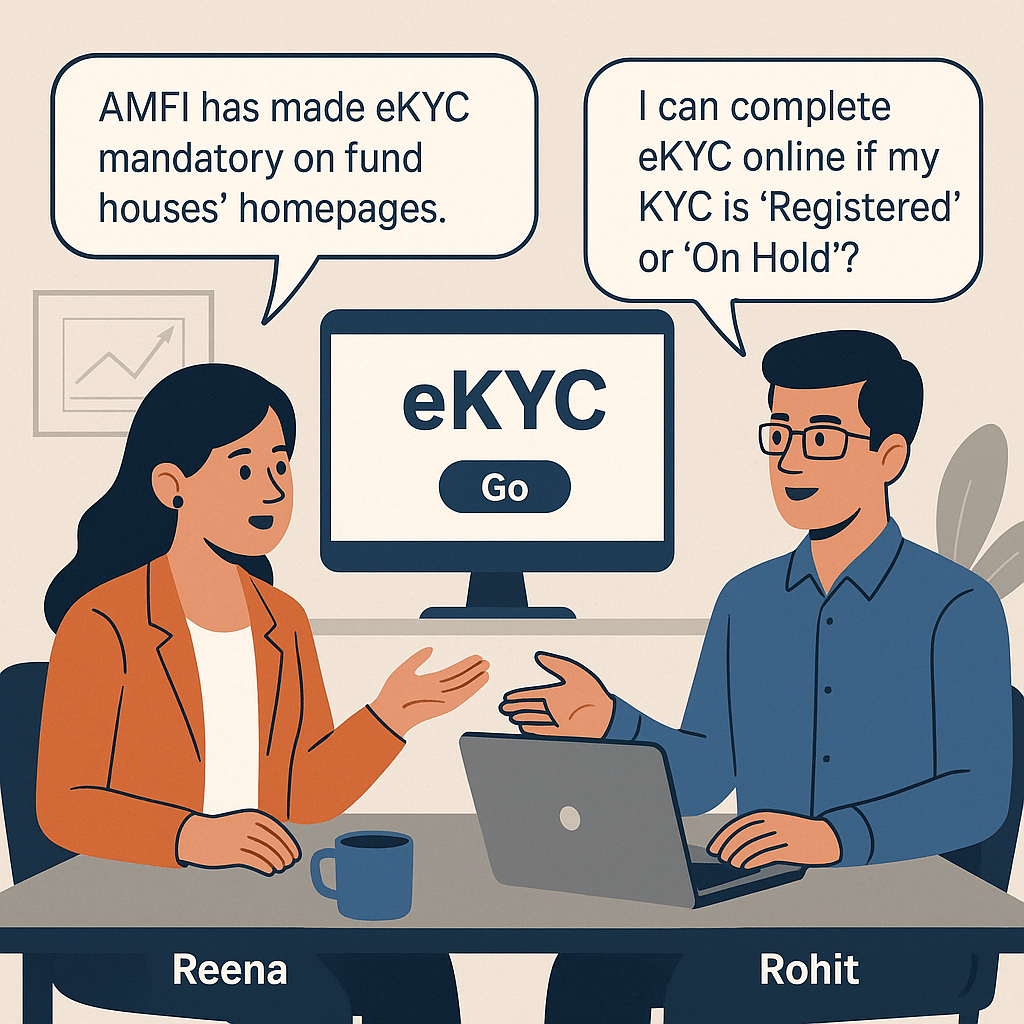
Rohit: Good question, Reena! This is part of a new initiative by AMFI. They’ve asked all fund houses to make their digital KYC or eKYC facility live right on their homepages.

The idea is to make it super easy for investors to complete or update their KYC online — especially those whose KYC is in “Registered” or “On Hold” status.

Reena: Hmm, I’ve seen those terms before — KYC Registered and KYC On Hold — but I never really understood what they mean. Can you explain?

Rohit: Of course! Let’s break it down.

KYC Registered: This means your KYC details — like PAN, Aadhaar, address proof, etc. — have been verified successfully by a KYC Registration Agency (KRA). You can freely invest across mutual funds without any restrictions.

KYC On Hold: This means your KYC was earlier accepted, but there’s now some missing or unverifiable detail — maybe your mobile number, email, or Aadhaar isn’t linked properly. So technically, your KYC isn’t invalid, but you can’t make new investments until you update it.

Reena: Ah, I see. So if my KYC is on hold, I can’t invest in new schemes?

Rohit: Exactly. You can view or redeem your existing investments, but you can’t add new money until you fix the KYC issue.

That’s why this new eKYC facility is such a good move — you can now update your KYC online, without paperwork or visiting an office.

Reena: That sounds convenient. So what’s changed now with this AMFI directive?

Rohit: Earlier, not all fund houses had an online KYC facility. AMFI has now made it mandatory for every mutual fund company to offer a digital KYC option right on their homepage.

Here’s how it works — when you click that eKYC link, the fund house automatically redirects you to the appropriate KRA website based on your PAN details. You can then complete or update your KYC online.

Reena: Got it. But can anyone use this — new investors too?

Rohit: That’s where the rule differs slightly.

Existing investors — those who already have a KYC status of “Registered” or “On Hold” — can complete or update their KYC without investing any money.

New investors, on the other hand, will need to invest in a scheme if they want to complete their KYC through a fund house’s digital facility.

Reena: So, if my KYC is on hold, I can just go to my fund house website, click eKYC, and complete it online — even without buying anything?

Rohit: Exactly! That’s the beauty of it. It saves time, eliminates paperwork, and keeps your investments ready for future transactions.

Reena: That’s a relief. I remember how messy physical KYC used to be — photocopies, signatures, and couriering forms.

Rohit: Those days are gone. AMFI and KRAs are working to make the mutual fund experience completely digital and investor-friendly.

Plus, it’s safer too — verification happens directly via KRAs, so your data stays secure.

Reena: Thanks, Rohit. So, just to confirm — if my KYC is Registered, I’m good to go. If it’s On Hold, I can fix it online. And if I’m new to investing, I’ll have to invest while completing KYC.

Rohit: Spot on, Reena! You’ve got it exactly right.

Reena: Perfect. I’ll check my KYC status today and complete it online if needed. Thanks for simplifying this — you always make finance sound less scary!

Rohit (smiling): That’s my job, Reena. Finance isn’t scary — it’s just about understanding the rules of the game.


EPF Demystified: What Really Happens to Your Money Each Month

“Robin, I’ve been working for years now, but I still don’t get how my EPF works,” sighed Shyam as he glanced at his payslip over his morning chai.

Robin smiled. “You’re not alone, Shyam. Most people know money goes into EPF every month but have no idea what’s really happening inside. Let’s make it simple.”

The Basics: Who Puts in the Money?

“Every month,” Robin began, “your salary slip shows a deduction called EPF — Employees’ Provident Fund. That’s money you’re saving for your retirement. But the cool part is — your employer also puts in money for you!”

Here’s how it works:

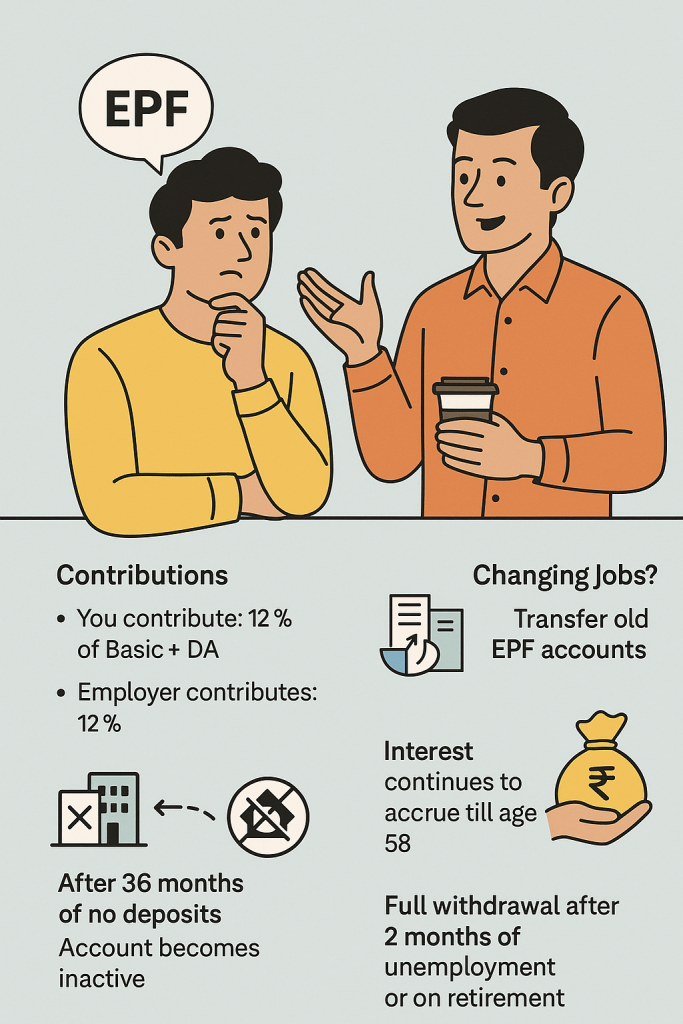
You contribute 12% of your basic salary + dearness allowance.

Your employer contributes another 12%.

But there’s a twist! The employer’s 12% doesn’t all go to your EPF.

8.33% goes to your pension account (EPS) — but only on a salary up to ₹15,000 (so ₹1,250 max per month).

The rest 3.67% goes to your EPF.

“Think of it like splitting your pizza,” laughed Robin. “Most slices go into your EPF, but one small slice goes into your pension.”

So, if your basic salary is ₹30,000 —

You’ll contribute ₹3,600 every month.

Your employer contributes ₹3,600 — ₹1,250 to pension, ₹2,350 to EPF.

Changing Jobs? Don’t Leave Your EPF Behind

Shyam nodded. “That’s clear. But I’ve changed jobs twice and never transferred my old EPF accounts. Is that bad?”

Robin chuckled. “Not bad, but not ideal either. It’s like having multiple savings jars at home — money’s safe, but you forget about them!”

Your EPF account should ideally move with you wherever you work. The UAN (Universal Account Number) is your lifelong ID for EPF. When you change jobs, you can easily transfer your old account online.

If you don’t, after 36 months (3 years) of no deposits, the account becomes inactive — kind of like an old phone number you no longer use.

Does an Inactive EPF Still Earn Interest?

“Will my old EPF just sit there doing nothing?” Shyam asked.

“Not exactly,” said Robin. “The good news is — even if your account becomes inactive, it still earns interest till you turn 58, as long as you haven’t withdrawn the money.”

So even if you switched jobs and forgot to transfer your EPF, it’s still growing quietly in the background.

But here’s something important — once you turn 58 and stop working, your account becomes inoperative.
From that point, interest earned will be taxable — and the tax will apply from the time you stopped contributing.

Imagine it like your parked car — it still shines in the garage, but after retirement, the government wants a small “parking fee” on the interest it earns!

When Can You Withdraw Your EPF?

There are two main situations when you can withdraw:

1. At the Time of Retirement (Age 58)

Once you retire, you’re allowed to withdraw 100% of your EPF balance — your and your employer’s contributions plus all interest earned.
After retirement, your EPF account becomes inoperative, and although it continues to earn interest, that interest becomes taxable from the time you stopped contributing.
So it’s better to withdraw or transfer the amount soon after retirement.

2. After 2 Months of Continuous Unemployment

If you leave your job and remain unemployed for 2 continuous months, you can also withdraw your entire EPF balance.
You just need to self-certify unemployment while applying for withdrawal through the EPFO portal.

Make a Note: Earlier, EPFO allowed only 75% withdrawal after 1 month of unemployment and the remaining 25% after 2 months.
Now, you can withdraw the full balance after being unemployed for 2 months.

However, if you join a new job before those 2 months, you can’t withdraw — you’ll need to transfer your EPF to your new employer through your UAN.

Everyday Example

Let’s take Shyam’s example again.

He worked at Company A for 4 years, then moved to Company B for 3 years. But he never transferred his old EPF account.

His old Company A account became inactive after 36 months.

It still earned interest till he turned 58.

But if Shyam forgets to withdraw even after retiring, any interest earned after 58 will be taxable — from the time he stopped contributing.

Now imagine if he had transferred both accounts under his UAN — he’d have one active account growing smoothly, with no confusion or tax surprises later.

General Advice :- “Your EPF is like that neem tree you planted years ago,” Robin said, finishing his chai. “It quietly grows in the background, giving you shade when you retire. Just make sure you don’t forget which garden you planted it in.”

Shyam smiled. “Thanks, Robin. My chai’s cold, but my EPF doubts are cleared — and I’m finally going to check my balance today!”

SIFs V/s Mutual Funds – at a glance

Shreya: Riya, I’ve been hearing a lot about Specialized Investment Funds—SIFs. I’m thinking of putting in a lump sum. It sounds exciting and “different” from mutual funds.

Riya: That’s interesting, Shreya. But before you jump in, let’s break it down. Do you remember the time you thought about buying that treadmill during lockdown?

Shreya: Yes, I bought it, but honestly, it’s gathering dust now. I hardly use it.

Riya: Exactly. You invested money because it felt like a good idea at the time, but without the habit or system in place, it didn’t work out. SIFs can be like that—tempting but not always practical for everyone.

Shreya: Hmm, so they’re not like mutual funds?

Riya: Nope. Think of mutual funds as your family car—a safe hatchback or sedan. You can take it to work, on road trips, even the market run. Easy to maintain, reliable, and useful for most situations.

Shreya: And SIFs?

Riya: SIFs are like sports cars. High performance, flashy, can speed up quickly—but they need expert drivers. On Indian roads, if you don’t know how to handle one, you can land in trouble.

Shreya: Okay, but what makes them so different?

Riya: A few things:

1. Entry Ticket SIFs  – For mutual funds, you can start with ₹500. For SIFs, you need ₹10 lakh minimum. It’s like paying a huge annual membership at a luxury club—you can’t just “try it out.”

2. Flexibility for the Manager – In mutual funds, managers mostly buy and hold good companies. In SIFs, managers can also “short sell”—betting that a stock will go down—or use derivatives. Think of it like a cricket match: a normal mutual fund bats steadily to build runs. A SIF tries reverse sweeps, switch hits, and risky shots. If they connect, great! If not, they’re bowled out quickly.

3. Risk and Reward  – Because of these fancy moves, returns can be higher—but losses can also be bigger. Like your stock-market-savvy cousin who once doubled his money quickly but then lost half in a single crash.

4. Liquidity Rules – With MFs, you can withdraw part of your money anytime. But with SIFs, if your balance falls below ₹10 lakh, you must take all your money out. Like being in a luxury gym that won’t let you downgrade to a smaller package—you either stay premium or leave.

Shreya: Sounds like a lot of conditions! But wouldn’t professional managers handle this well?

Riya: True, but even professionals can go wrong. Remember those IPL teams who hire the most expensive players but still don’t make the playoffs? Strategy matters, but so does execution.

Shreya: Hmm… so who should even invest in SIFs?

Riya: Think of your financial life like a thali. The roti, dal, rice, sabzi—that’s your basic portfolio: equity mutual funds, debt funds, gold, emergency savings. That fills you up.

SIFs? They’re the dessert—a fancy gulab jamun or a cheesecake. Tasty, but not the main meal. And only if you’ve already eaten well.

Shreya: So if I’m just building my basics, I should stay away?

Riya: Absolutely. First cover your essentials—insurance, emergency fund, regular mutual funds. Once you’re financially stable and have surplus, you can allocate a small slice—maybe 5–10%—to SIFs if you want to experiment.

Shreya: Got it! So, SIFs are not bad, but they’re not meant for me right now.

Riya: Exactly. Like driving a Ferrari in Bangalore traffic—it’s possible, but not practical. Build your portfolio foundation first, then think of adding such “luxuries.”

Shreya: Thanks, Riya. You’ve saved me from rushing into something flashy but risky.

Riya: Anytime! Remember, wealth creation is like gardening. First plant the basics, water them regularly. Once you have a lush garden, then add exotic flowers.

Why Your Salary Doesn’t Last Beyond the 10th each month (and What to Do About It)

It’s a familiar story. Salary gets credited at the start of the month, and for a few days we feel like kings and queens. By the 10th or 15th, we’re already waiting for the next payday. No matter how much we earn, money seems to slip away faster than we’d like.

Why does this happen? And more importantly, how do we break this cycle?

The Trap of Modern Lifestyle

Two big shifts have changed the way we spend money today:

1. Quick Commerce – Groceries, gadgets, and gourmet snacks delivered in 10 minutes. Convenience at a cost. The temptation is just one tap away.

2. Lifestyle Creep – With every salary hike, our expenses go up. A better phone, a fancier vacation, more dining out. We start living paycheck-to-paycheck even with higher incomes.

Everyday Situations That Drain Our Salary

If you look closely, the leakages are everywhere in our day-to-day lives:

The Daily Coffee Habit – That ₹200 latte may not feel like much, but at 20 days a month, it’s ₹4,000 gone without realizing.

Food Delivery Apps – A home-cooked meal might cost ₹100, but when ordered online, the same jumps to ₹300–₹400 with delivery and convenience fees.

Subscriptions Everywhere – Music, OTT, cloud storage, gym, e-learning – individually small, collectively they eat a chunk of your monthly budget.

“One-Day Sale” Traps – E-commerce notifications push us into buying things we don’t need, just because they’re discounted.

Impulse Electronics – That latest smartwatch, headphones, or phone upgrade often takes away the money that could have gone to investments.

These aren’t luxuries anymore; they’ve become “defaults” in our spending behavior. And that’s where the problem lies.

Mis-Selling: When Products Buy Us

On top of lifestyle choices, there’s another challenge. Salespeople from banks and financial institutions pitch products — insurance, ULIPs, credit cards — because they have targets to meet. We end up buying things we don’t fully understand.

They aren’t entirely wrong (it’s their job), but the problem is we don’t stop to ask: “Does this fit into my financial plan?”

What We Forget to Ask Ourselves

Every financial decision should begin with 3 questions:

1. Emergency Corpus – Do I have at least 6 months of expenses saved in liquid funds for emergencies?

2. Monthly Discipline – How much should I set aside each month before I start spending?

3. Retirement Plan – What’s my roadmap for life after work, when salary stops but expenses don’t?

Yet, most of us don’t pause to think about these basics.

Building the Right Money Habits

Here’s a simple framework:

1. Pay Yourself First – The moment salary hits, put aside at least 20–30% into savings/investments. Treat this as a non-negotiable “expense.”

2. Emergency First, Fancy Later – Before chasing high returns, build an emergency fund. This is your financial seatbelt.

3. Goal-Based Investing – Instead of buying random products, map out goals: child’s education, home purchase, retirement. Then pick the right instrument.

4. Budget Your Lifestyle – Use the 50-30-20 rule:

50% of income = needs (rent, EMI, groceries)

30% = wants (lifestyle, travel)

20% = savings & investments

5. Review Before You Buy – Before signing any financial product, ask:

Does this help my goals?

What are the costs/charges?

Is there a simpler alternative?


Why This Matters?

We often believe financial freedom comes with higher income. But the truth is, it comes from discipline, clarity, and planning. Without that, even a 7-figure salary can vanish in a fortnight.

Remember: Money is a tool. Either you control it, or it controls you.

Call to Action for Readers: – Starting this month. Before you make your next discretionary purchase, pause. Set aside for your emergency fund, review your retirement plan, and then spend. The peace of mind is worth far more than the latest gadget or instant indulgence.

Should you really buy a Term-Pan till the age of 75 Years?

One evening over tea, my friend Rajesh asked me a question that I’ve heard countless times:

“Why shouldn’t I buy a term plan till 75? Isn’t that when the risk of death is highest? Wouldn’t my family be more secure then?”

His tone was firm, almost challenging, as if I was missing something obvious. I smiled because I knew where this conversation was heading.

Scene 1 – Why Do We Buy Life Insurance?

I asked him gently, “Rajesh, tell me—why do you even need life insurance?”

He thought for a second and said, “Because if I die, my family will need money to survive.”

“Exactly,” I replied. “But think carefully—this need exists only as long as your family is financially dependent on you. If you’ve retired, your children are independent, and your spouse has the retirement corpus—what financial loss does your death cause? Emotional loss, yes. But financial? Not really.”

Rajesh sipped his tea, quiet now.

Scene 2 – The Retirement Factor

I continued, “By the time you hit 60, you’ll have bought your house, funded your kids’ education, maybe even married them off. Do you really think you’ll need a ₹1 crore cover at 70? Won’t your wealth by then be your real security?”

Rajesh raised his eyebrows. “But what if I live longer?”

“That’s exactly the point,” I said with a smile.

Scene 3 – The Insurer’s Game

I leaned forward. “Rajesh, remember this—insurance companies aren’t doing charity. They hire smart actuaries who calculate probabilities to the last decimal. If they let you buy a policy till 75, it’s because they know you’ll most likely survive till then. Which means—you’ll keep paying premiums faithfully, but chances are slim your family will ever get a payout.”

Rajesh chuckled, “So basically, the company is being smart—not me?”

“Bingo.”

Scene 4 – The Inflation Trap

“But wait,” Rajesh argued, “even if I die at 70, my family will still get ₹1 crore. That’s big money!”

I shook my head. “Not really. Think about inflation. Suppose you’re 40 now and you buy that policy. By the time you’re 70, with 7% inflation, that ₹1 crore will be worth just about ₹13.136 lakhs in today’s value. Do you see the trap? You’re paying premiums for decades, but the real value of that cover shrinks drastically over time.”

Rajesh sat back, stunned.

Scene 5 – The Bigger Picture

I concluded, “Rajesh, life insurance is not about squeezing maximum benefit. It’s about timely protection. You only need it until your retirement—your true working years. After that, your focus should be on building and preserving a solid retirement corpus. Beyond 60, keeping a term plan is like betting on your own death. And trust me, that’s not a bet worth making.”

Rajesh finally nodded, half laughing, half thinking deeply. “Looks like the insurance company isn’t the fool here—I would have been!”

I smiled. “Exactly. Act smart. Buy term insurance only for the years you truly need it. Beyond retirement, your wealth—not your policy—should take care of your family.”

Employer Health Cover V/s Personal Health Insurance

Shyam: Rishi, I don’t get why people keep saying “buy your own health insurance”. My company already covers me and my family. Why should I pay extra?

Rishi: That’s a fair question, Shyam. But let’s look at it differently. Employer-provided insurance is like renting a house—it’s great while it lasts, but the moment you change jobs, retire, or your employer changes policy, the cover can vanish overnight.

Shyam: But as long as I’m working, I’ll be covered, right? Why complicate things?

Rishi: You’re right—till you’re employed, you’re covered. But imagine two situations:

1. You switch jobs and your new company doesn’t provide health cover immediately.

2. You retire at 60—when you’ll actually need health insurance the most—no employer will cover you then.

And that’s when buying a fresh policy becomes very expensive, or worse, you may be denied if you develop lifestyle diseases like diabetes, hypertension, or heart issues.

Shyam: Hmm… but right now I’m young and healthy. Won’t it be a waste to buy an extra policy?

Rishi: That’s exactly why you should buy it now. Health insurance premiums are lowest when you’re young. With every year you delay, the premium rises. For example:

At 25, a ₹5 lakh cover might cost you ₹6,000 a year.

At 35, the same cover could cost ₹12,000.

At 45, it might jump to ₹25,000 or more.

So the earlier you lock in, the cheaper it is over the long run.

Shyam: But I can still invest that money instead of paying for insurance. Isn’t that smarter?

Rishi: Not really. Because one hospitalization can wipe out years of savings. Suppose you’ve built a ₹5 lakh mutual fund portfolio, but a sudden medical emergency costs ₹7 lakh. If your employer cover only pays ₹3 lakh, you’ll need to dip into your investments for the rest. That derails your financial plan instantly.

Shyam: That sounds scary. But are medical costs really that high?

Rishi: Yes. Lifestyle diseases are rising fast in India. Young people in their 30s are being diagnosed with diabetes, cholesterol issues, and even cardiac problems. Hospital bills for these can easily cross ₹5–10 lakh, especially in metro cities. Without adequate personal insurance, the burden falls directly on your savings.

Shyam: So you’re saying my employer cover is good, but not enough?

Rishi: Exactly. Think of employer insurance as a bonus—it’s useful, but not something to depend on forever. Your own policy gives you continuity, independence, and peace of mind.

Shyam: Okay, I see your point. If I buy now, I not only get lower premiums but also secure my future before lifestyle issues hit. And if I delay, I’ll pay more and risk my investments.

Rishi: Spot on, Shyam. Health insurance isn’t just a cost—it’s protection for your wealth and your family’s future.

Just 5,000 to Plan Retirement Corpus for your New Born Child

Becoming a parent is one of life’s greatest joys, but it also brings with it a new set of responsibilities. While sleepless nights and diaper changes take over in the early months, parents also begin to worry about the long-term financial security of their child. Unfortunately, many get trapped in traditional products like money-back policies, ULIPs, or bundled life insurance plans. These products feel “safe,” but they often deliver poor returns, leaving parents with far less than what’s truly possible. A smarter approach is to use the power of compounding to create a retirement corpus for your child, starting the day they are born, with just ₹5,000 a month.

Power of Compounding

Here’s how it works. Parents invest ₹5,000 per month in equity mutual funds in the child’s name for 18 years. By the time the child becomes an adult, the money grows into a corpus of around ₹31.8 lacs. At that point, the responsibility shifts. The child continues the exact same ₹5,000 monthly investment for another 37 years until they turn 55. That steady discipline grows into a retirement corpus of over ₹17.89 crore. Think about it: parents only contributed for the first 18 years, and yet they set in motion a plan that secures their child’s financial independence for life.

In real life, this approach is like planting a mango tree today. Parents water it for the first few years until it is strong enough to grow on its own. Once matured, the tree produces fruit year after year, long after the initial effort is over. Compare this to money-back policies or ULIPs, which are like planting a decorative plant—it looks safe, but it never really bears fruit in the way you expect.

Parents often underestimate how small sacrifices can lead to massive results. ₹5,000 a month is often spent on eating out at restaurants, paying for multiple OTT subscriptions, or impulse shopping on e-commerce sites. Redirecting just that amount into a SIP can secure your child’s financial life. Imagine telling your son or daughter at age 18: “This ₹31.8 lakh is not just money—it’s the foundation of your future. Keep adding to it, and you’ll never have to worry about retirement.” That conversation itself can be one of the best financial lessons you pass on.

To get started, parents need to open an investment account in the child’s name, with themselves as guardians until the child turns 18. Basic documentation like the child’s birth certificate and guardian KYC is needed. From there, the journey is simple: set up the SIP, stay disciplined, and educate your child when the time comes.

The truth is, the best financial gift you can give your child is not another toy, or even just a good education, but the quiet, consistent power of compounding. By starting this plan the day your child is born, you’re not only showing love today—you’re securing their freedom tomorrow.