Borrowers Smile, Savers Pause: The Repo Rate Story Explained

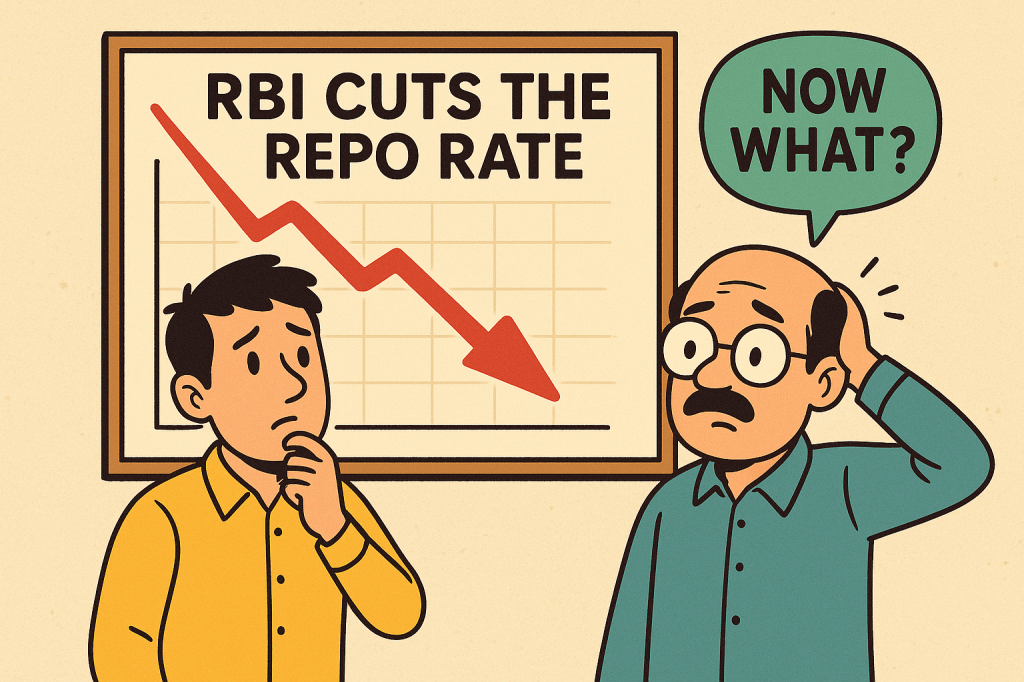
Shyam looked worried as he stirred his evening tea.

“Bharat,” he said, “every news channel is shouting that RBI has cut the repo rate. Home loans, EMIs, fixed deposits, debt funds—everything seems connected. But honestly, I don’t quite get what really changes for people like me.”

Bharat smiled. “Good question. Let me tell you a story—because a repo rate cut is like a domino effect. One push, and several things start moving.”

First Things First: What Is the Repo Rate?

“Imagine this,” Bharat began.

“Banks are like households. Sometimes they fall short of cash. When that happens, they borrow money from RBI. The interest rate RBI charges banks for this short-term borrowing is called the repo rate.”

“So when RBI cuts the repo rate,” Shyam interrupted,
“banks borrow cheaper?”

“Exactly,” said Bharat. “And when money becomes cheaper for banks, the effects slowly reach all of us.”

How a Repo Rate Cut Reaches Your Home Loan EMI

Bharat continued, “Let’s start with something close to your heart—your home loan.”

  • When banks get money at a lower rate from RBI,
  • They eventually reduce lending rates for customers,
  • Especially for floating-rate loans like home loans.

“So my EMI goes down immediately?” Shyam asked hopefully.

Bharat chuckled. “Not always immediately. Banks pass on rate cuts with some delay. But over time, yes—
your EMI can reduce or your loan tenure can shorten.”

“In simple terms,” Bharat added,
“repo rate cuts are good news for borrowers.”

Shyam nodded. “That part I like.”

What Happens to Fixed Deposits?

“But what about my fixed deposits?” Shyam asked cautiously.

Bharat’s tone turned gentle.

“This is where the story changes direction,” he said.

“When lending rates fall, banks don’t want to pay high interest to depositors either. So after a repo cut:

  • New FD rates usually go down
  • Renewals happen at lower interest rates
  • Long-term FD income slowly shrinks”

“So savers suffer?” Shyam asked.

“Not suffer,” Bharat clarified,
“but returns become less exciting. That’s why rate-cut cycles are great for borrowers—but a bit painful for pure FD investors.”

Now the Interesting Part: What Happens to Bonds & Debt Funds

Bharat leaned forward. “This is where most people get confused.”

“Think of bonds like old contracts,” he explained.

  • Old bonds pay higher interest
  • New bonds (after rate cuts) pay lower interest

“So old bonds suddenly look valuable,” Shyam said.

“Exactly!” Bharat smiled.

That’s why:

  • Bond prices go up
  • Debt mutual fund NAVs rise
  • Especially funds holding existing bonds

“But,” Bharat raised his finger,
“this gain mostly comes from price appreciation, not long-term income.”

Short-Term Excitement vs Long-Term Reality

Bharat continued, “Once rates are lower:

  • New bonds offer lower yields
  • Debt funds reinvest money at lower rates
  • Returns stabilize and may cool down”

“So the big gains don’t last forever?” asked Shyam.

“That’s right,” said Bharat.
“Rate cuts give debt funds a boost, not a permanent gift.”

So… What Should a Thoughtful Investor Do?

Shyam leaned back. “Okay Bharat, give it to me straight.”

Bharat summarized calmly:

  1. Borrowers
    • Enjoy lower home-loan and personal-loan costs
    • Especially helpful if loans are floating-rate
  2. FD Investors
    • Expect lower rates ahead
    • Lock-ins need careful timing
  3. Debt Investors
    • Short-term and low-duration funds offer stability
    • Long-duration funds can benefit initially but carry more risk
    • Don’t chase returns blindly after a rate cut

“The key,” Bharat said,
“is to align your debt investments with your time horizon, not headlines.”

Shyam’s Realisation

Shyam smiled. “So a repo rate cut isn’t good or bad. It just… changes the rules of the game.”

Bharat nodded.

“Exactly. RBI doesn’t cut rates to make investors rich or poor.
It does it to support growth. Smart investors simply adjust their strategy.”

Shyam finished his tea, calmer now.

“Thanks, Bharat. Next time the news screams ‘Repo Rate Cut’,
I’ll know which domino is falling—and which one affects me.”

How to Make Safe Investments Give Better Returns

For conservative investors, predictable income and capital safety often take priority over maximising returns. Products such as fixed deposits and Post Office schemes are therefore commonly used.

However, the final outcome depends not only on the product selected, but also on how the income generated by that product is utilised.

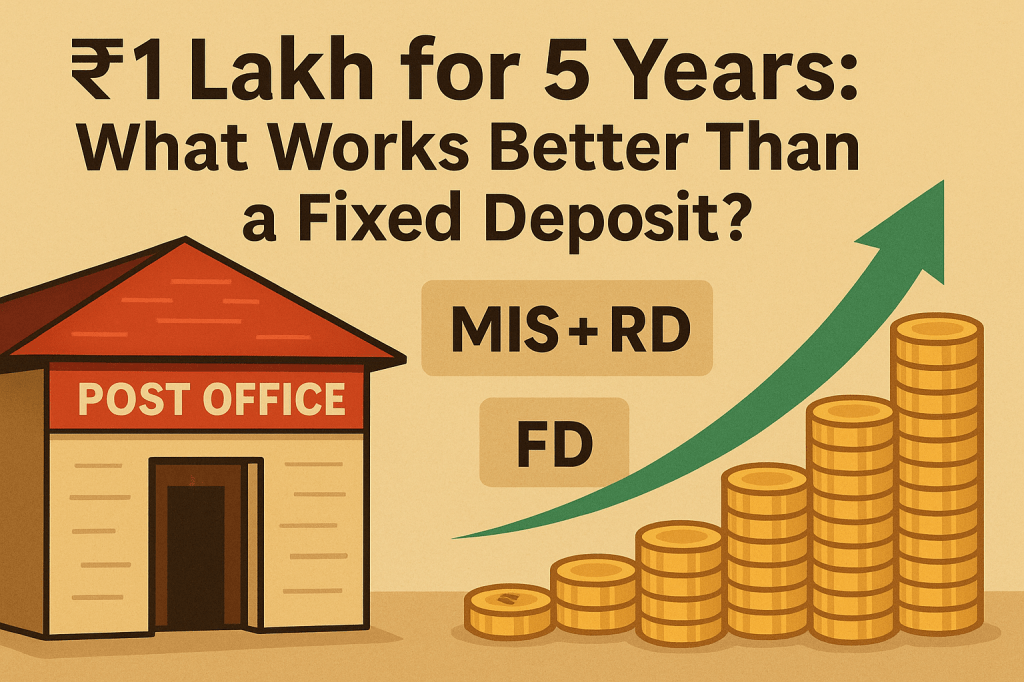
A simple example using the Post Office Monthly Income Scheme (MIS) in combination with a Post Office Recurring Deposit (RD) illustrates this clearly.

Step 1: Using MIS as an income generator

Assume an investor allocates ₹1,00,000 to the Post Office MIS Scheme for a fixed tenure of 5 years.

MIS interest rate: 7.4% per annum

Annual interest: ₹1,00,000 × 7.4% = ₹7,400

Monthly interest payout: ₹7,400 ÷ 12 = ₹617 (approx.)

This monthly interest is paid out and does not compound within MIS.
At the end of 5 years, the investor receives the original principal of ₹1,00,000.

Step 2: Reinvesting the monthly income through RD

Instead of spending the monthly ₹617, the investor opens a Post Office RD and deposits the same amount every month.

Monthly RD deposit: ₹617

RD interest rate: 6.7% per annum

RD tenure: 60 months

The RD allows these small monthly deposits to compound over time.

At the end of 5 years, the RD matures at approximately ₹44,000.

Of this accrued amount, around ₹37,000 is the total earnings made through Post office MIS interest and the remainder interest is earned through the RD account.

Final outcome after 5 years

Component Amount (₹)

MIS principal returned 1,00,000
RD maturity value 44,000
Total value after 5 years 1,44,000

Effectively, the original ₹1 lakh grows to ₹1.44 lakh over 5 years.

Now, let’s understand what is the effective annualised return?

When evaluated as a single investment:

Initial investment: ₹1,00,000

Final value after 5 years: ₹1,44,000

This corresponds to an annualised return (CAGR) of approximately 7.5%, higher than a typical 5-year cumulative fixed deposit offering around 7%.

Why does returns improve despite modest interest rates?

The improvement does not come from higher interest rates.

Instead, it comes from:

Treating MIS strictly as an income product

Giving that income a systematic reinvestment path

Allowing compounding to work through RD

In effect, the investor converts a periodic income into a long-term growth engine without increasing risk.

Final Takeaway :-

Conservative investing becomes more efficient when income is intentionally reinvested rather than passively received.

This principle applies not only to Post Office schemes, but to any strategy where the regular cash flows are involved. Structuring income with discipline can quietly improve long-term outcomes—even in low-risk portfolios.

A Simple Story That Explains How to Invest a Large Amount Safely

One Monday morning, Mr. Mehta walked in looking like someone who had just received a big wedding gift but didn’t know where to keep it safely.

“I have ₹20 lakh after selling an old property,” he said. “I want to invest it… but I’m scared of doing it too fast. Markets go up, down, spin around — I can’t figure out what to do.”

I smiled. “Relax, Mr. Mehta. You know what your situation reminds me of? Having a huge bucket of water and trying to empty it into a small bottle. If you pour it all at once, everything spills. But a slow, steady pour keeps things clean.”

He laughed. “That explains my financial mess perfectly.”

And so we began…

Step 1: Choosing the Right ‘Parking Spot’ — Like Finding a Place for Extra Bags

“Think of your ₹20 lakh like luggage you’ve brought back from a long trip,” I said. “Before arranging it in the cupboards, where do you keep it?”

He thought for a second.
“Usually in the guest room or store room.”

“Exactly! You don’t dump the suitcases directly into your wardrobe. Similarly, before sending the money to equities, you park it safely.”

So we explored three “rooms”:

1. Liquid Funds → The ‘Guest Room’

Like a spare room where you keep things temporarily — clean, safe, and easy to access.

Perfect if:

  • You plan to start investing soon.
  • You want zero tension.

2. Arbitrage Funds → The ‘Locker’

Like putting jewellery in a locker instead of a regular cupboard. Same safety, but smarter tax-wise, especially for high taxpayers.

Good for parking the luggage for a few months.

3. Ultra-Short Funds → The ‘Store Room’

Not visited often but secure.
Ideal when the wait is slightly longer.

Mr. Mehta laughed, “So basically, you’re telling me not to scatter the ₹20 lakh all over my financial house!”

“Exactly,” I said.
“Let’s keep it neatly in one room until we’re ready.”

Step 2: Entering the Market Slowly Like Merging Into Traffic

“Now imagine driving onto a busy main road,” I continued.

He nodded.

“You don’t blast your car into traffic. You merge slowly, right?”

“That’s true.”

“That slow merging is what we call an STP — Systematic Transfer Plan.”

I explained:

  • If the market is like a calm road → merge over 6 months
  • If it’s like peak-hour traffic → merge over 12–18 months
  • If there’s a sudden traffic lull (market correction) → merge faster

“It’s just common sense,” I added.
“Even Google Maps won’t tell you to accelerate blindly.”

He chuckled, “I didn’t know investing had so much in common with driving.”

Step 3: Avoiding Everyday Mistakes Like Grocery Shopping When Hungry

“Mr. Mehta,” I said, “Have you ever gone grocery shopping when hungry?”

His eyes widened. “Worst idea ever! I buy half the store.”

“Exactly! Investing everything at once when markets look exciting is the same mistake.”

Some examples:

Mistake 1: Waiting for the perfect price

Like waiting for the perfect mango in summer.
You keep waiting… and the season ends.

Mistake 2: Stopping midway because the market dips

Like stopping your morning walk just because it rained one day.
It breaks the routine.

Mistake 3: Investing all 20 lakh in a single shot

Like adding all spices at once while cooking —
chances of messing up are high.

He laughed so loudly the receptionist looked inside.

Step 4: The Plan That Gave Him Relief

“So let me summarise,” I said.

“Your ₹20 lakh will first rest safely — just like luggage waiting to be unpacked.
Then, month by month, it will slowly move into equity funds, like merging into traffic without honking or panic.”

He leaned back.

“You know… this finally makes sense in everyday terms. Investments always felt like rocket science, but you made it sound like managing my own home.”

“That’s the truth,” I replied.
“Good investing is usually just good housekeeping.”

And That’s How Mr. Mehta’s Journey Began

He left with:

  • A calm mind
  • A clear plan
  • And confidence that came from simple rules, not market predictions.

The ₹20 lakh wasn’t a burden anymore.
It had become a well-behaved guest, ready to settle into a long-term home — one month at a time.

Build Perpetual Passive Income: A Proven PPF Method Every Investor Must Know

Imagine this.

You are 35 years old.

You’re busy with career, family, kids, EMI, school fees — the usual life roller coaster.

Retirement feels far away… almost unreal.

But what if I told you that with just ₹5,000 per month, you can create a guaranteed, tax-free, lifetime pension that will start at age 60 — and never run out?

Yes, never.

This is not a scheme, not a policy, not a “new fund offer”.

This is your own PPF account — when used smartly.

Let me take you through this in a simple story.

The Story of Raj — A 35-Year-Old Who Built His Own Pension

Raj is like many of us — disciplined but busy.

He wants to retire peacefully, without worrying about markets, returns, or taxes.

One day, he learns about a powerful strategy:

“Use your PPF not just as a savings tool…

but as a pension generator.”

Curious, he begins at age 35.

Let’s understand this….Raj’s Pension Plan in Three Steps

Step 1: Age 35 to 60 → Invest ₹5,000 per month

That’s ₹60,000 per year

For 25 years

At a safe, government-backed 7.1% interest

Raj invests consistently.

By the time he turns 60…

His PPF balance grows to approx. ₹39.97 lakh

(Yes, fully tax-free!)

Step 2: Age 60 → Stop investing, start living

Raj stops his monthly deposit at 60.

Now the PPF money continues earning interest — tax-free.

At 7.1% per year, his ₹39.97 lakh earns:

₹2,83,852 interest per year

or

₹23,654 per month (tax-free)

Step 3: Age 60+ → Withdraw only interest = Pension for life

Raj withdraws just the monthly interest.

Because he never touches the principal:

The corpus stays intact

The pension never stops

Everything remains tax-free

This becomes his personal lifelong pension plan, created without buying any annuity or policy.

Final Result

If you invest ₹5,000/month in PPF from 35 to 60:

Your tax-free pension at 60 = ₹23,654 per month (approx.)

This pension can continue forever

Your principal remains untouched

Why This Strategy Works So Well

PPF interest is guaranteed

Backed by the Government of India.

Entire amount is tax-free

Contribution, interest, maturity — all exempt.

No market risk

Perfect for conservative investors.

Self-created pension

No need for expensive annuity products with low returns.

You retain control

Remember – Retirement is not about age — it’s about preparation.

Your PPF, when used wisely, is not just a savings product.

It’s your personal pension engine, silently compounding for decades and giving you a peaceful, tax-free income for the rest of your life.

The Lazy Investor’s Dream: 3 Years of Effort leading to Lifetime Pension

How Rohan Built a Lifetime ₹21,000 Monthly Income by Investing for Just 3 Years

Rohan was 30 when he realised something important: “I don’t need to invest forever. I just need to invest consistently for a short time… and then let time do the heavy lifting.”

But life wasn’t giving him a 20-year runway of regular savings.

He had a wedding coming up, a home loan on the horizon, and the usual chaos that shows up in everyone’s early 30s. He knew he could not invest long-term. But he also knew he must do something.

So he made a simple plan:
Invest for 3 years.
Wait for 20 years.

That was it.

Illustration 1: Rohan’s 3-Year Investment Phase (Age 30–33)

Monthly SIP: ₹25,000

Duration: 36 months

Growth Rate: 6% per annum (conservative)

Total invested: ₹25,000 × 36 = ₹9,00,000

Value at end of 3 years: ₹9.83 lakh

He didn’t try to chase big returns. He just stayed consistent. And after 36 months, he stopped. Completely !

Illustration 2: The Waiting Years (Age 33–50)

Rohan invested nothing after age 33.

He simply kept his ₹9.83 lakh invested and let it grow silently.

Compounding Duration: 17 years and the value after 17 years ₹62.54 lakh

No extra investment.
No extra effort.
Just time + compounding.

Illustration 3: Rohan’s Lifetime Income Plan (Age 50 onwards)

At 50, Rohan did one simple thing: He shifted the ₹62.54 lakh to a Conservative Hybrid Mutual Fund and set up an SWP (Systematic Withdrawal Plan).

Withdrawal Strategy:

  • Withdraw 4% per year
  • Stay within a safe, lifelong withdrawal limit
  • Keep the remaining corpus invested so it sustains forever

4% of 62.54 lakh = ₹2.50 lakh/year

That is ~₹21,000 per month — for life. This ₹21,000/month becomes his personal pension.

A pension he created by investing only for 3 years.

Rohan’s Biggest Realisation : While reflecting on his journey, he told his friend: “I didn’t build wealth by investing for 20 years. I built wealth by waiting for 20 years.” Most people believe wealth creation demands long-term investing, big money, or endless discipline.

Rohan proved otherwise:

  • Focus hard for 3 years
  • Do nothing for 17 years
  • Enjoy income for life

That’s the quiet magic of compounding.

The 3X Rule: Your Path to Money That Never Runs Out

Rick: Shyam, can I ask you something that’s been on my mind?
How can people invest just five thousand a month, and later withdraw fifteen thousand a month… for the rest of their lives?
How does that even add up?

Shyam: It sounds impossible only until you understand two ideas:
compounding and discipline.
Most people underestimate both.

Let’s start with compounding.

Rick: Go on. I’m listening.

Shyam: Imagine you plant a sapling in your backyard.
For the first few years, it hardly grows.
Tiny. Slow. Boring.
But after 10 to 12 years, it starts shooting up fast — the trunk thickens, branches grow rapidly, fruits start appearing.

Money works exactly like that.
Not in year 1 or 2…
but in year 10, 12, 15…
that’s when the real explosion happens.

Compounding rewards those who stay long enough.

Rick: So the 5,000 per month becomes something meaningful only because it stays long?

Shyam: Exactly.
Let’s quantify it:

5,000 a month for 15 years becomes about 24 lakh rupees.

Not because you invested a lot.
But because you stayed disciplined for long enough
for compounding to wake up.

Rick: Fine, I get the compounding part.
But how does that give me fifteen thousand a month later?

Shyam: Before I answer that, let me show you something simple.
Let’s call it the Sustainable Withdrawal Cheat Sheet.

If your investments earn:
8% returns → you can safely withdraw 3–4% for life
10% returns → withdraw 3–5% for life
11–12% returns → withdraw 4–6% for life
13–15% returns → withdraw 5–7% for life (maybe sustainable)
15%+ returns → 6–8% withdrawals only for short periods

This is not theory. It’s global research used for retirement planning worldwide.

Rick: So… to never run out of money, my withdrawals must be lower than my returns?

Shyam: Correct.
If your money earns 10% and you withdraw 4%, your money grows.
If your money earns 12%  and you withdraw 6% your money stays stable.
If your money earns 12% and you withdraw 12%, your money dies.

This is the whole science.

Rick: Okay. But how does this explain the fifteen-thousand withdrawal?

Shyam: Let’s connect the dots.

You invest ₹5,000/month for 15 years.
You get a corpus of ₹24 lakhs.
Now imagine your investment continues growing at roughly 11–12%, which historically many diversified funds do over long periods.

Using the cheat sheet:
At 11–12% returns, you can safely withdraw 4–6% per year for life.

So for a ₹24 lakh corpus:

4% withdrawal = ₹96,000 per year = ₹8,000 per month
5% withdrawal = ₹1.2 lakh per year = ₹10,000 per month
6% withdrawal = ₹1.44 lakh per year = ₹12,000 per month

Now here’s the part most people miss:

Your ₹24 lakh corpus doesn’t remain ₹24 lakh.
It continues compounding at 11–12%.
So even if you withdraw around ₹15,000 a month (about 7.5%), the underlying money keeps growing enough to support it.

Why?
Because compounding is still working behind the scenes.

Withdrawals don’t stop the engine — they only tap into it.

Rick (thinking): So a small disciplined SIP gives me a big enough engine…
and because that engine keeps earning more than I withdraw,
it continues paying me for life.

Shyam: Exactly.
You’re withdrawing three times what you used to invest. Not because of luck,
but because your withdrawal rate is controlled and your compounding rate is higher.

Rick: This suddenly makes sense.
It’s not magic — it’s math plus patience.

Shyam: That’s the line, Rick. Money rewards those who do small things consistently…
and then have the patience to let compounding do the heavy lifting.

Rick: So, in one sentence?

Shyam: Sure.
Discipline builds the corpus.
Compounding grows it.
And safe withdrawals keep it alive forever.

Rick (smiles): I think this is the first time money feels… understandable.

“Safe, Steady, and Secure — The Power of the Senior Citizens Savings Scheme”

Dinesh: Ram, now that I’ve retired, I’m trying to figure out where to park my savings. I want something absolutely safe — no stock market drama — and a steady income to manage my monthly expenses. Any ideas?

Ram: Of course, Dinesh ji! For someone in your situation, the Senior Citizens Savings Scheme (SCSS) is tailor-made. It’s backed by the Government of India, offers regular quarterly income, and ensures total safety of your principal.

Dinesh: Sounds good. But who can invest in it?

Ram: It’s simple — anyone who is 60 years or older can invest.
If you’re between 55 and 60 and have retired under superannuation or voluntary retirement (VRS), you can also join, as long as you invest within one month of receiving your retirement benefits.
Even defence personnel can invest, regardless of age.

But note — NRIs and HUFs are not eligible.

Dinesh: Got it. So how does one invest — monthly, like an SIP, or lump sum?

Ram: Ah, great question! The SCSS works only through a lump sum investment, not monthly installments or SIPs.
You deposit your chosen amount — say ₹5 lakh, ₹10 lakh, or ₹30 lakh — all at once at the time of opening the account.

You can’t add more money later, but you can open multiple SCSS accounts, as long as your total investment doesn’t exceed ₹30 lakh.

Dinesh: Hmm, so it’s like putting a lump sum from my retirement corpus?

Ram: Exactly! Think of it as parking a portion of your retirement money in a “safety vault” that pays you a guaranteed quarterly income.

For example, if you invest ₹15 lakh at the current interest rate of 8.2% per annum, you’ll earn:

> ₹15,00,000 × 8.2% ÷ 4 = ₹30,750 every quarter.

That’s ₹30,750 credited to your bank account every three months — enough to handle household bills, groceries, or even a small weekend getaway with your wife!

Dinesh: That’s nice! So how long does the money stay locked in?

Ram: The scheme runs for 5 years, and you can extend it once for 3 more years if you wish.
When you extend, the interest rate applicable at that time will apply for the extension period.

Dinesh: What about the interest rate itself? Does it stay fixed forever?

Ram: The Ministry of Finance decides the rate every quarter, based on government security yields.
Currently (for the July–September 2025 quarter), it’s 8.2% per annum, which is quite attractive compared to most bank FDs.

Dinesh: Makes sense. How is the interest paid — monthly or quarterly?

Ram: The interest is paid quarterly, not monthly. The payout dates are:
31 March, 30 June, 30 September, and 31 December.

For example, if you invest today, your first interest payment will arrive at the end of the next quarter — just like clockwork.

Many retirees plan their budget around these payouts — for example:

March interest for property tax or annual insurance,

June for family travel,

September for festival shopping,

December for medical check-ups or gifts for grandchildren.

Dinesh: I like that rhythm! But what about taxes — any relief there?

Ram: Sure. Here’s the tax story in two lines:

Your investment amount qualifies for deduction under Section 80C, up to ₹1.5 lakh.

But the interest earned is fully taxable under “Income from Other Sources.”

If your annual interest exceeds ₹50,000, TDS will be deducted automatically.

Dinesh: Okay, so it’s like regular income — I’ll pay tax based on my slab. What if I need the money early?

Ram: You can close the account prematurely, but there are small penalties:

Before 1 year: No interest is paid.

Between 1–2 years: 1.5% deduction from the principal.

After 2 years: 1% deduction from the principal.

So, if you invested ₹10 lakh and had to withdraw after 18 months, you’d get back ₹9,85,000 plus the interest earned.

Dinesh: Understood. So this is really for long-term income stability.

Ram: Exactly! Most retirees use it to cover monthly expenses or create a “pension-like” income.

For example:

Mr. and Mrs. Mehta invested ₹20 lakh from their retirement corpus. They now receive ₹41,000 every quarter — roughly ₹13,500 per month — which comfortably covers their electricity, grocery, and society bills.

Another retiree, Mr. Nair, invested ₹10 lakh, and uses his quarterly interest to pay for his grandchildren’s school fees every term.

That’s the beauty of SCSS — you invest once and let the income flow in regularly.

Dinesh: Ram, I like how you’ve explained this. I can see myself putting around ₹15–20 lakh here for safety and income. Maybe the rest I’ll keep in debt funds or FDs.

Ram: Perfect strategy, Dinesh ji. The SCSS takes care of your stability and safety, while your other investments can handle growth and liquidity.

Your Money Is Sleeping — Shouldn’t It Be Working?

Earn 2.5X more without taking extra risk. The secret lies in how you park your cash.

On 1st April 2024, Mr. Mehta quietly parked ₹10,000 in his savings account. “It’s safe,” he thought. “It’ll earn me some interest anyway.”

Fast forward to 1st November 2025 — 19 months later.
He checks his account and sees the balance has grown to ₹10,403.
A modest ₹403 in interest.

Not bad, right?

But here’s the twist — what if Mr. Mehta had instead parked that ₹10,000 in a low-risk overnight mutual fund?

The same period.
The same safety.
The same liquidity.

Only this time, his ₹10,000 would have quietly grown to around ₹11,026.

That’s nearly ₹1,026 in gains — almost 2.5X more than what the savings account delivered.

Why Do Savings Accounts Pay So Little?

Most large banks offer 2.5%–3% per annum on savings accounts. That’s barely enough to keep up with inflation — let alone grow your wealth.

The irony? Your idle money is far from “idle.”
The bank uses it to lend, invest, and earn — while giving you a fraction of the returns.

That ₹10,000 earned ₹403 over 19 months — roughly ₹50 per quarter. It’s safe, yes — but it’s also sleepy.

What Makes Overnight Funds Different?

Overnight funds invest in ultra-short-term, high-quality instruments that mature daily — often backed by government securities or AAA-rated collateral.

They typically mirror the RBI repo rate, offering 5% to 6% annual returns, without taking credit or duration risk.
You can redeem your money anytime, and the proceeds usually hit your account the next business day.

In essence, they offer:
Safety — backed by top-rated instruments
Liquidity — just a day away
Better returns — 2–3X that of your savings account

So, your ₹10,000 doesn’t just sit there — it works. Quietly, efficiently, and safely.

Safety, Liquidity, and Returns — The Perfect Trio

When it comes to short-term parking of your money, most investors look for three things — safetyliquidity, and returns.

A traditional savings account scores well on the first two, offering very high safety and instant access to your funds. However, it falls short on returns, yielding barely 2.5% per annum.

On the other hand, a low-risk overnight fund also offers very high safety, since it invests in short-term instruments that mature daily, and provides liquidity within one business day. The key difference lies in what it earns — these funds generally deliver around 5% to 6% per annum, nearly three times what a savings account offers.

Even from a tax standpoint, the growth option of an overnight fund can be more efficient over time, since it is treated as capital gains rather than regular interest income. This means your money not only grows faster but also gets to keep a larger share of what it earns.

In short, you don’t have to choose between safetyliquidity, and better returns — with overnight funds, you can have all three working quietly in your favor.

The Hidden Cost of “Safe” Money

The cost of keeping idle cash isn’t visible — but it’s real. Every rupee sitting in a low-interest account loses earning potential.

Let’s put that in perspective:

  • On ₹10,000 → you lose ₹723 in 19 months.
  • On ₹1 lakh → you lose ₹7,230.
  • On ₹10 lakh → that’s ₹72,300 quietly left on the table.

The longer your money sleeps, the harder it has to work later to catch up.

The Smarter Move

You don’t need to chase high-risk investments to make your money work harder. You just need to be mindful of where it rests.

Keep your savings account for transactions and emergencies.
But shift your idle balance — the money that sits for months — into overnight or liquid mutual funds that offer better yields with the same peace of mind.

Let your money work while you sleep. Because while your bank may love your idle balance…your future self will thank you for putting it to work.

Final Thought

Your money has only two choices:
It can rest safely in your bank account.
Or it can work smartly — safely, efficiently, and consistently.

So, ask yourself — Does it make sense to let your money sleep when it could be earning 3X more, risk-free?

Not All Returns Are Equal: Simple Story Behind Absolute, XIRR & Rolling Returns

Sam: (scrolling through his mutual fund app) Ravi, I’m so confused! My fund shows three different types of returns — Absolute, XIRR, and Rolling. Aren’t they all the same thing?

Ravi: (laughs) Not quite, Sam. They all talk about returns, but each one tells a different story. Let’s start with something simple.

Sam: Okay, shoot.

Ravi: Imagine you invested ₹5,000 in a mutual fund back in 2015. Today, in 2025, that ₹5,000 has grown to ₹10,000.

Sam: Sweet! That’s a 100% return!

Ravi: Exactly — that’s called your Absolute Return. You simply look at how much your investment grew. Like – (10,000−5,000)/5,000=100%

But here’s the thing — it doesn’t care how long it took.

Sam: Ohh… so even if it took 10 years, it still says 100%?

Ravi: Yep. It’s like saying, “I lost 10 kilos!” but not mentioning it took 3 years. You made progress, sure, but without the time factor, it’s not the full picture.

Sam: Got it. So what’s XIRR then?

Ravi: Good question. Suppose instead of investing once, you put ₹5,000 every year for 10 years. That’s ₹50,000 total. By 2025, your investment grows to ₹85,000.

Sam: Okay, I’m following.

Ravi: Now, XIRR helps you figure out what your average yearly return was, considering all those investments made at different times. When you calculate it, you’ll get roughly 9.8% per year.

Sam: Oh, so XIRR shows how much I earned each year on average, even though I invested gradually?

Ravi: Exactly! Think of it like your fitness tracker. It doesn’t just tell you how much weight you lost, it tells you how consistently you’ve been working out every month.

Sam: That makes sense! Now, what on earth are Rolling Returns?

Ravi: Ah, that’s where most people scratch their heads. Rolling Returns tell you how consistently the fund has performed across time — not just in one lucky stretch.

Sam: Give me an example.

Ravi: Okay, instead of only checking how the fund did from 2015–2025, Rolling Returns look at every possible 10-year period — like 2010–2020, 2011–2021, 2012–2022, and so on.

Sam: Hmm… like checking multiple innings instead of just one match?

Ravi: Exactly! If the fund’s 10-year returns mostly stay between 8% and 11%, it’s a steady player — like Rahul Dravid. But if it swings between –2% and +18%, it’s more like a hit-or-miss player — exciting but unreliable.

Sam: So Rolling Returns show consistency over time, right?

Ravi: Bingo. It helps you see if the fund performs well most of the time, not just in one good decade.

Sam: Alright, then tell me this — which one should I actually use to judge my returns?

Ravi: Depends on what you’re asking. If you just invested once and want to see how much your money grew — Absolute Return is fine.
If you invest regularly, like through SIPs — XIRR gives a clearer picture of your yearly growth. And if you want to check whether the fund itself is reliable — go with Rolling Returns.

Sam: So basically — Absolute tells me how much I made, XIRR tells me how efficiently I made it, and Rolling Returns tell me how consistently the fund performs?

Ravi: Perfectly said!

Sam: (smiling) You make it sound so simple, Ravi. I used to think returns were just one number. Now I realize, they’re like three different camera angles of the same scene — each showing a unique perspective.

Ravi: (grinning) Exactly, my friend. The trick is to look at all three — and not just chase the number that looks the biggest.

“Beyond the Yield: What Investors Miss About IRB InvIT Fund”

Shyam: Rupal, I was reading about IRB InvIT Fund — its price is around ₹62.50 per unit, and it’s paying ₹10 per year in dividends! That’s like a 16% yield. Isn’t that incredible?

Rupal: (smiling) It surely grabs attention, Shyam. A 16% dividend yield looks great on paper. But before we pop the champagne, let’s understand where that dividend is coming from.

Shyam: I know it’s an infrastructure investment trust. But how exactly do these InvITs work?

Rupal: Good question. InvITs like IRB InvIT own income-generating assets — in this case, toll roads. They collect tolls or annuity payments and distribute most of that cash to investors. By regulation, they must distribute at least 90% of their net distributable cash flows as dividends or interest.

Shyam: So, they’re not like companies that reinvest their profits to grow further?

Rupal: Exactly. InvITs are income vehicles, not growth engines. That’s why you see regular ₹2-per-quarter dividends from IRB InvIT since 2023. It’s steady cash flow, but remember — if toll income falls or traffic slows, payouts could reduce.

Shyam: Hmm… that’s fair. But the regularity of dividends — ₹2 every quarter — sounds reassuring. Isn’t that a sign of consistency?

Rupal: Yes, it shows stability, and the recent numbers support it. For the June 2025 quarter, IRB InvIT earned ₹292 crore in revenue and ₹99.6 crore in profit, up by 6% and 16% year-on-year respectively. But Shyam, consistency doesn’t always mean guaranteed safety.

Shyam: True. So, would you suggest I include it in my portfolio?

Rupal: If your goal is to earn steady income rather than chase capital appreciation, then yes — you could allocate a small part, let’s say a 5%, to IRB InvIT. But it should sit alongside other stable assets. Think of it as one piece of your income puzzle, not the entire picture.

Shyam: Got it. I’ll treat it as an income option, not a growth bet.

Rupal: That’s the right approach. And remember, Shyam — investment in securities markets are subject to market risks. Always read the related documents carefully before investing.

Shyam: (grinning) You sound like the fine print at the bottom of a mutual fund ad.

Rupal: (laughs) Maybe, but it’s the most important line! Past performance isn’t indicative of future returns, and what looks like a “safe” 16% yield could change if business conditions shift.

Shyam: Fair point. I’ll keep that in mind. Thanks for the reality check, Rupal — I almost mistook a high yield for a guarantee.

Rupal: Happens to many investors! Always remember: high yield often comes hand-in-hand with high risk. Balance, patience, and understanding your goal — that’s the real dividend of good investing.

This article is for educational and informational purposes only.
It does not constitute investment advice, financial advice, or a recommendation to buy, sell, or hold any security, including InvITs or mutual funds.