The Tree-Planting Mindset: The Secret to Smart Investing

Riya: Shyam, I don’t get it. I was conversing with one of my colleagues when she showed her mutual fund statement to prove a point. Her fund made a staggering annualized 17% return while my returns from the same fund just yielded 9.2%. How is that even possible?

Shyam (smiling): Ah, great question, Riya! It’s actually very common. It’s not the fund’s fault — it’s usually because of how people behave while investing.

Riya: Behavior? What do you mean?

Shyam: Let me explain with a real story. You’ve heard of the Great Peter Lynch, right? He managed the Fidelity Magellan Fund back in the day.

Riya: Yeah, I’ve heard his name. Big investing guy?

Shyam: Exactly! Under Lynch, the Magellan Fund gave an average return of around 29% a year — truly amazing. But guess what? The average investor in that fund made only about 7%–8% per year.

Riya (surprised): Wait, what?! That’s such a big gap!

Shyam: Yes! And it happened because people behaved emotionally.
They would jump into the fund after it had a great year — when prices were already high.
Then, when the markets dipped, they got scared and pulled their money out — locking in losses.

Riya: Ohh… So basically, they were buying high and selling low?

Shyam: Exactly! Instead of staying invested, they kept reacting to short-term ups and downs.
Peter Lynch himself used to say, “The key to making money in stocks is not to get scared out of them.”

Riya (nodding):Makes sense. So even if a fund is performing well, if I mess up my timing, my returns will suffer?

Shyam: Spot on, Riya.
It’s not just about which fund you invest in. It’s about how you behave while investing.
Consistency and patience are way more powerful than chasing returns.

Riya:Wow. That’s a real eye-opener. So what’s the trick to staying calm and not panicking?

Shyam (smiling): I’ll teach you a simple mindset trick. Want to hear it?

Riya:Of course! Tell me the trick, Shyam.

Shyam (leaning in, smiling): Alright, here it is.
Invest with the mindset that you’re planting a tree, not flipping a coin.

Riya (curious): Planting a tree? How does that help?

Shyam: Think about it.
When you plant a tree, you don’t dig it up every month to check if it’s growing faster, right?
You water it regularly, give it sunlight, and trust the process.

Similarly, when you invest, you should stay patient, keep adding bit by bit — like watering your investment — and give it time to grow.

Riya (smiling): That’s such a lovely way to think about it.

Shyam: Exactly.
If you focus on the long term and ignore the short-term noise, you automatically avoid the mistakes that cause poor investor returns — like panic selling or chasing trends.

Riya: So basically, behave like a calm gardener, not an anxious trader?

Shyam (laughing): Perfectly said!
Think about other things in life too —

  • You don’t abandon your studies just because one exam went bad.
  • You don’t uproot a mango sapling just because it didn’t give fruit in the first season!

Riya (laughing): True! If I had judged my cooking skills by my first few disasters in the kitchen, I would’ve given up on cooking altogether!

Shyam (smiling): Exactly! Good things — investments, skills, health, relationships — all grow with patience, consistent effort, and time. It’s the same magic formula everywhere.

Riya (nodding thoughtfully): Thanks, Shyam. I think I just became a tree planter today! 🌳

Shyam (raising his coffee cup): Cheers to that! Here’s to patience, prosperity, and mango trees bearing sweet fruits! 🍋

The Art of doing ‘Nothing’ when the market is volatile

Riya, a curious investor, and George, a calm and intelligent investor and an Analyst discuss the recent equity market scenario.


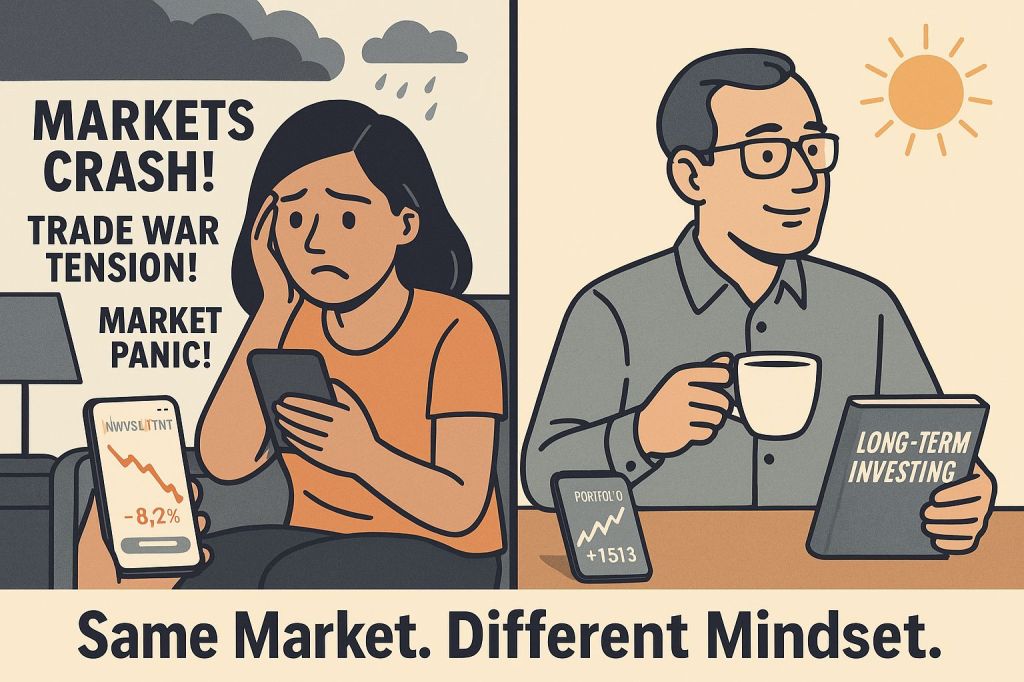
Riya: George, have you seen the news? Markets are crashing again because of some trade war! Should I be selling my investments? I’m really nervous.

George: Ah yes, another day, another headline. Okay, let me ask you this—if your favorite clothing store runs a 30% discount, do you stop shopping there or do you consider picking up a good deal?

Riya: I mean… if I like the stuff and it’s cheaper, I’d probably buy.

George: Exactly. The stock market’s no different. When prices dip, it’s not always a disaster—it can be a discount. But panic makes us forget that.

Riya: But it feels scary. Every time I open a news app, it’s like the world is ending!

George: That’s what headlines are designed to do—grab attention. It’s like when a weather app shows “Thunderstorm Alert” but you just get a light drizzle. Doesn’t mean you cancel your whole trip, right?

Riya: True… I usually carry an umbrella and go on with my day.

George: Same with investing. Volatility is the drizzle. You don’t shut everything down—you just stick to your plan and keep going.

Riya: Okay, but my neighbor just sold off half his mutual funds and other investments. Says he’ll “re-enter when things settle.”

George: That’s like trying to jump on a moving train. Timing your exit and re-entry is extremely tough—even for professionals. You end up stressed, and often worse off.

Riya: But isn’t doing nothing kind of… lazy?

George: Not at all. It’s like planting a mango tree. You don’t dig it up every month to check if it’s growing, right? You water it, give it sunlight, and wait. Investing is the same. Staying invested is the hard part—not reacting.

Riya: Hmm… and what about my SIPs? Should I continue?

George: Absolutely. Think of SIPs like your gym routine. Skipping workouts when progress is slow won’t help. Staying consistent builds results. Right now, your SIP is buying more units at lower prices—that’s good for your future self.

Riya: And the extra cash I’ve been saving?

George: Deploy it gradually. Like how you don’t pour all the batter at once into a pan—you make pancakes one at a time, patiently.

Riya (laughs): Okay, now you’re making me hungry and financially wiser!

George: Good. Because investing, like cooking, needs timing, patience, and trust in the process. And when the news starts screaming again, remember—it’s just the smoke, not the fire.The hardest thing in investing isn’t picking the right fund—it’s doing nothing when everything screams at you to do something. It takes patience, discipline, and a bit of faith.

The hardest thing in investing isn’t picking the right investment—it’s doing nothing when everything screams at you to do something. It takes patience, discipline, and a bit of faith.

Riya: Wow, George. You always manage to calm me down. You should really start your own podcast!

George (laughs): Maybe I will like —”The Zen of Doing Nothing.” Episode 1: Ignore the Noise, Stay the Course. Ha…ha…

The Tariff Tantrum and the Market Noise

Riya: Shyam, did you see what happened to the Banking stocks yesterday? They were up one day and crashing the next! I’m really stressed out. What’s going on?

The wild market swing

Shyam: I saw that, Riya. It’s what we call a tariff tantrum. At first, people thought the Banking sector would be safe from the trade tariffs. So the stocks jumped. But the very next day, news came out saying the opposite—and boom, they fell.

Riya: So should I be selling my investments now?

Shyam: Not so fast.

Riya:But this feels like 2018 all over again.When there was impact on the Chinese stocks?

Shyam: Exactly. Stocks did take a hit. But did businesses stop growing? No. Earnings, cash flow, and long-term performance continued just fine. Markets react emotionally, but businesses move at their own pace.

Riya: Still, this volatility is scary. Isn’t it risky?

Shyam: Riya, volatility isn’t the real risk. The real risks are:

  • Losing your capital permanently.
  • Chasing hot, trendy stocks without knowing the risks.
  • Paying too much for a good company.

That’s why I always suggest staying conservative and sticking to strong fundamentals.

Riya: So… what should I do when the market behaves like this?

Shyam:Ask yourself a few simple questions:

  • Has the company’s product become less useful?
  • Has their cost structure changed badly?
  • Or is it just short-term politics or fear?

If it’s the last one, it’s not a reason to panic.

Riya: Okay, but what kind of companies survive these shocks better?

Shyam:The strong ones.

Businesses with:

  • Pricing power
  • Durable moats
  • High return on capital
  • And steady cash flow

They handle storms better—and sometimes, when prices fall, those are the ones to even buy more of.

Riya: Hmm. So I should look at the long term?

Shyam: Exactly.

Philip Fisher said “The stock market is filled with individuals who know the price of everything, but the value of nothing.”— Value investing is about substance, not just price.
In other words, stock prices can swing wildly due to news or opinions. But over time, what really matters is the actual weight of the business—its earnings, value, and performance.

Riya:Makes sense. But can you give me a real-life example?

Shyam: Sure! Think about your favorite restaurant in town. One day, someone spreads a rumor that it’s shutting down. The crowd disappears. The next day, the owner clears the air—it was just a rumor. People return.

Did the taste of the food change? No. Did the service drop? No. It was just a temporary scare. That’s how the market works too.

Riya:That really helps, Shyam. I think I was getting carried away by the panic.

Shyam: It happens to the best of us. Just remember—stay calm, think long term, and stick to strong companies. The storm will pass away.

“Riding the Small-Cap Storm: Time to Panic or an  Opportunity?”

Scene: Rita, a concerned investor, meets Sam, a seasoned professional, to discuss the recent downturn in small-cap stocks.

Rita: Sam, I’m really worried. My small-cap investments are bleeding! Some stocks are down more than 50%! I’m thinking of stopping my SIPs.

Sam: I get it, Rita. It’s tough to see red in your portfolio. But tell me, when you go shopping and see your favorite brand of coffee at half price, what do you do?

Rita: Well… I stock up, of course!

Sam: Exactly! So why do we panic when stocks go on sale? Small caps had a great run in 2023 and 2024. Now, they’re correcting. It’s part of the cycle.

Rita: But this drop feels different. Some experts say things will get worse before they get better. Shouldn’t I get out now?

Sam: Let’s think of it another way. Remember your friend who started a bakery last year?

Rita: Yes, Anjali.

Sam: Now imagine she had a great first year—tons of customers, big profits. But this year, suddenly, her ingredient costs went up, and she lost some customers. Does that mean her business is doomed?

Rita: No, it just means she has to manage through tough times.

Sam: Exactly. Small companies, like Anjali’s bakery, go through ups and downs. If you believe in the long-term potential of good businesses, you don’t abandon them in tough times—you stay invested and let them grow.

Rita: But what if the market crashes further?

Sam: What do you do when you see storm clouds? Do you sell your house and move?

Rita: No, I wait for the storm to pass.

Sam: That’s what seasoned investors do. Timing the market is nearly impossible. Instead of stopping your SIPs, why not continue them and accumulate more units at a lower price? When the market recovers, you’ll be in a stronger position.

Rita: So, you’re saying this is a phase, and I should stay put?

Sam: Stay put, but also be smart. If you’re overexposed to small caps, rebalance. If you have a long-term horizon, continue your SIPs. And most importantly, invest in businesses, not just stock prices.

Rita: Thanks, Sam. You always simplify things for me. Maybe I’ll buy some extra small caps while they’re “on sale.”

Sam: Now that’s the right investor mindset!


Questions you should ask in the Investing World

Scene: (A cozy coffee shop. Riya, a new investor, and Sam, a seasoned investor, are chatting over coffee.)


Riya: Sam, I feel like investing is all about finding the best product. Afterall, everyone keeps asking—“Which the best stock in the market that they should buy?” or “Which mutual fund will give me the best returns in the market?” But I always feel unsure. How do you stay confident?

Asking the right questions is the key

Sam:Riya, let me ask you something—when you go for shopping, do you always look for the “best” product, or do you ask a few basic questions first?

Riya: Of course, I ask questions! Like, if I’m buying a phone, I check what features I need, my budget, and whether it’s reliable.

Sam:Exactly! You don’t just buy the most popular phone; you find the one that fits your needs. Investing works in a similar way. The key isn’t having the perfect answer—it’s about asking the right questions.

Riya: Hmm….What kind of questions?

Sam: Instead of asking, “Which stock will give me the highest return?” try asking:

  • Why am I investing in this? (Like asking why you need a phone—for work, for gaming, for photography?)
  • What can go wrong? (Like checking if a phone has overheating issues or a shortet battery life.)
  • Under what circumstances am I going to sell my investments? (Like deciding when you’d upgrade your phone—when it slows down or a new model offers a big improvement?)

Riya:That makes so much sense! But what if I don’t have all the answers?

Sam:You don’t. Take restaurants, for example. If you see a long line outside a new place, do you immediately assume it’s the best food in the town?

Riya: Not really. I’d check reviews or ask people if it’s actually worth the wait.

Sam: Exactly! Just because an investment is popular doesn’t mean it’s the right option for you. Before investing, ask yourself the following questions:

  • Do I really understand this company? (Like checking what cuisine the restaurant serves—do you even like it?)
  • How does it make money? (Like seeing if the restaurant is running on quality food or just hype.)
  • What’s the downside? (Like checking if the food is overpriced or the service is bad.)

Riya:I love this way of thinking! But when should I sell? People say, “I’ll sell when I make a good profit.”

Sam:That’s like saying, “I’ll stop going to the gym when I look fit.” Instead, wouldn’t it make more sense to decide upfront—“I’ll go to the gym until I reach my target weight or can run 5 kms. comfortably?”

Riya:Yeah, that makes sense! So I should have a clear exit plan for investments too?

Sam:Absolutely. Before buying, ask:

  • Under what conditions will I sell? (Like when you’d trade in your phone—battery issues, slow performance?)
  • What would make me change my mind about this investment? (Like if a restaurant you loved suddenly had terrible service—would you keep going just because you once enjoyed it?)

Riya: Wow, so investing is really about questioning my own decisions and hypothesis, not just chasing the “best” financial products in the market.

Sam: You got it! Good questions act like a safety net. They protect you from impulsive decisions—whether the market is going upwards or downwards.

Riya:This has been an eye-opener, Sam. Next time I invest, I’ll focus on asking some smarter questions instead of looking for the perfect financial products.

Sam: That’s the right mindset, Riya! Investing isn’t about predicting the future—it’s about preparing for it with a planned approach towards it.


“Health Insurance Dilemma: How Much Coverage is Enough?”

Scene: Aarti and Riddhi are sitting in a restaurant having lunch. Aarti, a working mom, is confused about how much health insurance she really needs?


Aarti: Riddhi, I saw some insurance companies offering ₹1 crore health coverage. That sounds like a lot! Do I really need that much?

When decision making is not that tough.

Riddhi: Not necessarily! A ₹1 crore policy is just like a regular policy, but with a higher coverage amount. It covers hospital bills, surgeries, and major treatments.

Aarti: Hmm… but isn’t more coverage always better?

Riddhi: Let’s compare it to grocery shopping. Would you buy 50 kg sac of rice for your family when you only need 10 kg a month?

Aarti: No, that would be a waste!

Riddhi: Exactly! Similarly, a ₹25-30 lakh health cover is usually enough for major treatments like heart surgery or cancer treatment.

Aarti: But medical costs are rising. What if ₹25 lakh isn’t enough in the future?

Riddhi: Good point! That’s why some policies offer an automatic reinstatement( like an automatic restore option) feature. Imagine your phone data plan—if you use up your daily limit, some plans automatically give you more data for the day.

Aarti: Oh, that’s helpful! But is there a catch?

Riddhi: Yes, some insurers have a cooling-off period before they restore the coverage, and it doesn’t help if you need it for a long-term treatment.

Aarti: So, if I need multiple rounds of expensive treatment, I could still run out of coverage?

Riddhi: Right! That’s where a super top-up plan can help you.

Aarti: What’s that?

Riddhi: Think of it like a food delivery subscription. Instead of paying a huge amount upfront, you pay for basic deliveries and add extra when needed.

Aarti: So, I can take a smaller base policy, like ₹10-25 lakh, and add a super top-up?

Riddhi: Yes! It’s much cheaper than buying a ₹1 crore policy directly.

Aarti: But what’s the downside?

Riddhi: You’ll have to deal with two insurers when filing claims—one for the base policy and one for the top-up. It’s like billing groceries at two different counters instead of one. But, to avoid this you can take the base plan from the same health insurance company as your super top up plan. That will save you from unnecessary hassles.

Aarti: That sounds good.

Riddhi: If saving money is a priority, it’s a great option. If convenience matters more, a direct ₹1 crore policy is better.

Aarti: Got it! A ₹25-30 lakh policy sounds like a good balance, and I can add a super top-up if needed.

Riddhi: Exactly! Choose what fits your pocket and comfort level.


“ELSS Funds: Should you Stay Invested or Switch?”

Shreya: Hey Raj, I’ve been reading up on ELSS (Equity Linked Savings Schemes also popularly known as Tax Saver funds), and I saw a comparison that reminded me of how some businesses get disrupted by big changes. Can you explain what that means?

To stay or Sell an ELSS funds?

Raj: Sure, Shreya. Imagine how Blockbuster (US based company was once a dominant force in the home entertainment industry, known for its video rental stores which once dominated video rentals, was overtaken by streaming services like Netflix. Just like Blockbuster struggled to adapt to new technology, ELSS funds are now facing challenges because government policies are shifting. The new tax regime is making traditional tax-saving benefits less attractive.

Shreya: I get that. So if I’ve already completed the three-year lock-in period for my ELSS, should I consider selling them off or hold onto them?

Raj: Think of it like deciding whether to keep an old appliance. If it still works well and you don’t need money urgently, you might keep it. But if it’s underperforming or you have a better alternative, you might sell it and upgrade. Similarly, if you need cash or feel your ELSS fund isn’t performing compared to others, you could consider liquidating. However, if you’re in it for the long term, sticking with your investment to benefit from market cycles and compounding might be the better choice.

Shreya: That makes sense. What kind of returns have ELSS funds been delivering over the years?

Raj: Over any 3-year period in the last decade, ELSS funds have averaged about ~14% annual returns, though there have been periods when returns dipped to ~ -7%. If you extend the period to five years, the average return is ~ 13%, and the worst case was around -2%.It’s similar to saving money in a piggy bank over time—the longer you leave it untouched, the more you benefit from steady growth, even if there are occasional dips.

Shreya: And how do ELSS funds compare to flexi-cap funds?

Raj: Imagine you have two similar grocery stores in your neighborhood. Both offer the same quality of products and prices over time, even though one might have a few restrictions like a minimum purchase. In the investment world, aside from ELSS’s three-year lock-in and tax benefits, both ELSS and flexi-cap funds tend to deliver similar long-term returns—above 12.8% annually over five- to seven-year periods. So for long-term wealth building, either option could work well.

Shreya: Got it. What about ongoing SIPs in ELSS funds? Should I continue or think about switching strategies?

Raj: Think of your SIPs like a regular gym membership. If you’re committed and disciplined, the membership keeps you in shape over time, even if you’re not getting an immediate transformation. The three-year lock-in in ELSS funds acts like that commitment—it prevents you from making hasty decisions. However, if you find another gym closer to your home with similar facilities (or in this case, a flexi-cap fund offering similar growth), you might consider switching, especially since the new tax regime reduces the advantage of those upfront tax benefits.

Shreya: So basically, if I don’t need immediate access to my funds and I’m focused on long-term growth, I should stick with my ELSS. But if my needs or performance expectations change, I might think about switching?

Raj: Exactly. It’s like deciding whether to keep using an old car or buying a new one. If the old car still runs well and meets your daily needs, there’s no rush to change. But if it starts costing too much in repairs or isn’t performing as well, you’d consider a new model. Align your investment choices with your financial goals and comfort with risk.

Shreya: Thanks, Raj. Using these everyday examples really helps me understand the concepts better!

Raj: I’m glad to hear that, Shreya. It’s always useful to relate financial decisions to day-to-day scenarios so you can see how they play out in real life.

“FDs or Debt Funds: Locking Safety or Unlocking Growth?”

Mukesh (Investor): Sujit, I’m planning to invest in a fixed deposit (FD), but I heard that the RBI has cut the repo rate. Does that mean FD rates will also go down?

Candid discussion about FDs and other options

Sujit (Financial Planner): Exactly, Mukesh. Think of it like this—when petrol prices drop, cab fares often follow the same. Similarly, when the RBI lowers the repo rate (the rate at which it lends to banks), banks also reduce the interest they offer on FDs. So, if you’re keen on FDs, locking in current rates before they drop further could be a good idea.

Mukesh: That makes sense. But before I jump in, what are some things I should keep in mind with FDs?

Sujit: Good question. FDs are like a fixed-rate train ticket—you know exactly what you’ll get at the end of the journey, but there are conditions:

  1. Breaking an FD early comes with penalties – Imagine booking a hotel for a week but checking out on Day 3; you’d likely lose some money. Similarly, banks charge a penalty (0.5-1%) if you withdraw early, plus you may get a lower interest rate based on your actual holding period.
  2. Tax impact – The interest you earn is added to your taxable income every year, just like your salary. If you’re in a higher tax bracket, your actual returns could be much lower than the advertised rate.

Mukesh: Got it. What are the current FD rates?

Sujit: Right now, major banks are offering around 6.5-7.5% for tenures of one to five years. Small finance banks may offer up to 9%, but they do come with slightly higher risk—kind of like choosing between a well-known airline and a budget carrier.

Mukesh: Hmm… Are there better alternatives?

Sujit: Yes! Debt funds, especially short-duration funds and targeted-maturity funds (TMFs), can be great options.

Mukesh: And how do they work?

Sujit: Think of a short-duration fund like a recurring deposit that invests in bonds maturing within 1-3 years. TMFs are more like a fixed deposit with not a set maturity date—you invest and hold, making returns more predictable.They are debt mutual funds that aim to replicate a specific debt index.

Mukesh: That sounds interesting. Have they performed better than FDs?

Sujit: Absolutely! If you compare their performance over the last five years:

  • 1-year period: Debt funds outperformed FDs about 65 to 70% of the time.
  • 2-year period: They outperformed ~75% of the time.

So, much like choosing between cooking at home (FDs) and ordering a meal kit (debt funds)—both get the job done, but one may offer more convenience and flexibility.

Mukesh: What about taxation?

Sujit: Debt funds have an edge here. Unlike FDs, where tax is deducted every year, debt funds are taxed only when you sell them. It’s like delaying tax payments until you actually withdraw money, allowing your investment to grow more efficiently.

Mukesh: That’s a big plus! And liquidity?

Sujit: Another advantage! With FDs, breaking them early costs you. But with debt funds, you can withdraw anytime without a penalty—like canceling a flight with a refundable ticket.

Mukesh: Are there any risks?

Sujit: Yes, but they can be managed:

  1. Interest rate risk – When interest rates rise, bond prices fall, slightly impacting returns. But short-duration funds handle this better than long-term ones.
  2. Credit risk – Some funds invest in lower-rated bonds (kind of like lending money to a friend with an uncertain repayment history). Sticking to AAA or AA-rated funds keeps the risk lower.

Mukesh: So, what’s your final advice?

Sujit: If you’re looking for 100% safety and fixed returns, go ahead and lock in a long-term FD before rates drop. But if you want higher potential returns, flexibility, and tax efficiency, debt funds—especially short-duration funds and TMFs—are a smarter choice.

Mukesh: I like the idea of having both—some in FDs for security and some in debt funds for better returns.

Sujit: That’s the best approach! Just like balancing your meals—you need both home-cooked food and a few restaurant outings.

NPS Vatsalya: Decoded

Scene: Rita, a young mother, meets Raj, a financial consultant, at a café to discuss a long-term financial plan for her child.

Rita: Hey Raj, I recently heard about NPS Vatsalya, a pension scheme for children. It sounds interesting, but I don’t fully understand how it works. Could you explain?

Understanding NPS Vatsalya

Raj: Absolutely, Rita! NPS Vatsalya is a pension scheme introduced by the Indian government in 2024, designed specifically for minors. It helps parents like you build a retirement corpus for their children from an early age.

Rita: Retirement planning for a child? That sounds a bit unusual!

Raj: I get it why it sounds that way. But think of it as a long-term financial security plan. With rising costs and uncertainties in the future, having an early start on retirement savings can be a huge advantage. Plus, it teaches financial discipline right from childhood. (For those of you who attended my webinar session I have provided a similar power of compounding magic with the classic 5,000 example)

Rita: That makes sense. So, how does one enroll in this scheme?

Raj: It’s simple! A parent or legal guardian can open an NPS Vatsalya account on behalf of a child below 18. The child is the beneficiary, but the guardian manages the account until they turn 18.

Rita: And what’s the minimum investment?

Raj: The minimum initial contribution is ₹1,000, and after that, you can invest as much as you like. There’s no upper limit.

Rita: That’s flexible! But where does the money get invested?

Raj: Just like a regular NPS account, you can choose from different Pension Fund Managers regulated by PFRDA. You also have the option to pick between an active investment mode, where you control asset allocation, or an auto mode, where the allocation happens based on predefined rules.

Rita: I like that flexibility! But what happens when my child turns 18?

Raj: Once the child turns 18, the account automatically converts into a regular NPS account, and they can continue contributing for their retirement.

Rita: That’s interesting. But what if I need to withdraw money before my child turns 18?

Raj: There are some withdrawal rules:

  1. Partial Withdrawals – Allowed after 3 years from the account opening date.
  2. Permitted Purposes – Education, treatment of serious illnesses, or if the child has a disability of more than 75%.
  3. Withdrawal Limit – Up to 25% of your contributions (excluding returns) can be withdrawn.

Rita: That’s reassuring! But what if something happens to the child before they turn 18?

Raj: In case of the unfortunate demise of the child, the entire accumulated corpus is paid to the parent or legal guardian.

Rita: And after 18, how can my child use the money?

Raj: At 18, they have two options:

  1. Annuity Purchase80% of the corpus must be used to buy an annuity, which will provide a regular pension.
  2. Lump-Sum Withdrawal – The remaining 20% can be withdrawn as a one-time payment.

Rita: But what if the corpus is small?

Raj: If the total corpus is ₹2.5 lakh or less, your child can withdraw the entire amount instead of buying an annuity.

Rita: That’s a fair balance between flexibility and long-term security. But can I switch my child’s NPS Vatsalya policy to another provider later?

Raj: Yes! NPS accounts are portable, so you can change the Pension Fund Manager if you’re not happy with the performance. Also, once the child turns 18, they can switch their investment preferences based on their risk appetite.

Rita: That’s great! But is it better than other investment options like PPF or mutual funds?

Raj: Each option serves a different purpose:

  • PPF – Great for safe, long-term tax-free savings.
  • Mutual Funds – Better for wealth creation, but market risks are higher.
  • NPS VatsalyaGuaranteed pension for the child’s future, ensuring financial security in retirement.

Rita: That’s a helpful comparison! Before I decide, is there anything else I should know?

Raj: Yes! Here are three more things to keep in mind:

  1. No-Claim Bonus (NCB): If no withdrawals are made, the investment grows faster due to compounding.
  2. Tax Benefits: Although it’s still evolving, NPS investments generally enjoy tax benefits under Section 80CCD(1B).
  3. Lifetime Renewability: Your child can continue investing and build a massive retirement corpus over time.

Rita: This was really insightful, Raj! I think NPS Vatsalya could be a great way to secure my child’s future while also teaching them about financial planning.

Raj: Absolutely! It’s a long-term commitment, but it ensures financial independence for your child when they grow up. Let me know if you need help with the application process!

Rita: Thanks, Raj! I’ll go through the details and get started soon.

Riding the Market Storm: Staying Steady Through Volatility

Scene: A cozy café, with soft music playing in the background. Rina, an investor, looks anxious as she sips her coffee. Pradeep, her financial planner, sits across from her, listening carefully.

Is it time to panic?

Rina (frowning):Pradeep, I’m really worried. The market’s been crashing — my portfolio is bleeding. The Sensex is down, and my small-cap funds are a disaster. I’m wondering if I should just pull out everything before it gets worse.

Pradeep (calmly):I understand, Rina. Market downturns can be scary, especially when you see your portfolio value drop. But let’s take a step back.

Rina:Oh? So what do you have to say?

Pradeep:I acknowledge that there is sharp decline in the Sensex and small-cap indices over the last six months siince September 2024. A lot of investors are seeing substantial losses, just like you.

Rina (sighing): So I’m not alone in this mess?

Pradeep (smiling):Not at all. But here’s the key part — if you zoom out and look at the last 5 year window, the Sensex has moved at the rate of 22.4% annualized rate that means your money would have doubled in approximately 3.2 years and small-caps have skyrocketed by over 39.4% CAGR and midcap by a whooping 66.44%.

Rina (surprised): Wait, really? Even after this crash?

Pradeep: Yes! The market might be down now, but over time, it has delivered tremendous growth. That’s why staying invested, even during turbulent times, is so crucial.

Rina:But emotionally, it’s just so hard to see my money shrink like this.

Pradeep: That’s completely valid. You have to be emotionally resilient. Short-term losses are painful, but if you have a gaol-based financial plan which focuses on your asset allocation that can help you avoid making rash decisions. Also Remember if you have over allocated to the mid cap and small cap you need to trim down your portfolio (as your financial plan was already well prepared for that). Remember, panic selling locks in your losses for forever.

Rina (nodding slowly): So, you’re saying I should just stay the course?

Pradeep:Exactly. We’ve built your portfolio with long-term growth in mind, and market dips — even severe ones — are a normal part of the investing journey. If anything, this might even be a chance to accumulate more units at lower prices through your SIPs.

Rina (smiling a little):I guess I need to trust the process and not let fear dictate my decisions.

Pradeep: That’s the spirit. Market storms will pass, and patience often rewards those who stay steady.

Rina:Thanks, Pradeep. This chat helped me breathe easier. I’ll hang in there — and maybe even top up my SIPs!

Pradeep (laughs): Now you’re thinking like a pro investor, Rina. Let’s ride this out together.