From Global Drama to Portfolio Nirvana: Staying Calm in a Noisy World

Rita (worried investor): Ricky, did you see today’s headlines? Tensions between Iran and Israel, gold prices shooting up, crude oil becoming so expensive overnight. And then suddenly they say “ceasefire” and everything cools down. The market feels like a rollercoaster! Honestly, I feel like selling my investments and just keeping cash. What if things get worse tomorrow?

Ricky (financial planner): Rita, I understand your worry. But let me ask — is this the first time you’ve seen such news?

Rita: Well… no. I remember tariff wars, elections, oil price shocks, even Covid times. But each time it feels different, scarier.

Ricky: Exactly. Global events are like movie plot twists — they keep coming. Today it’s war news, tomorrow it’s elections, next month it’ll be interest rates. But here’s the thing: your financial life shouldn’t behave like a WhatsApp forward — reacting to every little piece of noise.

Rita (half-smiling): You’re right… but when I see petrol prices rising or my gold jeweller friend looking extra happy, I panic.

Ricky (laughing): That’s like deciding your entire diet based on what’s on sale at the grocery store today. Just because mangoes are expensive doesn’t mean you stop eating fruits altogether!

Rita: Hmm. Fair point. So what should I do? Just sit and watch?

Ricky: Not sit and watch — but plan and act smartly. Let me give you five simple rules.


1. Have a Goal, Not Just an Investment

Ricky: Tell me Rita, why did you buy mutual funds in the first place?

Rita: Umm… everyone was saying SIP is good, so I started.

Ricky: That’s like going on a road trip without deciding the destination. You don’t just drive because the road is smooth — you drive because you want to reach Shimla or Jaipur, right?

Your investments should have the same purpose. Maybe your daughter’s college in 10 years, or your retirement. That’s your “destination.”


2. Diversify Intelligently

Rita: But if markets fall, everything falls, na?

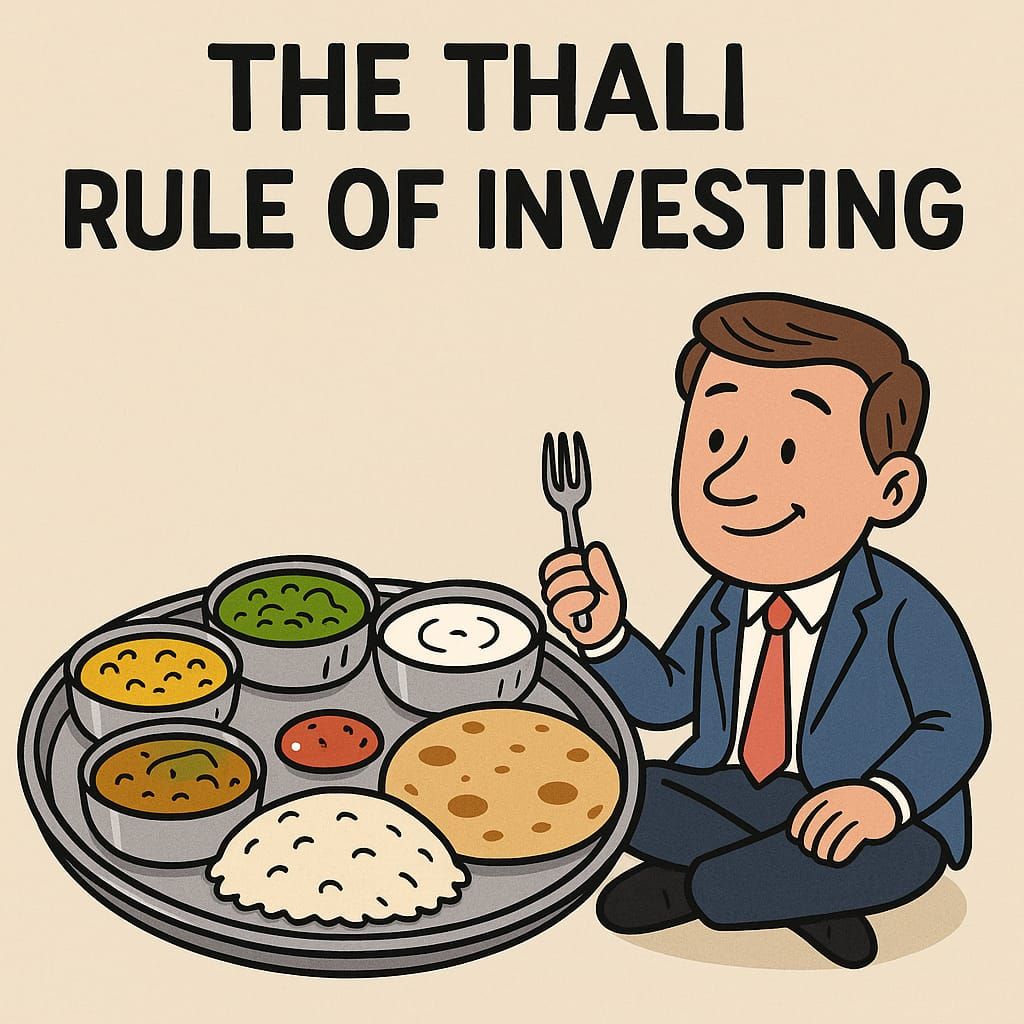
Ricky: Not really. Think of your portfolio like a thali. Rice, dal, sabzi, papad. If one item is a bit too salty, the others balance the taste. Similarly, when equity is down, gold or debt may balance things out. You’ll never love every item on the thali, but together it makes a satisfying meal.


3. Don’t Time the Market — Trust Time in the Market

Rita: But sometimes I feel like selling when the market is high and buying when it’s low.

Ricky (smiling): That’s like trying to predict whether the next raindrop will fall on your nose or your shoulder. Even experts can’t do it consistently.

Instead, just carry your umbrella (your long-term investments) and keep walking. Over 10–15 years, the rain and sunshine balance out.


4. Review, Don’t React

Rita: So when there’s war news or oil price spikes, I should do nothing?

Ricky: Not “nothing.” Review. Ask yourself — does this affect my child’s college fee goal? Does it affect your retirement? If not, stay the course.

If something changes in your life — like you got a new job, or your expenses doubled — then yes, we adjust. The Middle East doesn’t decide your retirement, but your decisions do.


5. Work With a Financial Planner

Rita: And that’s where you come in, right?

Ricky (laughing): Exactly. Think of me as your Google Maps. You’re driving the car, but I’ll reroute when there’s traffic, I’ll warn you when there’s a wrong turn. Headlines may shout “accident ahead!” but I’ll tell you whether you actually need a detour or just patience.


Rita (sighing in relief): So basically, don’t panic every time the world sneezes. Stick to the plan.

Ricky: Perfectly said. Global events are turbulence. But when you’re flying, do you ever see the pilot opening the door and saying, “Too much turbulence, I’m jumping off”? No! The pilot stays on course, follows the flight plan, and trusts the control tower.

You are the pilot of your money. And I’ll be your control tower. Together, we’ll ensure your journey is smooth — no matter how noisy the world gets.

Rita (smiling now): Thanks, Ricky. Guess I’ll finish my chai and delete those WhatsApp panic messages.

Ricky: Good idea. And maybe forward this instead: Patience pays, panic doesn’t.

💰 We Work So Hard. So Why Are We So Casual About Our Money?

Every morning, India wakes up to daily hustle.

From metro cities to small towns, from IT parks to factories, from office cubicles to kitchen counters—we work relentlessly. We put in extra hours, chase deadlines, skip vacations, and push ourselves for one core reason:

👉 To secure our family’s future.

But here’s what’s more puzzling.

When it comes to managing that hard-earned money, many of us suddenly take a back seat. We become indifferent. Casual. We blindly sign investment forms, trust agents without questions, and hope it all “somehow works out.”

Why this disconnect?

It’s not that we don’t care about our goals. But many of us have grown up with the mindset:

“My job is to earn. Investing? Naaaa…..Let the bank guy or agent handle it.”

This over-dependence on third parties—often incentivized to sell, not serve—has created a massive blind spot in the Indian earning class.

And it shows up in painful ways:

  • Policies that don’t beat inflation
  • Investments that don’t align with goals
  • Savings that lie idle in FDs for years
  • Tax-saving schemes bought at the last minute, with zero clarity on what they offer

The cost of this negligence?

Let me tell you about Rajiv (name intentionally changed here)

He earns ₹20 lakhs annually. Over 10 years, he’s diligently saved ₹3 lakhs a year in traditional life insurance policies and FDs.

But when his daughter turns 18 and he needs ₹25 lakhs for her college, he discovers his investments have barely grown—they’re worth ₹11 lakhs. No plan, no growth, just blind faith.

Now he’s staring at an education loan—and regret.

This is not rare. This is common.

So what’s the solution?

It’s financial awareness and ownership.
You don’t need to become a stock market expert. But you do need a basic financial plan. Here’s what it should cover:

Clear goals – Know why you’re investing?
Right insurance – Term life and health, not savings-linked traps
Emergency fund – 6–12 months of expenses
Smart investing – Mutual funds, SGBs, NPS, PPF—based on goals and timelines
Regular reviews – Because life changes

Most importantly: Stop outsourcing your financial life or find someone who really understands your financial needs and make it more easy for you

No one will care about your goals more than you do in the end. So be prudent.

Sales agents may smile and promise, but they don’t carry the burden of your child’s future or your retirement. You do.

My message to every hard-working Indian professional:

You work hard for your money.
Now let your money work smart for you.


👨‍👩‍👧‍👦 Because your dreams deserve more than random investments.
They deserve a clear plan. A thoughtful strategy. And your involvement.

Let’s be more than just earners. Let’s become financially aware, goal-driven individuals who take charge of their money—just like we take charge of our careers.

Beat Your Home Loan Early – Save Millions – Play Smart

Rahul: Hey Sameer, quick question. I’ve taken a home loan of ₹50 lakhs for 20 years at 8.5% interest. The EMI is around ₹43,400. But now that my income has improved, I’m wondering if I can close it earlier. Any ideas?

Sameer: Absolutely, Rahul! Great that you’re thinking about this. Reducing your home loan tenure can save you lakhs in interest. Let’s talk options.

Rahul: Sounds good. What’s the first thing I should consider?

Sameer: First option—increase your EMI. Even adding ₹5,000 more every month can make a big difference.

Rahul: Really? Just ₹5,000?

Sameer: Yep. If you increase your EMI from ₹43,400 to ₹48,400, your loan will close in about 199 months instead of 240—so over 3 years early. Plus, you save around ₹10.1 lakhs in interest.

Rahul: Wow, that’s impressive. What if I don’t want to commit to a higher EMI, but I can make some lump sum payments now and then?

Sameer: That’s the second way—part-payments or prepayments. Say you make an annual prepayment of ₹1 lakh starting from year 2, you could finish the loan in about 14.5 years instead of 20. That saves you roughly ₹14.5 lakhs in interest!

Rahul: That’s a huge saving! What about those step-up EMIs I’ve heard of?

Sameer: Ah yes—strategy three. Step-up EMIs are perfect if your salary increases every year. Suppose you increase your EMI by just 5% annually, your loan could be cleared in about 12 to 13 years.

Rahul: Wait, so just increasing my EMI slightly each year shaves off 7–8 years?

Sameer: Exactly! And it’s painless if your income is growing. You end up saving around ₹17–20 lakhs in interest over time.

Rahul: Amazing. What about switching lenders? I’ve heard about balance transfers.

Sameer: That’s the fourth way. If another bank offers you a lower rate—say 7.5%—you could save money. For instance, if you transfer your remaining loan after 3 years (which would be around ₹46.2 lakhs), your new EMI at 7.5% could reduce to ₹41,900.

Rahul: So I either pay less EMI or keep the same EMI and reduce tenure?

Sameer: Spot on. If you keep paying the same EMI of ₹43,400, you’ll finish the loan faster and still save around ₹4.5 lakhs.

Rahul: This is solid advice, Sameer. But with so many options, how do I decide?

Sameer: Depends on your financial situation. Here’s a quick guide: Strategy Best For Outcome Increase EMI Higher monthly surplus Reduces tenure & interest Part-payment Bonuses or savings Flexible & impactful Step-up EMI Predictable salary hikes Loan ends much earlier Balance Transfer High existing interest rates Interest savings or tenure cut

Rahul: Super helpful! I’m leaning towards increasing my EMI and maybe throwing in a few lump sum prepayments. Can you help me with an Excel tracker?

Sameer: Of course! I’ll build one for you that lets you compare EMI increase, prepayment, and step-up options. You’ll be amazed how much faster you can be debt-free.

Rahul: Thanks a ton, Sameer. I finally feel like I have a plan.

Sameer: Anytime, Rahul. Home loans don’t have to feel like a 20-year trap—you just need the right strategy.

“The Hidden Cost of Limited Pay Insurance Plans: What Every Policyholder Should Know”

Raj: Hey Vijay, I’m thinking of buying a life insurance policy with a limited premium payment option—pay for just 10 years and get coverage for 25 years. Seems like a win-win, right?

Vijay: It sounds good at first, Raj. But have you looked at the details? These limited premium plans often look attractive on paper, but there are some real downsides.

Raj: Really? Like what?

Vijay: First off, the annual premium is much higher because you’re paying for a long-term cover in a shorter period. It can become a heavy burden on your yearly budget.

Raj: Hmm. But at least I won’t have to worry about paying premiums after 10 years.

Vijay: True, but the returns you get from these traditional policies are very low—somewhere around 4 to 6% per annum. That’s barely beating inflation. You’re locking up a lot of money, and getting little in return.

Raj: I thought these plans give bonuses too?

Vijay: They do, but even with bonuses, the overall return doesn’t go much beyond 5–5.5%. Plus, the opportunity cost is huge. If you had invested the same amount elsewhere—like mutual funds or even PPF—you’d likely end up with a much larger corpus.

Raj: But at least my money is safe, right?

Vijay: That’s a common perception. But what if you need to exit early due to an emergency? The surrender value in the first few years is very low, and you could lose a significant chunk of your money.

Raj: Okay… that doesn’t sound great. So how do insurance companies benefit from this?

Vijay: Good question. They collect your premiums upfront, invest them in long-term instruments like government bonds earning 7–9%, and return only a small part to you. Plus, many policies lapse or are surrendered early—so they make money even if you don’t complete the term.

Raj: Wow, that’s stacked in their favor.

Vijay: Exactly. Let me give you a real example. A 35-year-old man buys a traditional limited premium policy with a Rs. 10 lakh life cover. He pays about Rs. 68,000 per year for 16 years, which is Rs. 10.96 lakh in total.

Raj: Okay.

Vijay: At maturity after 25 years, the insurer projects he’ll get around Rs. 24.5 lakh, assuming the best-case bonus rate. That’s an annual return of just around 5.3%. If bonuses are lower, he may get only Rs. 18.5 lakh—an IRR of just 3.4%.

Raj: That’s less than what a decent FD gives!

Vijay: Exactly! And if he were to pass away in the 10th year, the nominee would receive Rs. 10 lakh plus accrued bonuses—maybe around Rs. 13 lakh total. But by then, he’d have already paid about Rs. 6.8 lakh in premiums.

Raj: Hmm. So what would you suggest instead?

Vijay: Simple. Buy a term insurance plan for Rs. 1 crore. It’ll cost you around Rs. 8,000 per year. Then invest the remaining Rs. 60,000 every year in mutual funds. Over 16 years, that investment could grow to Rs. 41 lakh or more at 10% CAGR by the time 25 years are up.

Raj: That’s a huge difference. And I get 10 times the life cover too!

Vijay: Exactly. That’s the power of separating insurance and investment. Insurance is meant for protection. Investment is meant for growth. Combining both usually benefits the insurer, not you.

Raj: Thanks, Vijay. You just saved me from making a costly mistake.

Vijay: Anytime, Raj. Just remember: If it sounds too convenient, it’s probably more convenient for the insurer than for you.

Role of Psychology in Money Management

This blog talks about how your “psychology” can play a major role with the way you make your investment decisions. This can even lead you to make wrong choices impacting your returns.


Riya:Sujit, I’ve been investing for a few years now, but honestly, sometimes I feel like my emotions mess things up. Is that normal?

Sujit:Completely normal, Riya! In fact, most investors struggle with psychological biases. Our brains are wired in ways that can sabotage our investment decisions.

Riya:Really? Like how?

Sujit:Let’s start with Loss Aversion. Imagine you find ₹500 on the road—feels great, right?

Riya:Absolutely! Instant joy.

Sujit:Now imagine you lose ₹500 from your wallet. That hurts more, doesn’t it?

Riya:Way more!

Sujit:Exactly. We fear losses more than we enjoy equivalent gains. So when markets dip, many investors panic-sell—even if it’s temporary. That’s loss aversion.

Riya:Oh! I think I did that in 2020 during the market crash.

Sujit:You’re not alone. Now, here’s Recency Bias. Let’s say you ordered food from a new place last night and it was bad. You might avoid that place forever—even if it’s usually great.

Riya:Haha, yes! I totally hold grudges like that with restaurants.

Sujit:Investors do the same with stocks. If the market just crashed, they assume it’ll keep falling. If it recently surged, they think it’ll never fall. Both are dangerous assumptions.

Riya:That explains why people buy high and sell low!

Sujit:Right. Then there’s Overconfidence. Ever played fantasy cricket?

Riya:Of course!

Sujit:When you win once, do you feel like you’ve cracked the code?

Riya:Totally. I start thinking I’m the next expert selector.

Sujit:That’s overconfidence. In investing, people think they can time the market or pick the best stocks consistently. But it rarely works long-term.

Riya:Guilty as charged…

Sujit:Next up: Herd Mentality. Remember when everyone was buying fidget spinners or that dalgona coffee craze?

Riya:Yes! I joined in just because it was everywhere.

Sujit:That’s what happens with IPOs or trending stocks. People buy because everyone else is buying—not because it makes financial sense.

Riya:Hmm… I bought into an NFO recently just because everyone in my WhatsApp group was investing.

Sujit:There you go! Then there’s Anchoring. Say you saw a dress priced at ₹5,000, then later it’s ₹3,500. You feel it’s a good deal, right?

Riya:Yes, because my mind is stuck on the original ₹5,000 price.

Sujit:Exactly. Investors do the same. They anchor to a stock’s previous high and keep holding it hoping it’ll bounce back, even when fundamentals have changed.

Riya:Oh, that’s why I kept holding that penny stock I bought in 2021. I wanted to “at least recover my cost.”

Sujit:That’s Disposition Effect too—selling winners too early to feel good and holding losers too long hoping they bounce back.

Riya:I do that too! Selling after a small gain and then regretting it when it keeps going up.

Sujit:You’re not alone, Riya. Then there’s Confirmation Bias—you know when you Google “Why is XYZ stock great” instead of looking at both pros and cons?

Riya:Haha yes! I do that all the time. I only read articles that support my views.

Sujit:That can be dangerous. We tend to ignore red flags. Lastly, there’s the Endowment Effect. Ever tried selling old clothes online?

Riya:Yes, and I always feel they deserve a higher price than buyers are willing to pay.

Sujit:Same with investments. We overvalue stocks just because we own them.

Riya:Wow, I didn’t realize how much psychology played a role!

Sujit:That’s why I always tell clients:

  • Stick to a long-term plan
  • Diversify your portfolio
  • Review it regularly, and
  • Don’t let emotions drive decisions

Riya:That makes so much sense. I’m glad we had this chat.

Sujit:Always happy to help. Remember, the market is not just about numbers—it’s also a mirror reflecting human behavior.


Lapsed your Car Insurance Policy? –  Don’t Let a Scratch Cost You a Fortune

Naveen: Hey Ramesh, I just realized my car insurance expired last week. I’ve been juggling office deadlines and totally forgot!

Ramesh: Oh ho, Naveen! That’s like forgetting your anniversary—harmless at first, but can explode anytime! And trust me, if your car gets even a scratch now, you’ll be footing the whole bill.

Naveen: Haha, fair point! But I haven’t taken the car out. Can I still renew it online?

Ramesh: Yes it’s quite possible insurance companies usually offer a grace period for car insurance renewal, though it’s not mandated by the IRDAI. The grace period typically ranges from 30 to 90 days, but the exact duration is determined by the individual insurer. It’s like the grace period after missing a train—you can still catch the next one.

Naveen: Phew! What about my No Claim Bonus? I was banking on that 20% discount!

Ramesh: Ah, the NCB is like a loyalty reward card at your favorite tea point —valid only if you keep visiting. You have 90 days from the expiry date. After that, poof! The discount’s gone.

Naveen: Duly noted! Also, I might sell my car next month. Should I just leave the insurance as is for the buyer?

Ramesh: Big no-no! Selling a car without transferring the insurance is like handing over your house keys but keeping the nameplate. For the first 14 days, only third-party cover continues. The buyer won’t be covered for own damage unless they get it transferred.

Naveen: Interesting! So my NCB goes with me, right?

Ramesh: Exactly! Think of it like frequent flyer miles. You earned them, not the car! You can use it for your next car’s policy, but the new owner can’t.

Naveen: Makes sense. When I renew, should I go with the same insurer or explore others?

Ramesh: Depends. If your current insurer treats you well—good claim support, decent premium—stick with them. If not, it’s like a bad gym membership. Dump it! Other insurers may offer better rates, even loyalty or switcher discounts.

Naveen: Hmm… anything else I should watch out for?

Ramesh: Definitely. Don’t blindly accept the Insured Declared Value (IDV) they give—check if it reflects your car’s actual worth. And consider add-ons like zero depreciation or engine protection. Think of them like seatbelts—you don’t need them until you do.

Naveen: Engine protection? Really?

Ramesh: Absolutely! Monsoon in India is like a wildcard IPL match—anything can happen. One flooded street, and your engine’s gone. The add-on saves you from a massive bill.

Naveen: This is gold, Ramesh! I never thought insurance could be this interesting.

Ramesh: Bro, insurance is like a helmet. You won’t feel the need… until you crash. Always better to be 5 minutes early than 5 lakhs sorry!

Naveen: Haha, true that! Let’s renew this thing ASAP.

Ramesh: Done. Sending you options now. And this time, let’s set a reminder on your mobile phone, like you do for cricket matches!

Car Insurance Simplified

Riya: Hi Amit! I just bought my first car and I’m super excited… but a bit confused about which car insurance to pick. Everyone says different things.

Amit: Congrats, Riya! And don’t worry — I’ll simplify it for you. First, do you know the two types of insurance?

Riya: Umm… third-party and comprehensive?

Amit: Spot on!

  • Third-party is mandatory — it covers damages you cause to someone else’s vehicle or property.
  • But Comprehensive insurance covers both third-party damage and your own car’s damage — due to accidents, fire, theft, floods, etc.

Riya: Got it. So comprehensive is like full coverage?

Amit: Exactly. Think of it like this — if someone hits your car, or a tree falls on it during a storm, third-party won’t help. Only comprehensive will.

Riya: Makes sense. But I saw different premiums based on something called IDV?

Amit: Good observation. IDV stands for Insured Declared Value — it’s the current market value of your car. That’s the amount you’d get if the car is stolen or totally damaged.

Riya: So higher IDV = higher premium?

Amit: Yes, but also better compensation. Don’t reduce the IDV just to save premium — it’ll hurt during a claim.

Riya: Okay. Now what are these add-ons people talk about?

Amit: Add-ons are like toppings on your pizza — optional, but useful.

Here are some:

  • Zero Depreciation: You get full claim without any deduction for parts’ depreciation. Perfect for new or premium cars.
  • Engine Protection: Great if you live in flood-prone areas like Mumbai.
  • Return to Invoice: If your car is stolen, this add-on gives you the full invoice value of the car — not just market value.
  • NCB Protector: If you’ve never made a claim, you get a No Claim Bonus. This add-on lets you keep that bonus even if you make one claim.

Riya: Ohh! That’s actually helpful. I didn’t know the difference. What about deductibles?

Amit: Good question.
There are two types:

  • Compulsory deductible: Set by the regulator — you must pay it during any claim.
  • Voluntary deductible: You choose to pay more from your side, so your premium goes down.

For example, if your bill is ₹10,000 and you chose a ₹2,000 voluntary deductible, you pay that, and the insurer pays ₹8,000.

Riya: Hmm, I’ll keep that in mind. Anything else?

Amit: Yes! A few important things:

  • Check claim settlement ratio – A company that settles 95% of claims is more reliable than one at 70%.
  • Cashless garages – Make sure they have garages near your area.
  • Know the exclusions – Accidents due to drunk driving or without a valid license aren’t covered.
  • Discounts – You can get discounts for installing anti-theft devices or being a member of automobile clubs.

Riya: Wow Amit, you made that so easy! I was expecting insurance to be all boring fine print.

Amit: Haha, it can be. But with the right guidance, it becomes manageable. And hey, pick smart now, and you’ll be thanking yourself later during a claim.

Riya: I’m definitely going with comprehensive insurance now — and maybe a few add-ons. Thanks again!

Amit: Anytime, Riya. And congrats again on your new ride. Drive safe!

“Zero Cost EMI – Too Good to Be True?”

Rimmi: Gyan, guess what? I finally bought my dream mobile phone — on Zero Cost EMI! !

Rimmi:No interest, no extra charges. Feels like a total win.


Gyan: Ah, the sweet illusion of “free.” You’re not wrong, but also… not entirely right.No interest, no extra charges. Feels like a total win


Rimmi: Wait, what do you mean? I’m paying ₹10,000 a month for 6 months. That’s the exact price — ₹60,000. Zero cost, right?


Gyan: To you, yes. But behind the scenes, it’s like a magic trick. The interest still exists — it’s just being paid by someone else.


Rimmi: So… who’s footing the bill? The mobile company?


Gyan: Could be a mobile company. Could be the store. Whoever is desperate to make the sale. Think of it this way: –  If the bank normally charges 15% annual interest, that would’ve been around ₹2,500 extra for your iPhone over 6 months.  But the merchant quietly pays that to the bank for you — so the EMI feels “free.” or in other ways your cost is somehow inflated to an extent that covers up for the free interest part !


Rimmi: Ohhh. Like a hidden sponsor in the background. Kind of like my dad when I first got my OTT subscription.


Gyan:  Exactly! You enjoy the show; someone else handles the bill.


Rimmi: But why would the bank go for this? What’s in it for them if I’m not paying interest?


Gyan: Good question. Let me break it down:
Interest subsidy from the merchant – in your case, ₹2,500.

Interchange fee – the bank earns 1.5–2.5% from the store, say ₹1,200

You’re now locked in with that card for 6 months. Loyalty = future business.

Rimmi: Wow, they really planned this out. It’s like everyone’s making money off my excitement!


Gyan: True. And here’s the kicker — if you miss even one EMI payment? Boom. Late fees. Interest. Your “Zero Cost” EMI becomes “Mega Cost” EMI.


Rimmi: Okay okay, lesson learned! No late payments.


Gyan: And it’s not just phones. This happens with TVs, refrigerators, even fancy mattresses.
Rimmi:  Mattresses?! So I could be paying for sleep… on EMI?


Gyan: Yup. Imagine paying ₹2,000 a month for 12 months — for a bed. That’s ₹24,000. But the bank gets a hidden ₹3,000 from the brand, and you sleep happy thinking you won the deal.


Rimmi: This is blowing my mind. So in a way, I’m part of a giant retail-finance conspiracy!


Gyan: Haha, not a conspiracy — just capitalism wrapped in a bow. But to be fair, if you’re financially disciplined, Zero Cost EMI can genuinely help spread out big purchases without strain.


Rimmi: As long as I don’t miss a payment or get carried away.


Gyan: Exactly. Use it smartly — like fire: great for cooking, dangerous if you don’t respect it.


Rimmi:  Alright then, next stop: a new fridge on Zero Cost EMI — responsibly, of course. 😉

How to use Credit Cards without falling into Debt Trap!

Dheeraj (worried): Raj, I think I messed up. I didn’t pay my full credit card bill last month. Just paid the minimum due. Now my new bill looks inflated, and I have no clue what’s happening!

Sound Advice

Raj (calmly): Relax, Dheeraj. You’re not alone. Tell me, how much was your total due?

Dheeraj: It was ₹10,000. I paid ₹500—the minimum due. I thought I was safe.

Raj: Ah, that’s where the trap is. Let me explain. That ₹500 kept you safe from late payment fees, but it didn’t save you from interest.

Now you still owe ₹9,500, right?

Let’s say your card charges 3% monthly interest. That’s ₹285 in just one month (3% of ₹9,500). And that’s just interest—no principal paid.

Dheeraj (wide-eyed): ₹285 on top of the ₹9,500? Already?

Raj: Yes. And if you made any new purchases, say ₹2,000, they’ll start attracting interest from day one, because you’ve lost your interest-free period.

So now, your total dues next month will look like:

₹9,500 (old balance)

₹285 (interest)

₹2,000 (new spending)

₹60 (interest on new spending at 3% for 1 month)
= ₹11,845 total due next month!

And if you again pay just the minimum, say ₹600 this time, the rest keeps snowballing.

Dheeraj: Oh man. This is like a debt trap!

Raj: Exactly. That’s how credit card companies make money. The minimum due is just enough to keep you from defaulting, but not enough to get out of debt.

Dheeraj: So what should I do now?

Raj: Three things:

  1. Stop using the card until it’s paid off.
  2. Pay the full outstanding, even if it takes two or three installments—just pay more than the minimum.
  3. If you’re struggling, check if your card offers EMI conversion or a balance transfer to another card with lower interest.

And most importantly, going forward—always aim to pay the full due every month. That way, you get up to 45 days of interest-free credit.

Dheeraj: Got it. This ₹285 lesson is one I won’t forget.

Raj (grinning): Good. Credit cards are like fire—great when used wisely, dangerous when mishandled

Don’t Sell in Panic, Grow with Patience

[Scene: A coffee shop. Shyam looks anxious, sipping his coffee. Reny notices.]

Reny:Shyam, you look tense. Everything okay?

Don’t Panic

Shyam: Ugh, not really. The markets have been falling for the past few weeks, and my portfolio is bleeding. I’m wondering if I should just pull my money out before it gets worse.

Reny (smiling calmly):
Ah, the classic investor panic moment. Let’s talk this through. When markets fall, it’s not your portfolio you should look at first — it’s yourself.

Shyam (confused):Myself? But I’m not the one making the markets fall!

Reny:True. But your reaction to the fall makes all the difference in your long-term success.
Let me explain with some examples.


1. Market corrections are natural

Reny:Think of the market like the seasons. You don’t pack away all your clothes in winter and swear never to come out again, right?
You prepare for it — maybe buy a jacket.
Similarly, market dips are just part of the financial seasons. They come and go.

Shyam:So you’re saying this is normal?

Reny:Exactly. Short-term pain is part of long-term growth.


2. Avoid selling in a panic

Shyam:But shouldn’t I sell before I lose more?

Reny:Only if you want to lock in losses permanently. Imagine you own a flat worth ₹1 crore. Someone knocks on your door and offers ₹80 lakhs during a downturn.
Would you sell?

Shyam:Of course not!

Reny:That’s what panic selling is — selling at a temporary low just because someone else thinks it’s worth less today. Not a smart choice.


3. Focus on your long-term goals

Shyam:But it’s hard to ignore the red numbers every day.

Reny:True. But remember why you invested — in a house? Kids’ education? Retirement?
You don’t give up on your 10-year fitness goal just because you had a cheat meal, right?

Shyam (smiling):Guilty as charged.

Reny:So don’t let short-term noise derail your long-term plans.


4. Embrace simplicity

Reny:You don’t need fancy investment strategies right now.
Just like you don’t need ten different apps to track your steps. A basic pedometer works, right?

Shyam:Yes, the more complex things get, the more I overthink.

Reny:Exactly. Stick to the basics — diversify, invest regularly, and keep costs low.


5. Use downturns and market fall as more of an opportunity

Shyam:Opportunities? In this mess?

Reny:Absolutely. Think of it like an end-of-season sale. Quality stuff at lower prices.
The best investors buy more when prices drop — not run away.

Shyam:So I should be investing more now?

Reny:If your financial foundation is strong — yes, gradually. Not all at once.


6. Diversify your portfolio

Reny:You wouldn’t eat only chips all day, right? You mix fruits, veggies, grains…

Shyam:Now that you say it — yes.

Reny:Same with investments. A mix of equity, debt, gold, maybe international funds — reduces risk. When one goes down, others may hold you up.


7. Stick to a plan

Shyam:But it’s tempting to change things when everything’s falling…

Reny:I get it. But think of a GPS. When you hit traffic, do you throw away your destination?

Shyam:No, I wait it out or take another route.

Reny:Exactly. Don’t abandon your financial plan just because of a market jam. The journey is still worth it.


Shyam (sighing with relief):Reny, this was so helpful. I walked in thinking of selling everything. I’m walking out thinking of planting more.

Reny (smiling):That’s the spirit. Be the calm gardener, not the nervous weather reporter.

Shyam:Thanks again. I think I need this conversation saved and replayed every time the market dips!

Reny (raising her coffee):To calm minds and to the  long-term wealth creation.