The Lazy Investor’s Dream: 3 Years of Effort leading to Lifetime Pension

How Rohan Built a Lifetime ₹21,000 Monthly Income by Investing for Just 3 Years

Rohan was 30 when he realised something important: “I don’t need to invest forever. I just need to invest consistently for a short time… and then let time do the heavy lifting.”

But life wasn’t giving him a 20-year runway of regular savings.

He had a wedding coming up, a home loan on the horizon, and the usual chaos that shows up in everyone’s early 30s. He knew he could not invest long-term. But he also knew he must do something.

So he made a simple plan:
Invest for 3 years.
Wait for 20 years.

That was it.

Illustration 1: Rohan’s 3-Year Investment Phase (Age 30–33)

Monthly SIP: ₹25,000

Duration: 36 months

Growth Rate: 6% per annum (conservative)

Total invested: ₹25,000 × 36 = ₹9,00,000

Value at end of 3 years: ₹9.83 lakh

He didn’t try to chase big returns. He just stayed consistent. And after 36 months, he stopped. Completely !

Illustration 2: The Waiting Years (Age 33–50)

Rohan invested nothing after age 33.

He simply kept his ₹9.83 lakh invested and let it grow silently.

Compounding Duration: 17 years and the value after 17 years ₹62.54 lakh

No extra investment.
No extra effort.
Just time + compounding.

Illustration 3: Rohan’s Lifetime Income Plan (Age 50 onwards)

At 50, Rohan did one simple thing: He shifted the ₹62.54 lakh to a Conservative Hybrid Mutual Fund and set up an SWP (Systematic Withdrawal Plan).

Withdrawal Strategy:

  • Withdraw 4% per year
  • Stay within a safe, lifelong withdrawal limit
  • Keep the remaining corpus invested so it sustains forever

4% of 62.54 lakh = ₹2.50 lakh/year

That is ~₹21,000 per month — for life. This ₹21,000/month becomes his personal pension.

A pension he created by investing only for 3 years.

Rohan’s Biggest Realisation : While reflecting on his journey, he told his friend: “I didn’t build wealth by investing for 20 years. I built wealth by waiting for 20 years.” Most people believe wealth creation demands long-term investing, big money, or endless discipline.

Rohan proved otherwise:

  • Focus hard for 3 years
  • Do nothing for 17 years
  • Enjoy income for life

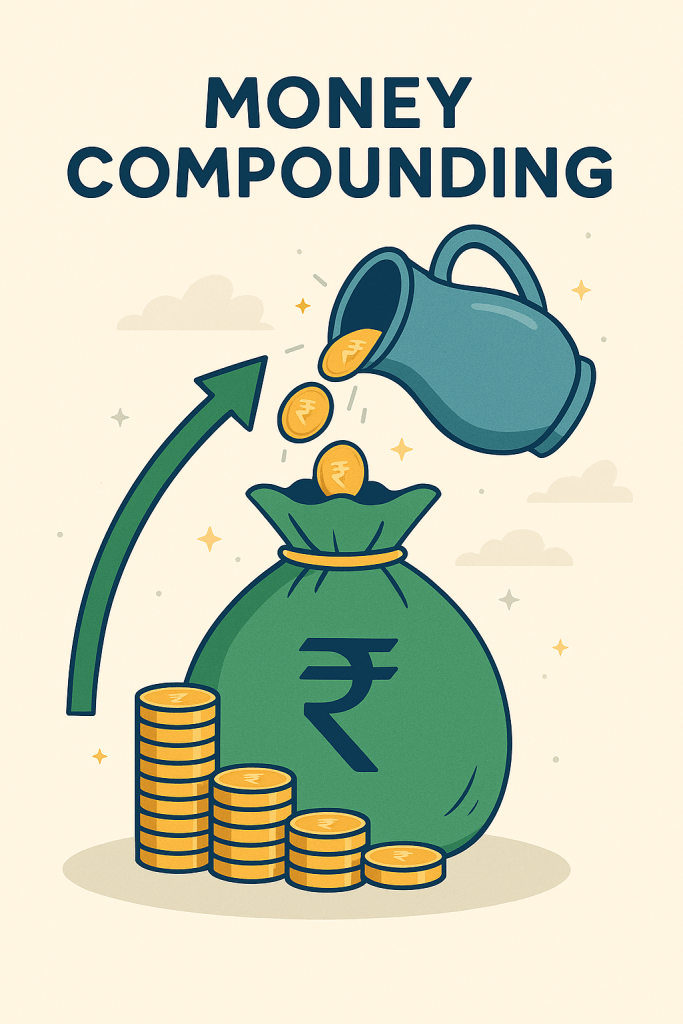
That’s the quiet magic of compounding.

The 3X Rule: Your Path to Money That Never Runs Out

Rick: Shyam, can I ask you something that’s been on my mind?
How can people invest just five thousand a month, and later withdraw fifteen thousand a month… for the rest of their lives?
How does that even add up?

Shyam: It sounds impossible only until you understand two ideas:
compounding and discipline.
Most people underestimate both.

Let’s start with compounding.

Rick: Go on. I’m listening.

Shyam: Imagine you plant a sapling in your backyard.
For the first few years, it hardly grows.
Tiny. Slow. Boring.
But after 10 to 12 years, it starts shooting up fast — the trunk thickens, branches grow rapidly, fruits start appearing.

Money works exactly like that.
Not in year 1 or 2…
but in year 10, 12, 15…
that’s when the real explosion happens.

Compounding rewards those who stay long enough.

Rick: So the 5,000 per month becomes something meaningful only because it stays long?

Shyam: Exactly.
Let’s quantify it:

5,000 a month for 15 years becomes about 24 lakh rupees.

Not because you invested a lot.
But because you stayed disciplined for long enough
for compounding to wake up.

Rick: Fine, I get the compounding part.
But how does that give me fifteen thousand a month later?

Shyam: Before I answer that, let me show you something simple.
Let’s call it the Sustainable Withdrawal Cheat Sheet.

If your investments earn:
8% returns → you can safely withdraw 3–4% for life
10% returns → withdraw 3–5% for life
11–12% returns → withdraw 4–6% for life
13–15% returns → withdraw 5–7% for life (maybe sustainable)
15%+ returns → 6–8% withdrawals only for short periods

This is not theory. It’s global research used for retirement planning worldwide.

Rick: So… to never run out of money, my withdrawals must be lower than my returns?

Shyam: Correct.
If your money earns 10% and you withdraw 4%, your money grows.
If your money earns 12%  and you withdraw 6% your money stays stable.
If your money earns 12% and you withdraw 12%, your money dies.

This is the whole science.

Rick: Okay. But how does this explain the fifteen-thousand withdrawal?

Shyam: Let’s connect the dots.

You invest ₹5,000/month for 15 years.
You get a corpus of ₹24 lakhs.
Now imagine your investment continues growing at roughly 11–12%, which historically many diversified funds do over long periods.

Using the cheat sheet:
At 11–12% returns, you can safely withdraw 4–6% per year for life.

So for a ₹24 lakh corpus:

4% withdrawal = ₹96,000 per year = ₹8,000 per month
5% withdrawal = ₹1.2 lakh per year = ₹10,000 per month
6% withdrawal = ₹1.44 lakh per year = ₹12,000 per month

Now here’s the part most people miss:

Your ₹24 lakh corpus doesn’t remain ₹24 lakh.
It continues compounding at 11–12%.
So even if you withdraw around ₹15,000 a month (about 7.5%), the underlying money keeps growing enough to support it.

Why?
Because compounding is still working behind the scenes.

Withdrawals don’t stop the engine — they only tap into it.

Rick (thinking): So a small disciplined SIP gives me a big enough engine…
and because that engine keeps earning more than I withdraw,
it continues paying me for life.

Shyam: Exactly.
You’re withdrawing three times what you used to invest. Not because of luck,
but because your withdrawal rate is controlled and your compounding rate is higher.

Rick: This suddenly makes sense.
It’s not magic — it’s math plus patience.

Shyam: That’s the line, Rick. Money rewards those who do small things consistently…
and then have the patience to let compounding do the heavy lifting.

Rick: So, in one sentence?

Shyam: Sure.
Discipline builds the corpus.
Compounding grows it.
And safe withdrawals keep it alive forever.

Rick (smiles): I think this is the first time money feels… understandable.

“Safe, Steady, and Secure — The Power of the Senior Citizens Savings Scheme”

Dinesh: Ram, now that I’ve retired, I’m trying to figure out where to park my savings. I want something absolutely safe — no stock market drama — and a steady income to manage my monthly expenses. Any ideas?

Ram: Of course, Dinesh ji! For someone in your situation, the Senior Citizens Savings Scheme (SCSS) is tailor-made. It’s backed by the Government of India, offers regular quarterly income, and ensures total safety of your principal.

Dinesh: Sounds good. But who can invest in it?

Ram: It’s simple — anyone who is 60 years or older can invest.
If you’re between 55 and 60 and have retired under superannuation or voluntary retirement (VRS), you can also join, as long as you invest within one month of receiving your retirement benefits.
Even defence personnel can invest, regardless of age.

But note — NRIs and HUFs are not eligible.

Dinesh: Got it. So how does one invest — monthly, like an SIP, or lump sum?

Ram: Ah, great question! The SCSS works only through a lump sum investment, not monthly installments or SIPs.
You deposit your chosen amount — say ₹5 lakh, ₹10 lakh, or ₹30 lakh — all at once at the time of opening the account.

You can’t add more money later, but you can open multiple SCSS accounts, as long as your total investment doesn’t exceed ₹30 lakh.

Dinesh: Hmm, so it’s like putting a lump sum from my retirement corpus?

Ram: Exactly! Think of it as parking a portion of your retirement money in a “safety vault” that pays you a guaranteed quarterly income.

For example, if you invest ₹15 lakh at the current interest rate of 8.2% per annum, you’ll earn:

> ₹15,00,000 × 8.2% ÷ 4 = ₹30,750 every quarter.

That’s ₹30,750 credited to your bank account every three months — enough to handle household bills, groceries, or even a small weekend getaway with your wife!

Dinesh: That’s nice! So how long does the money stay locked in?

Ram: The scheme runs for 5 years, and you can extend it once for 3 more years if you wish.
When you extend, the interest rate applicable at that time will apply for the extension period.

Dinesh: What about the interest rate itself? Does it stay fixed forever?

Ram: The Ministry of Finance decides the rate every quarter, based on government security yields.
Currently (for the July–September 2025 quarter), it’s 8.2% per annum, which is quite attractive compared to most bank FDs.

Dinesh: Makes sense. How is the interest paid — monthly or quarterly?

Ram: The interest is paid quarterly, not monthly. The payout dates are:
31 March, 30 June, 30 September, and 31 December.

For example, if you invest today, your first interest payment will arrive at the end of the next quarter — just like clockwork.

Many retirees plan their budget around these payouts — for example:

March interest for property tax or annual insurance,

June for family travel,

September for festival shopping,

December for medical check-ups or gifts for grandchildren.

Dinesh: I like that rhythm! But what about taxes — any relief there?

Ram: Sure. Here’s the tax story in two lines:

Your investment amount qualifies for deduction under Section 80C, up to ₹1.5 lakh.

But the interest earned is fully taxable under “Income from Other Sources.”

If your annual interest exceeds ₹50,000, TDS will be deducted automatically.

Dinesh: Okay, so it’s like regular income — I’ll pay tax based on my slab. What if I need the money early?

Ram: You can close the account prematurely, but there are small penalties:

Before 1 year: No interest is paid.

Between 1–2 years: 1.5% deduction from the principal.

After 2 years: 1% deduction from the principal.

So, if you invested ₹10 lakh and had to withdraw after 18 months, you’d get back ₹9,85,000 plus the interest earned.

Dinesh: Understood. So this is really for long-term income stability.

Ram: Exactly! Most retirees use it to cover monthly expenses or create a “pension-like” income.

For example:

Mr. and Mrs. Mehta invested ₹20 lakh from their retirement corpus. They now receive ₹41,000 every quarter — roughly ₹13,500 per month — which comfortably covers their electricity, grocery, and society bills.

Another retiree, Mr. Nair, invested ₹10 lakh, and uses his quarterly interest to pay for his grandchildren’s school fees every term.

That’s the beauty of SCSS — you invest once and let the income flow in regularly.

Dinesh: Ram, I like how you’ve explained this. I can see myself putting around ₹15–20 lakh here for safety and income. Maybe the rest I’ll keep in debt funds or FDs.

Ram: Perfect strategy, Dinesh ji. The SCSS takes care of your stability and safety, while your other investments can handle growth and liquidity.

Your Money Is Sleeping — Shouldn’t It Be Working?

Earn 2.5X more without taking extra risk. The secret lies in how you park your cash.

On 1st April 2024, Mr. Mehta quietly parked ₹10,000 in his savings account. “It’s safe,” he thought. “It’ll earn me some interest anyway.”

Fast forward to 1st November 2025 — 19 months later.
He checks his account and sees the balance has grown to ₹10,403.
A modest ₹403 in interest.

Not bad, right?

But here’s the twist — what if Mr. Mehta had instead parked that ₹10,000 in a low-risk overnight mutual fund?

The same period.
The same safety.
The same liquidity.

Only this time, his ₹10,000 would have quietly grown to around ₹11,026.

That’s nearly ₹1,026 in gains — almost 2.5X more than what the savings account delivered.

Why Do Savings Accounts Pay So Little?

Most large banks offer 2.5%–3% per annum on savings accounts. That’s barely enough to keep up with inflation — let alone grow your wealth.

The irony? Your idle money is far from “idle.”
The bank uses it to lend, invest, and earn — while giving you a fraction of the returns.

That ₹10,000 earned ₹403 over 19 months — roughly ₹50 per quarter. It’s safe, yes — but it’s also sleepy.

What Makes Overnight Funds Different?

Overnight funds invest in ultra-short-term, high-quality instruments that mature daily — often backed by government securities or AAA-rated collateral.

They typically mirror the RBI repo rate, offering 5% to 6% annual returns, without taking credit or duration risk.
You can redeem your money anytime, and the proceeds usually hit your account the next business day.

In essence, they offer:
Safety — backed by top-rated instruments
Liquidity — just a day away
Better returns — 2–3X that of your savings account

So, your ₹10,000 doesn’t just sit there — it works. Quietly, efficiently, and safely.

Safety, Liquidity, and Returns — The Perfect Trio

When it comes to short-term parking of your money, most investors look for three things — safetyliquidity, and returns.

A traditional savings account scores well on the first two, offering very high safety and instant access to your funds. However, it falls short on returns, yielding barely 2.5% per annum.

On the other hand, a low-risk overnight fund also offers very high safety, since it invests in short-term instruments that mature daily, and provides liquidity within one business day. The key difference lies in what it earns — these funds generally deliver around 5% to 6% per annum, nearly three times what a savings account offers.

Even from a tax standpoint, the growth option of an overnight fund can be more efficient over time, since it is treated as capital gains rather than regular interest income. This means your money not only grows faster but also gets to keep a larger share of what it earns.

In short, you don’t have to choose between safetyliquidity, and better returns — with overnight funds, you can have all three working quietly in your favor.

The Hidden Cost of “Safe” Money

The cost of keeping idle cash isn’t visible — but it’s real. Every rupee sitting in a low-interest account loses earning potential.

Let’s put that in perspective:

  • On ₹10,000 → you lose ₹723 in 19 months.
  • On ₹1 lakh → you lose ₹7,230.
  • On ₹10 lakh → that’s ₹72,300 quietly left on the table.

The longer your money sleeps, the harder it has to work later to catch up.

The Smarter Move

You don’t need to chase high-risk investments to make your money work harder. You just need to be mindful of where it rests.

Keep your savings account for transactions and emergencies.
But shift your idle balance — the money that sits for months — into overnight or liquid mutual funds that offer better yields with the same peace of mind.

Let your money work while you sleep. Because while your bank may love your idle balance…your future self will thank you for putting it to work.

Final Thought

Your money has only two choices:
It can rest safely in your bank account.
Or it can work smartly — safely, efficiently, and consistently.

So, ask yourself — Does it make sense to let your money sleep when it could be earning 3X more, risk-free?

Not All Returns Are Equal: Simple Story Behind Absolute, XIRR & Rolling Returns

Sam: (scrolling through his mutual fund app) Ravi, I’m so confused! My fund shows three different types of returns — Absolute, XIRR, and Rolling. Aren’t they all the same thing?

Ravi: (laughs) Not quite, Sam. They all talk about returns, but each one tells a different story. Let’s start with something simple.

Sam: Okay, shoot.

Ravi: Imagine you invested ₹5,000 in a mutual fund back in 2015. Today, in 2025, that ₹5,000 has grown to ₹10,000.

Sam: Sweet! That’s a 100% return!

Ravi: Exactly — that’s called your Absolute Return. You simply look at how much your investment grew. Like – (10,000−5,000)/5,000=100%

But here’s the thing — it doesn’t care how long it took.

Sam: Ohh… so even if it took 10 years, it still says 100%?

Ravi: Yep. It’s like saying, “I lost 10 kilos!” but not mentioning it took 3 years. You made progress, sure, but without the time factor, it’s not the full picture.

Sam: Got it. So what’s XIRR then?

Ravi: Good question. Suppose instead of investing once, you put ₹5,000 every year for 10 years. That’s ₹50,000 total. By 2025, your investment grows to ₹85,000.

Sam: Okay, I’m following.

Ravi: Now, XIRR helps you figure out what your average yearly return was, considering all those investments made at different times. When you calculate it, you’ll get roughly 9.8% per year.

Sam: Oh, so XIRR shows how much I earned each year on average, even though I invested gradually?

Ravi: Exactly! Think of it like your fitness tracker. It doesn’t just tell you how much weight you lost, it tells you how consistently you’ve been working out every month.

Sam: That makes sense! Now, what on earth are Rolling Returns?

Ravi: Ah, that’s where most people scratch their heads. Rolling Returns tell you how consistently the fund has performed across time — not just in one lucky stretch.

Sam: Give me an example.

Ravi: Okay, instead of only checking how the fund did from 2015–2025, Rolling Returns look at every possible 10-year period — like 2010–2020, 2011–2021, 2012–2022, and so on.

Sam: Hmm… like checking multiple innings instead of just one match?

Ravi: Exactly! If the fund’s 10-year returns mostly stay between 8% and 11%, it’s a steady player — like Rahul Dravid. But if it swings between –2% and +18%, it’s more like a hit-or-miss player — exciting but unreliable.

Sam: So Rolling Returns show consistency over time, right?

Ravi: Bingo. It helps you see if the fund performs well most of the time, not just in one good decade.

Sam: Alright, then tell me this — which one should I actually use to judge my returns?

Ravi: Depends on what you’re asking. If you just invested once and want to see how much your money grew — Absolute Return is fine.
If you invest regularly, like through SIPs — XIRR gives a clearer picture of your yearly growth. And if you want to check whether the fund itself is reliable — go with Rolling Returns.

Sam: So basically — Absolute tells me how much I made, XIRR tells me how efficiently I made it, and Rolling Returns tell me how consistently the fund performs?

Ravi: Perfectly said!

Sam: (smiling) You make it sound so simple, Ravi. I used to think returns were just one number. Now I realize, they’re like three different camera angles of the same scene — each showing a unique perspective.

Ravi: (grinning) Exactly, my friend. The trick is to look at all three — and not just chase the number that looks the biggest.

“Beyond the Yield: What Investors Miss About IRB InvIT Fund”

Shyam: Rupal, I was reading about IRB InvIT Fund — its price is around ₹62.50 per unit, and it’s paying ₹10 per year in dividends! That’s like a 16% yield. Isn’t that incredible?

Rupal: (smiling) It surely grabs attention, Shyam. A 16% dividend yield looks great on paper. But before we pop the champagne, let’s understand where that dividend is coming from.

Shyam: I know it’s an infrastructure investment trust. But how exactly do these InvITs work?

Rupal: Good question. InvITs like IRB InvIT own income-generating assets — in this case, toll roads. They collect tolls or annuity payments and distribute most of that cash to investors. By regulation, they must distribute at least 90% of their net distributable cash flows as dividends or interest.

Shyam: So, they’re not like companies that reinvest their profits to grow further?

Rupal: Exactly. InvITs are income vehicles, not growth engines. That’s why you see regular ₹2-per-quarter dividends from IRB InvIT since 2023. It’s steady cash flow, but remember — if toll income falls or traffic slows, payouts could reduce.

Shyam: Hmm… that’s fair. But the regularity of dividends — ₹2 every quarter — sounds reassuring. Isn’t that a sign of consistency?

Rupal: Yes, it shows stability, and the recent numbers support it. For the June 2025 quarter, IRB InvIT earned ₹292 crore in revenue and ₹99.6 crore in profit, up by 6% and 16% year-on-year respectively. But Shyam, consistency doesn’t always mean guaranteed safety.

Shyam: True. So, would you suggest I include it in my portfolio?

Rupal: If your goal is to earn steady income rather than chase capital appreciation, then yes — you could allocate a small part, let’s say a 5%, to IRB InvIT. But it should sit alongside other stable assets. Think of it as one piece of your income puzzle, not the entire picture.

Shyam: Got it. I’ll treat it as an income option, not a growth bet.

Rupal: That’s the right approach. And remember, Shyam — investment in securities markets are subject to market risks. Always read the related documents carefully before investing.

Shyam: (grinning) You sound like the fine print at the bottom of a mutual fund ad.

Rupal: (laughs) Maybe, but it’s the most important line! Past performance isn’t indicative of future returns, and what looks like a “safe” 16% yield could change if business conditions shift.

Shyam: Fair point. I’ll keep that in mind. Thanks for the reality check, Rupal — I almost mistook a high yield for a guarantee.

Rupal: Happens to many investors! Always remember: high yield often comes hand-in-hand with high risk. Balance, patience, and understanding your goal — that’s the real dividend of good investing.

The 12% Debt Puzzle – Decoded

Riya: Shyam, have you heard about this platform called ABC Wealth? My social feed, the YouTube ads are all full of people claiming you can earn 11–12% returns through “safe” debt investments! That sounds way better than my FD. Is it for real?

Shyam: (smiling) Yes, Riya. It’s real — but not risk-free. ABC Wealth doesn’t lend your money directly. It helps investors like you invest in secured debt instruments issued by NBFCs — think of it as you indirectly lending to those NBFCs, who in turn lend to others.

Riya: So I’m not lending to ABC Wealth, but through them?

Shyam: Exactly. ABC Wealth is a debt marketplace, not a borrower. It connects investors to NBFCs offering secured, asset-backed bonds — like those backed by gold loans, vehicle loans, or SME loans.

How Do They Offer 9–12%?

Shyam: Let’s take a real example from their website.

One bond listed is by XYZ Fincorp Ltd, rated AAA by CRISIL, with a coupon rate of ~10.25% and maturity in March 2027.

Another listing is Proxyz Jun’25, offering a Yield to Maturity (YTM) of around 11.75%, maturing in January 2027.

These are secured bonds — meaning they’re backed by underlying collateral like gold or vehicles. But remember, secured doesn’t mean risk-free.

Let’s Do the Math

Riya: Okay, let’s say I invest ₹10,000 in one of these. How much will I actually earn?

Shyam: Sure — here’s a quick breakdown:

Example Coupon/Yield Tenure Annual Interest Total Interest Maturity Amount

XYZ Fincorp Ltd 10.25% 2 years in year one you will get ₹1,025 and in year 2 – ₹2,050 which totals to  ₹12,050
Proxyz Jun’25 11.75% 2 years, you will get ₹1,175 in year 1 and then in year 2 – ₹1,175 which totals to ₹12,350

So, on a ₹10,000 investment, you could expect between ₹2,000–₹2,350 in interest over two years, depending on the bond.

The Big BUT — These Are Not Guaranteed Returns

Riya: So, that’s guaranteed, right? I just need to hold till maturity?

Shyam: (shaking his head) Not quite. These are target returns, not guaranteed ones.
Remember, you’re lending to an NBFC — not depositing in a bank.

Here’s what could go wrong:

1. Credit Risk: If the issuer delays or defaults, interest or principal may be affected.

2. Collateral Risk: Even though it’s secured, selling collateral takes time and may not recover full value.

3. Liquidity Risk: You can’t exit early — these bonds are listed, but hardly traded.

4. Servicer Risk: The NBFC manages repayments from borrowers; if it collapses, collections can stall.

So yes — 11–12% is possible, but it comes with credit risk and default risk.

Understanding “Secured” Bonds

Shyam: Think of these as asset-backed loans.

In a gold loan pool, the gold jewelry is the collateral.

In a car loan pool, the vehicles are.

In a loan-against-property pool, real estate backs it.

Even if an NBFC defaults, the trustee can liquidate that collateral.
But recovery isn’t immediate — and sometimes, not full.

Riya: So it’s relatively safer, but not guaranteed safe.

Shyam: Exactly. That’s why ABC Wealth products are best suited for diversified investors — people who already have FDs, mutual funds, and equities — and are okay locking in 5% of their debt portfolio for higher yield.

Riya: Okay, so if I invest ₹10,000 today in that Proxyz bond, I might get around ₹12,350 after two years, provided everything goes right.

Shyam: Exactly. That’s your target return.
But if the issuer defaults, delays interest, or if collateral takes time to liquidate — your real return could drop or be delayed.

Riya: Got it. I’ll keep this as a small slice of my portfolio — not my main investment.

Shyam: Perfect, Riya. Use it to enhance returns, not replace your core debt holdings.

Takeaways for Smart Investors

What Works & What to Watch Out For

High fixed returns (10–12%) is Not guaranteed – it depends on issuer performance
Asset-backed (secured) Collateral recovery can take time
Regulated issuers (NBFCs, SEBI-listed) Still subject to credit & liquidity risk
Transparent structures Complex legal frameworks, not for beginners
Good for diversification Avoid overexposure; limit to 5% of debt portfolio

“Returns are the reward for risk — it’s never magic. Win

ABC Wealth products can offer great yields, but only if you understand what you’re signing up for.”

Make a Note :- This story is for educational purposes only. Examples like XYZ Fincorp Ltd and Proxyz Jun’25 are bonds currently listed on ABC Wealth (as of October 2025 names changed slightly).
However, returns are not guaranteed, and investors must assess credit, liquidity, and structural risks before investing.

“Think Again: Your Selfie Can Cost You Money”

Riya: Raj, you won’t believe how cool these new AI photo apps are! I uploaded one of my selfies, and it made me look like a movie star. Everyone’s posting them online — I thought I’d join the trend too.

Raj: (smiling) They do look impressive, Riya. But have you ever thought about what happens to those photos once you upload them?

Riya: Not really. I assumed it’s all safe — just a bit of fun, right?

Raj: That’s what most people think. But these AI image generators don’t just make pictures — they collect biometric data. Your face, expressions, and features are unique identifiers — once they’re uploaded, you’re giving that data to a hungry algorithm.

Riya: So, you mean they can actually use my face for something else?

Raj: Exactly. Once your photo is out there, it can be scraped, cloned, or even repurposed to create hyperrealistic fakes — or deepfakes — that look just like you. And that’s where the risk begins.

Riya: (concerned) Oh no, I didn’t realize that! But how does that connect to money or financial fraud?

Raj: Well, scammers can use synthetic identities built from real photos like yours. Imagine someone creating a fake PAN card, Aadhaar, or ID with your photo — they could use it to apply for loans, credit cards, or even commit online frauds.

Riya: That’s terrifying! Can that really happen?

Raj: Unfortunately, yes. AI-generated images are so realistic now that they can sometimes fool basic KYC verification systems. It’s not science fiction anymore.

Riya: So, what can we do to protect ourselves?

Raj: Quite a few things, actually. Here’s what I tell everyone —

1. Be selective about what you upload. Avoid giving clear front-facing selfies to unknown apps or websites.

2. Use avatars or illustrations instead of real photos for public profiles.

3. Check your privacy settings on social media — restrict downloads, tagging, and face recognition features.

4. Don’t reuse the same photo across multiple platforms.

5. Turn on multi-factor authentication for all financial and email accounts.

6. Use strong, unique passwords — and a password manager if needed.

7. Monitor your bank and card statements regularly for suspicious activity.

8. Check your CIBIL report every 6 months to a year. It’s free once a year, and it helps you spot any unfamiliar loans, credit cards, or inquiries — early signs of identity misuse.

Riya: Wow, I’ve never checked my CIBIL report. I’ll do that. I guess it’s like a health check-up, but for your financial life.

Raj: (nodding) Exactly. Think of it as your financial fingerprint — if someone misuses your identity, it’ll show up there before the damage gets bigger.

Riya: You’ve really opened my eyes today. I thought deepfakes were just entertainment, but it’s actually a real risk to my financial identity.

Raj: That’s right, Riya. This isn’t just about filters and fun — it’s about information. Every upload is a small donation to a data ecosystem that can be misused if it falls into the wrong hands.

Riya: So, the bottom line?

Raj: Treat your face like your bank PIN. You wouldn’t share that publicly, right? Similarly, protect your digital identity — because once your face is out there, you can’t change it.

Riya: That’s such a powerful thought. No more random uploads for me! From now on, I’ll think twice before trusting any app with my face.

Raj: (smiling) That’s the spirit. Technology is amazing, but awareness is your strongest safeguard. Be curious, but cautious — your money and identity will thank you for it.

NPS Tier 1 & Tier 2 Explained

Ever wondered what’s the real difference between NPS Tier I and Tier II — and how the smart ones use both to save tax and stay flexible? Let’s eavesdrop on a friendly chat between Rishabh and Alex.”

Rishabh: Hey Alex, everyone’s been talking about NPS. I know it’s for retirement, but I’m confused between Tier I and Tier II accounts. What’s the deal?

Alex: Think of it like this — Tier I is your main retirement vault, while Tier II is your everyday investment wallet.

Rishabh: Vault and wallet? I like the sound of that. Go on.

Alex: Sure. Tier I is your long-term lockbox. Once you put money in, it’s meant for your retirement — not impulse withdrawals.
It’s like buying a long-term gym membership for your money — you can’t just walk out early, but you’ll thank yourself later for the discipline.

Rishabh: Makes sense. So I can’t touch it till retirement?

Alex: Mostly, yes. At retirement, you can withdraw up to 60% tax-free, and the remaining 40% buys an annuity that gives you monthly income.
But it’s not all locked — you can make partial withdrawals (up to 25%) for specific needs like kids’ education, buying your first home, or medical emergencies.

Tier II – The Freedom Account

Rishabh: And Tier II?

Alex: That’s your flexible sidekick. You can invest and withdraw anytime — no lock-in, no exit load.
It’s like keeping a piggy bank with a smart lid — you can dip in and out, but your money still earns decent returns.

Rishabh: Sounds like a mutual fund.

Alex: Exactly! Tier II works a lot like a mutual fund but at ultra-low cost — fund management charges are as low as 0.01% to 0.09%.


And here’s something cool: you get four free switches every year to change your fund allocation or even your fund manager.

Rishabh: Four free switches? That’s better than most mutual funds!

Alex: Absolutely. You can move between equity, corporate bonds, and government securities based on market conditions.
When markets rise, you can shift some money from equity to debt to lock in gains.
When markets correct, move back into equity to buy low.

Smart Transfers Between Tier II and Tier I

Rishabh: But if Tier II has no tax benefit, why should I invest there?

Alex: Here’s where strategy comes in. You can transfer money from Tier II to Tier I whenever you want to claim tax benefits — it’s a hidden gem most people overlook.

Rishabh: Really? Give me an example.

Alex: Sure! Imagine you invest ₹10,000 a month in Tier II for flexibility — like your “bonus” savings jar.
Come March, you realize you haven’t used your extra ₹50,000 NPS deduction (under 80CCD(1B)).
You can simply transfer ₹50,000 from Tier II to Tier I — and bam! it becomes a tax-saving contribution.

Rishabh: That’s actually clever — like moving money from your savings account to a tax-saving FD, but smarter.

Alex: Exactly! It’s flexibility today and tax advantage tomorrow.

A Smart Move Before Retirement

Rishabh: So can I use this Tier II to Tier I transfer trick even later in life?

Alex: Oh, absolutely — and that’s where the real magic happens.
Let’s say when you’re 55, your Tier II account has ₹5 lakh.
You know Tier II withdrawals are taxable, right?

Rishabh: Right. So if I withdraw directly, I’ll pay tax on the gains.

Alex: Exactly. But here’s a smarter play — instead of withdrawing, you can gradually transfer your Tier II balance into Tier I over the next few years before you retire.
By doing this, that ₹5 lakh becomes part of your Tier I retirement corpus, and when you finally retire, 60% of it will be tax-free!

Rishabh: So, by just shifting it ahead of time, I save tax later?

Alex: You got it! It’s like slowly moving money from your “taxable bucket” into your “tax-free future bucket.”
It’s a great way to optimize tax without disturbing your asset allocation.

Managing Your NPS

Rishabh: How do I keep track of all this? Sounds like a lot to manage.

Alex: Not at all. Everything’s digital now — through NSDL or KFintech CRA portals.
You can check your balance, returns, switch funds, and even change fund managers in just a few clicks.

Rishabh: That’s handy. And since it’s so low cost, more of my money stays invested, right?

Alex: Exactly. NPS is one of the cheapest and most efficient retirement tools out there. Those small savings in charges compound beautifully over time.

Investing Beyond Tax Limits

Rishabh:You mentioned I can invest more than the tax limit. How much is too much?

Alex: There’s actually no upper limit on how much you can invest.

Tax deductions are capped at ₹2 lakh (₹1.5L under 80C + ₹50K under 80CCD(1B)),
but you can put in more purely for long-term wealth creation.

Rishabh: So if I get a big bonus, I could dump it into NPS for retirement?

Alex: Absolutely! It’s a great way to make your bonus work for you — not disappear in lifestyle inflation.

The Complete Retirement Plan

Rishabh: Alex, this really sounds like a complete retirement package — growth, flexibility, tax savings, and a pension!

Alex: Exactly. NPS isn’t just another investment — it’s a one-stop retirement solution that brings together:

Equity growth for wealth creation,

Debt stability for safety,

Tax benefits for today, and

A pension for tomorrow.

Alex: Good call, my friend. Future-you will thank you for this one!

“Now Complete Your eKYC Online: AMFI Makes It Easier for Mutual Fund Investors”

Reena: Hey Rohit, I was just checking my mutual fund website and noticed a big banner about “eKYC now available.” What’s this all about? Do I need to do something new again?

Rohit: Good question, Reena! This is part of a new initiative by AMFI. They’ve asked all fund houses to make their digital KYC or eKYC facility live right on their homepages.

The idea is to make it super easy for investors to complete or update their KYC online — especially those whose KYC is in “Registered” or “On Hold” status.

Reena: Hmm, I’ve seen those terms before — KYC Registered and KYC On Hold — but I never really understood what they mean. Can you explain?

Rohit: Of course! Let’s break it down.

KYC Registered: This means your KYC details — like PAN, Aadhaar, address proof, etc. — have been verified successfully by a KYC Registration Agency (KRA). You can freely invest across mutual funds without any restrictions.

KYC On Hold: This means your KYC was earlier accepted, but there’s now some missing or unverifiable detail — maybe your mobile number, email, or Aadhaar isn’t linked properly. So technically, your KYC isn’t invalid, but you can’t make new investments until you update it.

Reena: Ah, I see. So if my KYC is on hold, I can’t invest in new schemes?

Rohit: Exactly. You can view or redeem your existing investments, but you can’t add new money until you fix the KYC issue.

That’s why this new eKYC facility is such a good move — you can now update your KYC online, without paperwork or visiting an office.

Reena: That sounds convenient. So what’s changed now with this AMFI directive?

Rohit: Earlier, not all fund houses had an online KYC facility. AMFI has now made it mandatory for every mutual fund company to offer a digital KYC option right on their homepage.

Here’s how it works — when you click that eKYC link, the fund house automatically redirects you to the appropriate KRA website based on your PAN details. You can then complete or update your KYC online.

Reena: Got it. But can anyone use this — new investors too?

Rohit: That’s where the rule differs slightly.

Existing investors — those who already have a KYC status of “Registered” or “On Hold” — can complete or update their KYC without investing any money.

New investors, on the other hand, will need to invest in a scheme if they want to complete their KYC through a fund house’s digital facility.

Reena: So, if my KYC is on hold, I can just go to my fund house website, click eKYC, and complete it online — even without buying anything?

Rohit: Exactly! That’s the beauty of it. It saves time, eliminates paperwork, and keeps your investments ready for future transactions.

Reena: That’s a relief. I remember how messy physical KYC used to be — photocopies, signatures, and couriering forms.

Rohit: Those days are gone. AMFI and KRAs are working to make the mutual fund experience completely digital and investor-friendly.

Plus, it’s safer too — verification happens directly via KRAs, so your data stays secure.

Reena: Thanks, Rohit. So, just to confirm — if my KYC is Registered, I’m good to go. If it’s On Hold, I can fix it online. And if I’m new to investing, I’ll have to invest while completing KYC.

Rohit: Spot on, Reena! You’ve got it exactly right.

Reena: Perfect. I’ll check my KYC status today and complete it online if needed. Thanks for simplifying this — you always make finance sound less scary!

Rohit (smiling): That’s my job, Reena. Finance isn’t scary — it’s just about understanding the rules of the game.